






Key Points
- Brent crude rebounded above $95 per barrel on Friday after falling below $90 earlier this week.
- US President Donald Trump’s comments on Iran raised concerns that the conflict could continue, keeping potential disruptions to regional oil supplies in focus.
- The Strait of Hormuz remains a key supply risk, as potential shipping disruptions could tighten global oil availability.
- OPEC+ production moved closer to pre-war levels in October, while higher US oil inventories could limit further price gains.
- Traders are watching $100 as the next major upside threshold, while $92–$90 remains an important downside area.
Market Move
Brent crude prices moved back above $95 per barrel on Friday, recovering sharply after falling below $90 earlier this week.
The rebound followed US President Donald Trump’s comments that Washington did not need a deal with Iran, raising concerns that the conflict could remain unresolved and that disruptions to Middle East oil supplies could persist.
The Strait of Hormuz remains a key focus for oil markets, as any disruption to shipping activity through the strategic waterway could tighten global supply and add further upward pressure on crude prices.
Why Traders Are Watching
Despite the recovery in oil prices, the market faces competing supply pressures. While geopolitical uncertainty could keep supply risks elevated, recovering production from OPEC+ could help ease some of the tightness in the market.
OPEC+ oil output in October moved closer to its pre-Iran war rate, led by Saudi Arabia, suggesting that additional production could gradually improve global supply availability and limit further price increases.
The broader economic impact is another factor. Higher oil prices could add to inflationary pressures, potentially complicating central banks’ interest rate decisions. Bank of Canada officials have indicated that uncertainty surrounding higher oil prices and ongoing trade tensions with the US would not necessarily prevent further rate increases.
This could also have implications for the Canadian dollar (CAD), as Canada is a major energy exporter. While higher crude prices could support its export outlook, interest rate expectations and broader economic conditions will also influence the currency.
Traders are therefore assessing whether geopolitical risks will continue to support oil prices or whether recovering production and broader supply conditions will limit further gains.
Key Trading Levels
| Price Level | Significance |
| $98.40 | Recent swing high / upper resistance |
| $98.00 | Immediate resistance |
| $97.15 | Intraday low / near-term support |
| $96.00 | Next support |
| $94.00 | Previous consolidation area |
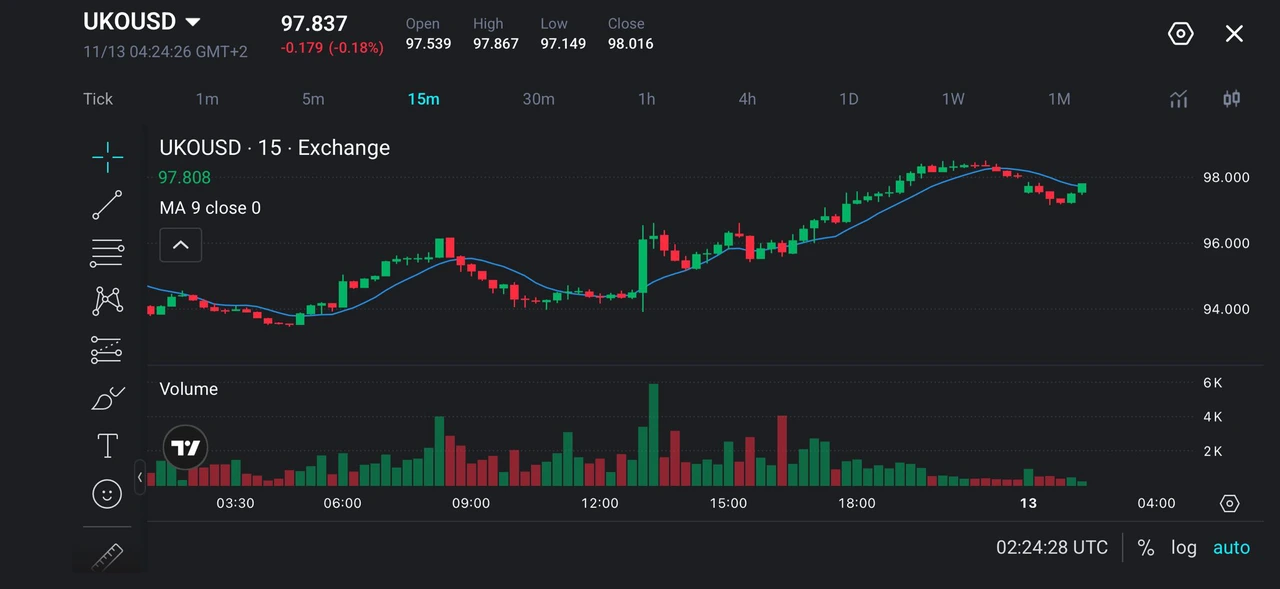
The chart shows UKOUSD trading around $97.84 after recovering from approximately $94. Prices advanced towards $98.40 before pulling back, with the latest candles showing a modest rebound around $97.80.
The $98.00 level is the immediate resistance, while the recent swing high around $98.40 represents the next upside reference. On the downside, $97.15 marks the displayed intraday low. A break below this area could expose support around $96.00, followed by the earlier consolidation area near $94.00.
Bullish and Bearish Setups
| Scenario | Confirmation / Trigger | Potential Level |
| Bullish continuation | Break and hold above $98.00–$98.40 | $99.00 |
| Bearish correction | Break below $97.15 | $96.00 |
In a bullish scenario, UKOUSD would need to reclaim $98.00 and break above the recent high around $98.40. A sustained move above this resistance zone could indicate renewed buying momentum, potentially opening the way towards $99.00.
In a bearish scenario, failure to maintain the current recovery could bring $97.15 back into focus. A sustained break below this level may signal a deeper correction towards $96.00, particularly if selling pressure increases.
Disclaimer
The price levels and market scenarios above reflect the author’s assessment at the time of writing. They do not represent financial advice or an official recommendation from VT Markets. Traders should conduct their own analysis and manage risk carefully.
Brent Crude Price Prediction: What Could Drive UKOUSD Up or Down?
Brent crude’s near-term direction will depend on whether geopolitical supply concerns continue to outweigh improving production conditions.
The main developments to monitor are:
- Middle East tensions: Whether the conflict involving Iran escalates or diplomatic developments ease concerns over regional oil supplies.
- Strait of Hormuz: Whether shipping disruptions affect the movement of crude oil through this strategic route.
- OPEC+ production: Whether recovering output, particularly from Saudi Arabia, adds sufficient supply to offset geopolitical risks.
- US oil inventories: Whether inventory changes indicate tighter supply or greater availability in the market.
- Inflation and interest rate expectations: Whether sustained higher oil prices increase inflationary pressure and influence central bank policy decisions.
An escalation in Middle East tensions or further disruption to oil shipments could support Brent crude and potentially push prices towards the $100 psychological level. Conversely, easing geopolitical risks, recovering OPEC+ production and higher inventories could limit the recovery and increase the possibility of a pullback.
The balance between geopolitical developments and global supply conditions will remain central to Brent crude’s near-term direction.
Trade Brent Crude with VT Markets
Follow Brent crude alongside forex, indices and other CFD markets with VT Markets. Use advanced charting tools and market insights to assess price movements and monitor developments influencing the energy market.
Create a live VT Markets account to access trading tools and educational resources. Review the instrument’s trading hours, contract specifications and margin requirements before opening a position.
CFDs are leveraged products and carry a high risk of loss.
Frequently Asked Questions
Why did Brent crude rise above $95?
Brent crude recovered above $95 as renewed Middle East tensions raised concerns about potential disruptions to global oil supplies. Comments from US President Donald Trump indicating that Washington did not need a deal with Iran also contributed to the rebound.
How could Middle East tensions affect Brent crude prices?
Escalating tensions could disrupt oil production or shipping routes, particularly around the Strait of Hormuz. Reduced supply availability could increase upward pressure on crude prices.
How does OPEC+ production affect Brent crude prices?
Higher OPEC+ production could increase global oil availability and help offset supply disruptions. This may limit price gains, particularly if geopolitical tensions begin to ease.
Could higher oil prices affect the Canadian dollar?
Yes. Canada is a major energy exporter, so higher crude prices could support its export outlook and influence CAD demand. However, the Canadian dollar also responds to interest rate expectations, economic data and broader currency market conditions.
Could Brent crude reach $100?
A move towards $100 is possible if geopolitical tensions escalate and concerns over global oil supply intensify. However, recovering OPEC+ production and higher inventories could limit further gains. UKOUSD would first need to overcome the near-term resistance zone around $98.00–$98.40.
Start trading now — click here to create your real VT Markets account.



