






Key Points
- The cash Nikkei 225 fell 0.7% at 9:08 a.m. Tokyo time on 2 November, following a sharp decline in US semiconductor shares.
- Kioxia’s weaker-than-expected profit outlook raised concerns about memory pricing and technology-sector profitability.
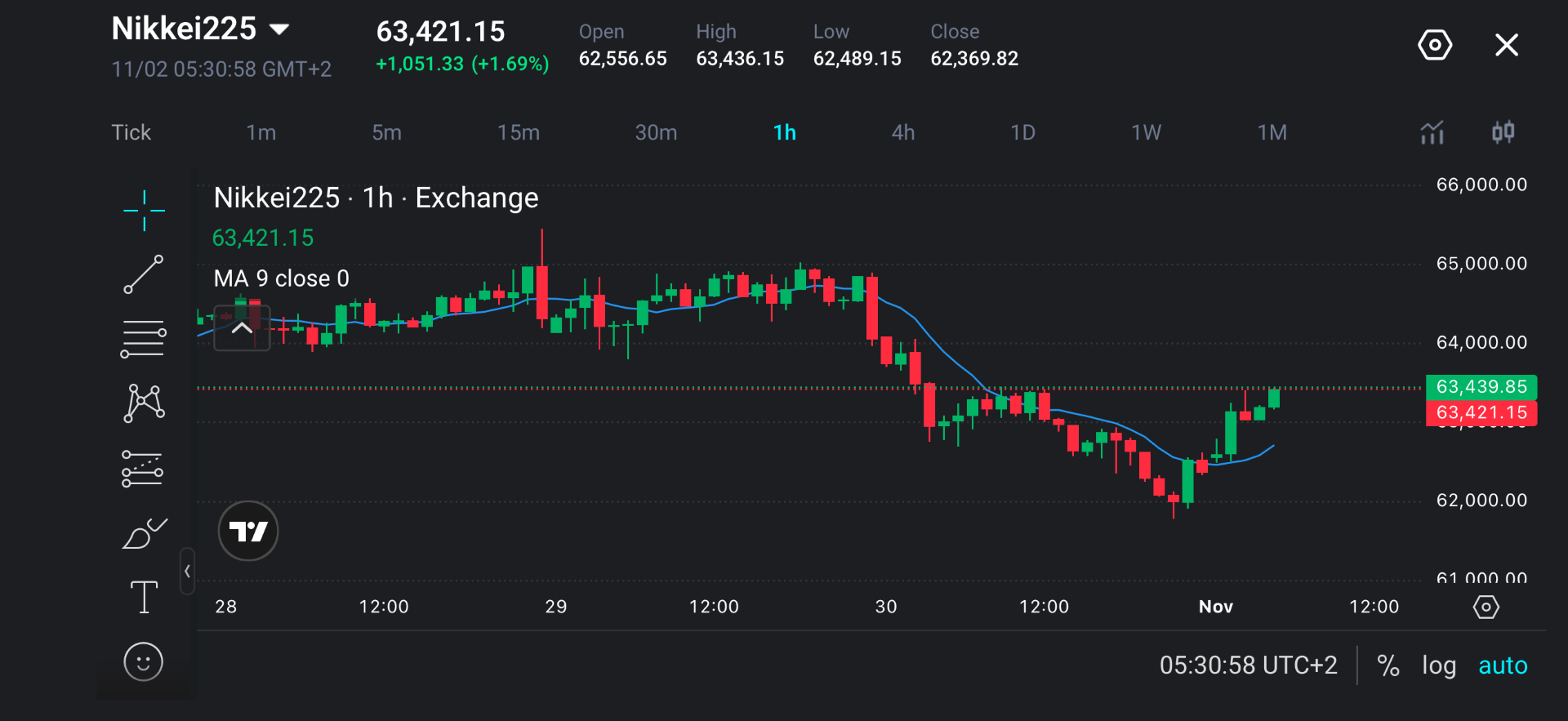
- Nikkei225’s latest session shows a subsequent recovery to 63,421.15, with 63,440–63,500 the immediate resistance area.
- Japan’s cash-market holiday and the US midterm elections will likely keep traders cautious.
Market Move
Japanese stocks opened lower on Monday as weakness in US technology shares carried into Asian trading. According to reports, the Nikkei 225 declined 0.7% by 9:08 a.m. Tokyo time, while the broader Topix fell approximately 0.8%. Ibiden and Sumco were among chip-related shares under pressure.
However, the latest session shows Nikkei225 attempting a recovery at 63,421.15, up 1,051.33 points or 1.69% against the opening price. This rebound suggests buying interest has returned, although semiconductor earnings concerns and uncertainty over AI investment returns continue to weigh on market sentiment.
Why Traders Are Watching
Nikkei225’s opening price decline followed a difficult session for US semiconductor stocks on 30 October. The Philadelphia Semiconductor Index plunged 7.2%, while Intel recorded its largest fall in more than four decades as technology earnings disappointed investors. Kioxia added to the cautious mood. The Japanese chipmaker forecast quarterly operating profit of ¥2 trillion, approximately $12.7 billion, below market expectations. Its outlook also raised concerns that the recent surge in memory prices could stall.
Markets are deciding whether demand linked to artificial intelligence can continue supporting earnings as spending rises. Kioxia’s outlook brings memory pricing into question. Slower price growth could limit earnings momentum even if demand remains strong.
The recovery also falls on an eventful week. Japan’s cash equity market will be closed on 3 November for Culture Day. The US midterm elections take place on 3 November. Results will begin emerging during Asian trading hours on 4 November, potentially influencing expectations for trade, taxation and government spending as Japanese cash trading resumes.
Key Trading Levels
| Level | Role | Significance |
| 65,000 | Major resistance | Area around several highs before the recent decline. |
| 64,000–64,200 | Resistance | Previous trading area above the current recovery. |
| 63,440–63,500 | Immediate resistance | Latest quoted high near 63,436 and nearby prior price reactions. |
| 63,000 | Initial support | Round-number reference below the latest price. |
| 62,500–62,600 | Support | Area around the displayed opening price and low. |
| 62,000 | Major support | Recent trough area from which the rebound developed. |
| 61,800–61,900 | Lower support | Approximate lower-wick area beneath the recent trough. |
Nikkei225 has recovered above its short moving average, but remains below the earlier 64,000–65,000 trading area.
Holding above 63,000 would support the rebound, while a sustained break through 63,440–63,500 would strengthen the recovery case.
Bullish and Bearish Setups
| Scenario | Trigger | Potential Levels |
| Bullish recovery | Sustained break above 63,440–63,500, followed by support holding on a retest. | 64,000, then 64,200 |
| Bullish extension | Recovery above 64,200 with higher lows developing. | 64,500, then 65,000 |
| Bearish rejection | Failure at 63,440–63,500, followed by a break below 63,000. | 62,600, then 62,500 |
| Bearish continuation | Sustained break below 62,500 and failure to reclaim the area. | 62,000, then 61,800–61,900 |
A bullish recovery would require a sustained break above 63,440–63,500, with buyers defending this area on a retest. This could open the way towards 64,000, followed by 64,200. A further recovery above 64,200, supported by higher lows, could extend gains towards 64,500 and 65,000.
A bearish rejection could develop if Nikkei225 fails to clear 63,440–63,500 and then falls below 63,000, bringing 62,600–62,500 into focus. A sustained break below 62,500, followed by an unsuccessful attempt to reclaim it, would increase the risk of a decline towards 62,000 and 61,800–61,900.
Disclaimer
The price levels and market scenarios above reflect the author’s assessment at the time of writing. They do not represent financial advice or an official recommendation from VT Markets. Traders should conduct their own analysis and manage risk carefully.
Nikkei225 Prediction: What Could Drive Stocks Up or Down?
Nikkei225’s outlook depends on whether upcoming earnings can stabilise profit expectations across Japan’s technology sector. Stronger guidance, resilient memory demand and evidence that AI investment is generating returns could attract buyers. A broader recovery across Japanese shares would also give the rebound firmer support than strength concentrated in a few companies.
Further earnings misses or weaker pricing expectations could prolong selling pressure. Election-related changes in US yields, currencies and risk appetite may add volatility when Japanese cash trading resumes.
Traders should closely monitor economic events and data this week for clues on future market direction.
Trade Nikkei 225 with VT Markets
Traders looking to follow movements in Japan’s equity market can access Nikkei 225 index CFDs through VT Markets.
Trading index CFDs allows traders to take positions on both rising and falling market prices without owning the underlying shares. Through the VT Markets trading platforms, traders can monitor market movements, apply technical indicators and manage their positions using risk management tools.
Start a live trading account today and explore Forex pairs, gold, 24/7 trading and more.

Frequently Asked Questions
Why did Japanese stocks open lower on 2 November?
Japanese shares followed weakness in US technology stocks. Semiconductor selling and Kioxia’s disappointing profit outlook weighed on sentiment.
Did Nikkei225 recover after the early decline?
Nikkei225 is trading at 63,421.15, up 1.69% in its latest trading session.
Why does Kioxia’s outlook matter?
Its guidance raised concerns that slower memory-price growth could limit earnings momentum across parts of Japan’s technology sector.
What are the main Nikkei225 support and resistance levels?
Immediate resistance is around 63,440–63,500, followed by 64,000–64,200. Support sits near 63,000, 62,500–62,600 and 62,000.
Is Japan’s stock market closed on 3 November?
Yes. Japan’s cash equity market is closed for Culture Day.
Could the US midterm elections affect Nikkei225?
Yes. Changes in expectations for US trade, taxation and spending policies could influence Japanese shares, while movements in the yen and global risk appetite may amplify the reaction.
Start trading now — click here to create your real VT Markets account.



