






Bitcoin is often called “digital gold” because, like gold, its supply is limited: no more than 21 million bitcoin can ever exist. The comparison has limits. Gold has a history spanning thousands of years and is held by central banks, while bitcoin was launched in 2009 and has historically been far more volatile than gold.
This guide explains where the label comes from, how the two markets differ, and where the comparison stops working. It is educational only. It does not recommend either asset, rank one above the other, or describe how to trade either.
Why bitcoin is called “digital gold”
The “digital gold” label comes from a set of arguments made by bitcoin supporters. It is worth setting them out because they explain why the comparison exists, though they are arguments and not established facts.
- A fixed supply. Gold is scarce because it has to be mined, and new supply grows slowly. Bitcoin’s rules limit the total number of coins to 21 million, and the rate at which new coins are created is built into the software and falls over time. Supporters compare this to gold’s scarcity and to the way that money printed by governments can be expanded.
- No central issuer. No government or central bank issues bitcoin. Its supply schedule is enforced by a network of computers running open-source software. Supporters point out that gold also sits outside any single government’s control.
- Portable and divisible. Bitcoin can be sent across borders digitally and divided into very small units. Supporters contrast that with physical gold, which must be stored, insured and moved.
These are the points people make when they use the phrase. This guide does not endorse the label. The sections below look at where the comparison holds and where it does not.
Gold vs bitcoin at a glance
| Aspect | Gold | Bitcoin |
|---|---|---|
| Supply | Mined; new supply grows gradually and has no fixed cap | Capped at 21 million coins by the protocol’s rules |
| History | Used as money and a store of wealth for thousands of years | Launched in 2009 |
| Main holders | Central banks, investors, jewellery and industry | Individuals, funds and companies; not held by central banks as reserves in the way gold is |
| Main price drivers | US dollar, real yields, central-bank buying, safe-haven demand | Adoption, regulation, liquidity, events in the crypto industry |
| Trading hours | Trades close to 24 hours on weekdays through the global gold market | Trades 24 hours a day, seven days a week, on crypto exchanges |
| Regulation | Long-established markets and reporting frameworks | Rules vary widely by country and are still developing |
The table describes structural differences only. It does not compare performance, because past price moves are not a guide to what either market will do.
What drives each price
The gold price responds to the US dollar, because gold is priced in dollars, and to real yields, which are interest rates after inflation. Central-bank buying is another driver, since central banks hold gold as part of their reserves, according to World Gold Council data. Gold also responds to safe-haven demand: a safe haven is an asset investors have historically turned to during uncertainty.
Bitcoin’s price responds to a different set of factors:
- Adoption. How widely bitcoin is used and held, including by institutions.
- Regulation. Announcements by governments and regulators about how cryptocurrencies may be traded, held or taxed.
- Liquidity. How much money is available in financial markets, and how easily bitcoin can be bought and sold.
- Crypto events. News from within the industry, such as exchange failures, technology changes or the scheduled reductions in the rate of new bitcoin creation.
Some of these forces overlap, since changes in interest rates and liquidity can affect both. Overall, though, the drivers differ: gold responds mostly to monetary and geopolitical conditions, and bitcoin responds mostly to conditions within the crypto market. Gold and bitcoin are driven by very different forces. For gold’s side of the picture, see the beginner’s guide to gold versus the US dollar.
Volatility: the biggest difference
Volatility describes how much and how quickly a price moves. It is the sharpest difference between the two. Bitcoin has historically been far more volatile than gold, with larger and faster price swings in both directions. Gold is also a volatile instrument and can move sharply, but its moves have generally been smaller.
Higher volatility works both ways. Larger swings can mean larger changes in value in either direction over short periods. When CFDs are involved, leverage magnifies that effect, and losses can build rapidly. Cryptocurrencies are highly volatile instruments, and prices can move sharply against a position.
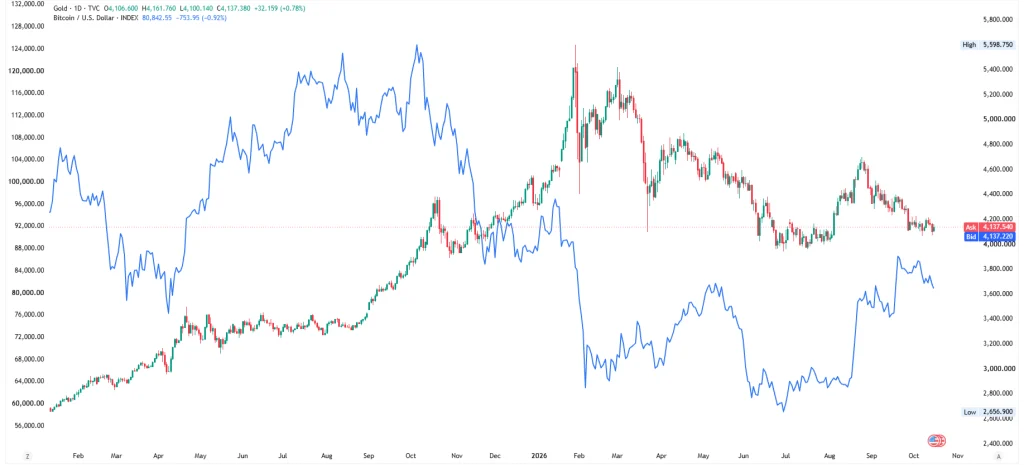
Monthly price ranges show the scale. Based on monthly Yahoo Finance data, bitcoin traded between about $62,200 and $81,300 in August 2026, while gold traded between about $4,075 and $4,755. In June, bitcoin’s range was about $58,100 to $74,000 and gold’s about $3,955 to $4,575. Bitcoin’s ranges were wider relative to its price in both months.
This guide does not quote price-change percentages. A volatility figure is only meaningful with its source, the measure used and the time window, and past price moves do not indicate future ones.
Are gold and bitcoin correlated?
Correlation measures how closely two prices move together, on a scale from -1 to +1. The relationship between gold and bitcoin has varied over time. There have been periods where they moved in the same direction and periods where they moved independently or in opposite directions, so no single figure describes it. It is not fixed and cannot be relied on to hold. In June, July and August 2026, gold and bitcoin moved in the same direction each month: both fell in June and both rose in July and August. In September, bitcoin rose to a close near $83,500 while gold fell back to about $4,190.
This has a practical meaning: neither asset is a substitute for the other. Because they respond to different drivers, the price of one says little about the other. A correlation is also only a description of past behaviour, measured over a particular window, and a reading from one window may not apply to the next. The What Correlates With Gold? guide explains how correlations are read and why they change.
Where the “digital gold” comparison breaks down
Several differences limit the comparison.
- A short history. Gold has been valued across many civilisations for thousands of years. Bitcoin has existed since 2009. It has gone through fewer economic cycles, so there is much less evidence about how it behaves under different conditions.
- Regulatory uncertainty. Rules for cryptocurrencies differ between countries and are still changing. A regulatory decision can affect the price and even whether it is available. European and international bodies, such as ESMA and the Bank for International Settlements, have published warnings about the risks of crypto-assets.
- Large drawdowns. A drawdown is a fall in price from a previous high. Bitcoin has experienced large drawdowns in the past, and they can happen quickly. In 2026, for example, bitcoin traded as high as about $97,900 in January and as low as about $60,100 in February.
- Custody and exchange risk. Holding bitcoin directly means relying on a wallet, a private key or an exchange. Losing access to a key, or an exchange failing, can mean losing the asset, with limited recourse. Physical gold has storage costs and security concerns of its own, but the risks are different in kind.
These points explain why the comparison is contested. Gold and bitcoin share one feature, a limited supply, and differ on many others.
FAQ
Why is bitcoin called digital gold?
Supporters use the label because bitcoin, like gold, has a limited supply: no more than 21 million coins can ever exist. They also point to the absence of a central issuer. The comparison is an argument, not a fact, and it has limits, including bitcoin’s short history and higher volatility.
What is the difference between gold and bitcoin?
Gold is a physical metal with a history spanning thousands of years, held by central banks and used in jewellery and industry. Bitcoin is a digital asset launched in 2009 with a fixed supply cap. They differ in history, holders, price drivers, trading hours and regulation.
Is bitcoin more volatile than gold?
Yes, historically bitcoin has been far more volatile than gold, with larger and faster price swings. Gold can also move sharply, but its moves have generally been smaller. Volatility changes over time, and past behaviour does not indicate what either market will do next.
Are gold and bitcoin correlated?
The relationship has varied over time. There have been periods when gold and bitcoin moved in the same direction and periods when they moved independently or in opposite directions. It is not fixed, so neither asset is a substitute for the other, and a reading from one period may not apply to another.
What drives the price of gold vs bitcoin?
Gold responds mainly to the US dollar, real yields, central-bank buying and safe-haven demand. Bitcoin responds mainly to adoption, regulation, liquidity and events within the crypto industry. Some forces, such as interest rates and liquidity, can affect both, but the main drivers differ.
Risk warning: CFDs are complex instruments and come with a high risk of losing money rapidly due to leverage. Gold is a volatile instrument, and prices can move sharply against a position. Cryptocurrencies are highly volatile instruments, and prices can move sharply against a position. You should consider whether you understand how CFDs work and whether you can afford to take the high risk of losing your money. This article is for informational purposes only and does not constitute investment advice or a recommendation to trade any instrument.
Availability of cryptocurrency CFDs varies by jurisdiction.








