





European markets ended little changed as Persian Gulf risks and new US trade measures offset the support from softer US inflation and still-rich AI valuations. Two ADNOC ships were attacked in the Strait of Hormuz, while US Treasury Secretary Bessent pointed to “unprecedented” economic steps on Iran next week and a carrier deployment; Russia’s Sergei Lavrov said an immediate Ukraine ceasefire was not possible as NATO examined a Latvian drone incident, its second since June, following an 8 August detonation near a Bulgarian gas pipeline. In Europe, Switzerland’s Q2 GDP rose 1.5% q/q versus 0.3% expected, Germany’s wholesale prices ran at 5.3% y/y and France and Finland held CPI at 2.1%, while equities saw Tech and Media up 1.1% and Utilities and Basic Resources down 1.7%; Trump’s Section 232 drone tariffs set 25% on smaller units, 100% above 25kg and 15% country rates on the EU, Japan and Switzerland (UK 10%), due in 180 days.
US July PPI was flat versus +0.2% expected after in-line CPI, pushing September Fed hike odds to about 30% from 50% earlier, as Fitch reaffirmed the US at AA+/stable and projected 1.9% growth, deficits at 7.4% of GDP and debt/GDP at 123% by 2028. Asia was mixed, with KOSPI up 2.4%, and Europe ranged from -0.3% to +0.6%; Brent added 1.0% and WTI 1.6% as DXY fell 0.2% and gold dipped 0.1%, while BTC slid 1.4% and ETH 0.7%. Big single-stock moves included DFDS up 18% after lifting 2026 revenue growth to 3–5%, raising the EBIT floor to DKK1.2bn from DKK1.0bn and targeting ~DKK500m adjusted FCF, as Valneva rose 16% on an EMA review and Innate Pharma fell 16.5% on a €22.5m private placement; broader data included Euro Zone Q2 GDP at 0.4% q/q and 1.0% y/y, June trade balance at +€1.8bn, and Euro Zone employment at 0.1% q/q and 0.5% y/y.
Energy and Currency Market Strategies Amid Escalating Geopolitical Risks
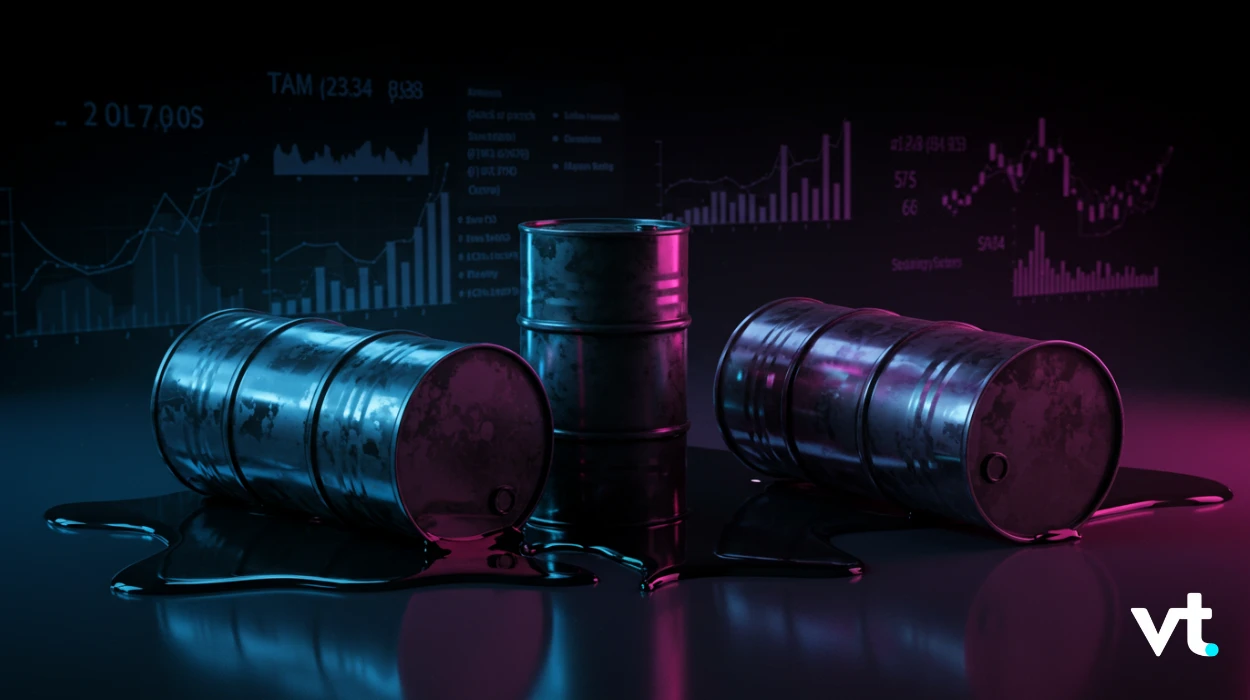
We need to brace for immediate volatility in the energy sector as geopolitical tensions escalate in the Strait of Hormuz, through which roughly 20 million barrels of oil flow daily. With the US planning unprecedented economic sanctions against Iran next week and recent attacks on cargo ships, global energy supply chains are highly vulnerable. We should focus on buying long call options on Brent crude to hedge against a sudden supply shock, especially since historical geopolitical blockades have rapidly pushed oil prices up by more than 10%.
In the currency markets, we must prepare for a stronger Japanese Yen as the Bank of Japan signals aggressive interest rate hikes as early as September. The USD/JPY pair is currently hovering near the 159 level, making JPY call options an attractive short-term play before the policy shift takes place. Additionally, the massive Swiss Q2 GDP surprise of 1.5% suggests the Swiss Franc is fundamentally strong, prompting us to buy put options on EUR/CHF to profit from a expected downward correction.
Protection Tactics Against Technology Supply Chain Disruptions
The newly announced US tariffs on drones—ranging from 15% on European imports to 100% on heavier units—will disrupt industrial tech supply chains over the next 180 days. While Chinese open-source AI models like GLM-5.3 show that software gains are bypassing hardware limitations, the broader hardware sector is bound to face rising input costs. We should purchase out-of-the-money protective puts on tech and industrial indices to shield our portfolios from these spreading trade barriers.








