






SanDisk delivered almost everything investors wanted from its fiscal fourth quarter.
Revenue came in at around $8.97 billion, ahead of consensus expectations near $8.48 billion. Adjusted earnings per share reached $39.25, comfortably above the $34.96 analysts had forecast. Data centre revenue also accelerated, reaching roughly $2.97 billion as demand from AI-related infrastructure continued to build. Margins were exceptionally strong.
Then came the outlook.
SanDisk guided current-quarter revenue of $10.3 billion to $10.8 billion. The midpoint was slightly below where some of the more optimistic expectations had moved. That small gap was enough for the market to focus on what was missing rather than what was delivered.
This is the earnings paradox that often appears in strong cycles. Stocks do not trade on results alone. They trade on the difference between results and expectations. When a company has performed this well for this long time, the market often projects a higher benchmark than published estimates suggest. A beat can still disappoint if investors are already positioned for something bigger.
For SanDisk, there is another issue. Memory remains a cyclical industry, and record margins are usually a sign of tight supply conditions. They create an opportunity, but they also create a response. Strong pricing encourages producers to increase investment, which can eventually bring more supply back into the market.
In memory, the best periods often contain the seeds of the next downturn.
SanDisk earnings show a bigger shift beyond NAND
For much of the AI rally, investors could group semiconductor companies under one broad supply theme. That is becoming harder to justify as NAND and DRAM demands become more specific.
The differences between a few major players:
| Company | AI exposure | Business position |
| SK Hynix | High | Leading supplier of high-bandwidth memory (HBM), a critical component for AI accelerators |
| Micron | Growing | Shifting its memory portfolio towards data centre demand |
| Samsung | Broad | Exposure across memory, foundry, logic and consumer electronics |
| SanDisk | Different | NAND-focused, with no DRAM or HBM exposure |
SanDisk stands apart because it does not participate directly in the HBM market, which has become one of the clearest winners of the AI infrastructure build-out.
That distinction matters. Not all memory demand benefits equally from AI spending.
NAND has historically been one of the most volatile sides for semiconductors. Oversupply has damaged profitability before, and supply discipline remains the factor that determines how each cycle ends. AI does not change that underlying dynamic. What it changes is the quality of demand within parts of the market.
AI is changing what storage means
AI is often described as a computing story, but it is also a data story.
Training large models requires enormous datasets. Inference at scale requires fast access to stored information. Enterprises deploying AI systems are also generating more internal data through documents, video, customer records and operational logs.
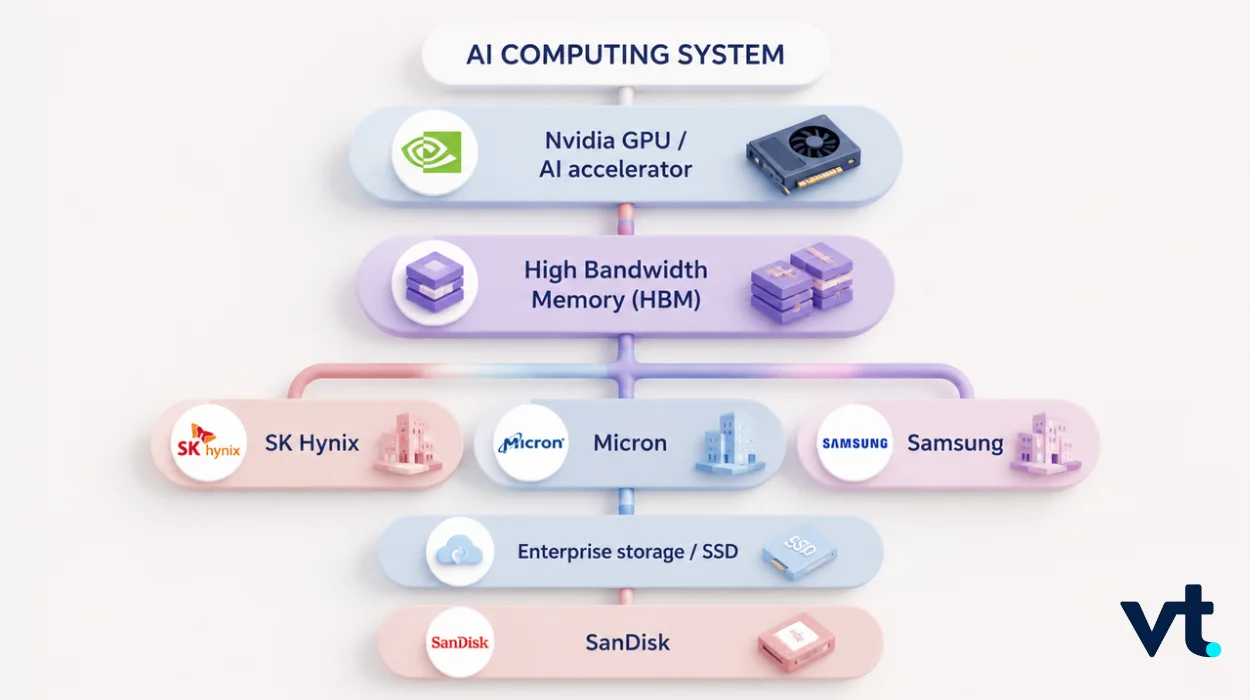
That demand is increasingly shifting towards enterprise SSDs, a higher-quality segment than traditional consumer flash products.
Enterprise storage tends to have:
- longer qualification cycles
- larger customers
- more predictable purchasing patterns
- stronger relationships with hyperscalers
It is a better business than selling consumer memory cards.
SanDisk is benefiting from this shift, but the transition is still underway.
Enterprise AI storage can improve NAND economics, but it does not remove the industry’s underlying supply cycle. The same manufacturing capacity still produces the memory, and excess supply in one segment can eventually affect others.
SanDisk’s longer-term answer is High Bandwidth Flash, a stacked flash architecture being developed together with SK Hynix. The technology could open a new opportunity, particularly as AI systems require more specialised storage solutions. However, it remains a longer-term growth opportunity rather than something that changes near-term earnings.
SNDK stock also depends on data centre growth
SanDisk’s next phase depends less on whether it can deliver another strong quarter. Current conditions suggest it probably can.
The bigger issue is whether the company’s revenue mix can continue shifting towards contracted data centre demand quickly enough to justify a valuation closer to an infrastructure company than a traditional NAND producer.
The consumer business remains an important detail.
A company with a declining consumer segment and a rapidly growing data centre business is one in transition. Transitions can create opportunities, but they also create uncertainty because investors are paying for the future before the business has fully arrived there.
The market is not only valuing SanDisk’s current earnings. It is valuing the possibility that part of its NAND business can become structurally better. That expectation is where the pressure sits.
How to read the next print
The next set of results will likely be less about whether SanDisk can beat estimates and more about whether the underlying shift continues.
- Guidance: Shows whether current demand strength is continuing
- Data centre mix: Indicates whether higher-quality revenue is becoming a larger part of the business
- Consumer demand: Reveals whether weaker segments are stabilising or deteriorating
- Industry capex: Shows whether producers are preparing the next supply cycle
Investors should also watch the broader memory group, not just SanDisk.
Strong margins encourage every producer to invest. If capacity expands too quickly, the same cycle that created today’s profitability can eventually pressure it. A post-earnings selloff does not necessarily mean the business has weakened. Sometimes it reflects positioning, expectations, or a market that had already priced in a strong result.
SanDisk’s quarter was the easy part. The harder task is proving that NAND can become a more durable business in AI infrastructure.
Access market data and real-time price tracking for SK Hynix, Micron, and SanDisk, tradable at VT Markets.
Tap for TL;DR
Why did SanDisk stock fall despite strong earnings?
SanDisk delivered better-than-expected results, but investors focused on guidance that fell slightly below elevated expectations.
What did SanDisk’s latest earnings reveal about its AI opportunity?
The results showed growing data centre demand, but the market is still assessing whether NAND can become a higher-quality AI infrastructure business.
How is SanDisk different from other AI memory stocks?
Unlike SK Hynix and Micron, SanDisk does not benefit directly from HBM demand, making its AI exposure more focused on enterprise storage.
What should investors watch after SanDisk earnings?
Data centre revenue mix, consumer demand trends and industry-wide memory capacity investment will help determine the stock’s next move.
Can SanDisk stock justify a higher valuation?
The market is looking beyond earnings to see whether SanDisk can successfully shift towards more durable, contracted data centre demand.
Start trading now — click here to create your real VT Markets account.








