





US Treasury CFDs are leveraged financial derivatives tracking the price of US government bond futures without giving traders ownership of the underlying Treasury security. They allow traders to take long or short positions on instruments such as the 2-year, 5-year, 10-year and 30-year Treasuries through platforms including MetaTrader 4 and MetaTrader 5. Since Treasury prices generally move inversely to yields, these CFDs are influenced by Federal Reserve policy, inflation and employment data, Treasury auctions and safe-haven demand. This guide explains how US Treasury CFDs work, how they are priced, their trading costs and risks, and how traders can use them to express an interest-rate view or manage broader market exposure.
Key Takeaways:
- US Treasury CFDs track US government bond futures without owning the bond.
- Bond prices and yields move inversely, so rising rates push Treasury prices lower.
- The 10-year note is the benchmark; the 30-year moves most per change in yield.
- Costs are the spread, overnight financing, and a quarterly contract rollover.
- Fed policy, inflation data and safe haven flows are the main price drivers.
Most new traders start with forex or gold. Very few think about bonds. That is a missed opportunity.
The US Treasury market is the largest and most liquid bond market in the world. It sets the reference rate for mortgages, corporate borrowing and currencies everywhere. When Treasury yields move, almost every other asset reacts.
US Treasury CFDs give you a practical way to trade that market. You do not need a large portfolio or a futures account. You need a CFD account, a platform such as MetaTrader 4 or MetaTrader 5, and a clear understanding of how the instrument behaves. This guide covers what they track, how they are priced, what they cost, and what moves them.
What Is a US Treasury CFD?
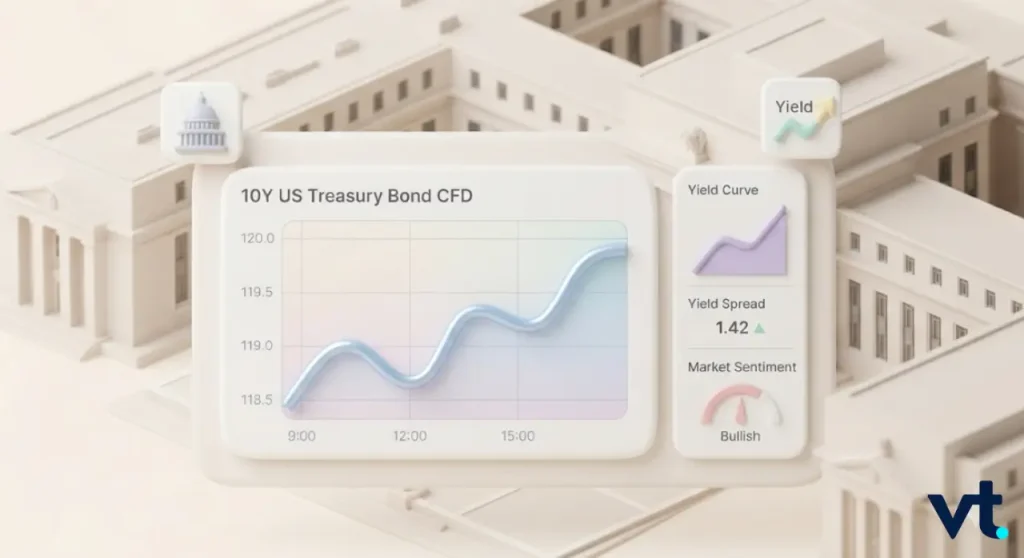
A US Treasury CFD is a contract for difference based on the price of a US government bond futures contract. You exchange the price difference between opening and closing the position.
Cash-settled in your account currency, these instruments support both long and short positions on MT4 and MT5, with leverage and margin requirements applying.
What the Instrument Actually Tracks
This is where many traders go incorrect. A Treasury CFD does not track one physical bond. It tracks the price of the Treasury bond futures contract listed on the CBOT, part of CME Group. That makes it a derivative of a derivative, which means two things:
- Your price feed follows the front-month futures contract
- Your position is rolled forward when that contract nears expiry
Do You Own the Underlying Bond?
No. You never take delivery, you are not lending to the US government, and you hold no claim against it.
This matters when people ask, is it safe to buy US treasury bonds? An actual Treasury security is regarded as one of the lowest credit risk investments available. This is because it is backed by the US government. Trading a CFD at that price is different. Your exposure is market risk multiplied by leverage, not credit risk on the issuer.
US Treasury CFDs Compared With Futures and Bond ETFs
| Feature | US Treasury CFD | Treasury Futures | Bond ETF |
| Ownership | None | None | Fund shares |
| Typical size | Flexible, set by broker | $100,000 face value | Per share |
| Leverage | Yes | Yes | Limited |
| Short selling | Straightforward | Yes | Needs margin account |
| Expiry | Rolled by broker | Fixed quarterly | None |
| Income received | None | None | Distributions |
| Platform | MT4 or MT5 | Futures broker | Stockbroker |
- Futures demand a larger account and a separate platform
- ETFs are easy to buy but hard to short and barely leveraged
- Government bond CFDs sit between the two on cost and access
How US Treasury CFD Pricing Works
Understanding US Treasury CFD pricing starts with knowing how bond prices, yields, and market expectations interact. Pricing mechanics, contract details, and financing costs all affect how Treasury CFDs behave.
Why Bond Prices and Yields Move in Opposite Directions
This is the most important concept in bond CFD trading, and it trips up almost everyone at the start. A bond pays a fixed coupon. If new bonds pay more, older bonds become less attractive and their price falls until the return matches the market.
Worked simply:
A bond pays $4 a year on $100 face value, a 4% yield. If market rates rise to 5%, that $4 coupon only represents 5% once the price drops to roughly $80.
- Yields rise, prices fall, US Treasury CFDs move lower
- Yields fall, prices rise, US Treasury CFDs move higher
- The longer the maturity, the larger the swing
Buying or Selling US Treasury CFDs When Rate Expectations Shift
| Your market view | Expected yield move | Position |
| Fed will cut rates | Down | Buy (long) |
| Economy strong, no cuts coming | Up | Sell (short) |
| Inflation surprises to the upside | Up | Sell (short) |
| Risk-off shock hits markets | Down | Buy (long) |
Pro tip: Trade the change in expectations, not the announcement. A widely predicted cut barely moves price. A small shift in tone can move it sharply.
How US Treasury CFD Prices Are Quoted
Treasury futures are quoted in points and thirty-seconds. Most CFD brokers convert this into decimal pricing for MT4 and MT5. Always confirm the contract specifications before sizing a trade.
Contract Size, Tick Size and Position Value
A worked example, using illustrative figures:
- Contract size: 1 lot equals 1,000 units
- Current price: 110.50
- Notional value: 110.50 x 1,000 = $110,500
- Margin at 2%: $2,210
- Price rises to 111.00, a move of 0.50 points
- Profit: 0.50 x 1,000 = $500, or roughly 22.6% of margin used
Reverse it and the same move costs $500, nearly a quarter of your margin. That symmetry is why position sizing matters more than entry timing.
Why US Treasury CFDs Do Not Pay Coupons
You never own the bond, so no coupon reaches your account. You get an overnight financing adjustment instead, often called a swap:
- It applies to any position held past the daily rollover time
- It can be a credit or a debit, depending on direction and rates
- Intraday traders who close before rollover avoid it entirely
How Contract Rollover Works
Treasury futures follow a quarterly cycle: March, June, September and December. As the front-month contract nears expiry, your position rolls forward.
- Your broker applies a cash adjustment for the price gap
- Your position stays open, though stops may need reviewing
- The net effect should be broadly neutral, not a hidden fee
Which US Treasury CFDs You Can Trade
Below covers US Treasury CFDs that are available across different maturities, each reacting differently to interest rates and economic expectations. Choosing the right maturity depends on your trading style, risk tolerance, and market view.
The 2-Year, 5-Year, 10-Year and 30-Year Explained
Availability varies between brokers, but four maturities dominate:
- 2-year note: Most sensitive to near-term Federal Reserve policy
- 5-year note: Balances policy sensitivity with moderate volatility
- 10-year note: The global benchmark and most heavily traded
- 30-year bond: The longest maturity and the largest swings
Why Duration Determines Price Sensitivity
Duration measures how much a bond price moves for a given change in yield. Longer maturity means higher duration, which means bigger moves.
| Instrument | Approx. duration | Approx. price move per 0.25% yield change |
| 2-year note | ~2 years | ~0.5% |
| 5-year note | ~4.5 years | ~1.1% |
| 10-year note | ~7.5 years | ~1.9% |
| 30-year bond | ~16 years | ~4.0% |
These figures shift with the level of yields, but the ranking never changes.
The 10-Year Note as the Global Benchmark
The 10-year Treasury note is the reference point for global finance. It influences mortgage rates, equity valuations and currency pairs. This type of note offers the tightest spreads and deepest liquidity of the four. This is the sensible first instrument if you are starting out.
The 30-Year Bond and Why It Is Called the Long Bond
The 30-year is known as the long bond. It responds less to short-term policy and more to long-run expectations for inflation and growth.
This long-term bond is represents the largest price movement per basis point of yield change. It suits traders wanting bigger ranges from fewer positions. It requires wider stops and smaller position sizes.
Choosing a Maturity to Match Your Trading Style
- Day traders: the 10-year, for liquidity and predictable range
- Fed policy traders: the 2-year or 5-year, fastest to react
- Swing traders seeking larger moves: the 30-year, with reduced size
- Beginners: the 10-year, without exception
Costs, Margin and Leverage on US Treasury CFDs
Trading US Treasury CFDs involves understanding margin, leverage, and ongoing costs. These factors affect position size, risk exposure, and the overall cost of holding a trade.
How Margin Is Calculated
Margin follows the standard formula: price x contract size x lots, divided by leverage. Using the earlier example at 100:1:
- Notional value: $110,500
- Margin required: $110,500 / 100 = $1,105
Why Bond Margin Requirements Differ From Equities
Treasuries are less volatile than shares, so brokers often set lower margin. That is an advantage, and also a trap. It is due to lower margin means a much larger notional position per dollar deposited. In addition, risk per dollar of capital ends up similar to any other market.
Spreads, Commission and Ongoing Costs
| Cost | When it applies | How to manage it |
| Spread | Every trade you open | Trade during active US hours |
| Commission | Account type dependent | Compare raw versus standard accounts |
| Swap | Positions held overnight | Check the swap table before entry |
| Rollover adjustment | Quarterly, at contract change | Note the dates in your calendar |
At VT Markets, Treasury instruments sit alongside forex, indices and commodities on one platform, so margin and swap details appear in the contract specifications on MT4 and MT5.
What Moves US Treasury Prices
US Treasury prices respond to changes in monetary policy, economic data, debt supply, and global risk sentiment. Understanding these drivers helps explain why bond markets move and how they interact with other assets.
1. Federal Reserve Policy and Interest Rate Expectations
Federal Reserve policy is the dominant driver. The decision itself is rarely the main event. There are eight scheduled FOMC meetings each year. The statement language matters more than the rate itself. The press conference tone often moves prices most.
2. Inflation and Employment Data
These releases produce the sharpest intraday moves in fixed income CFDs:
- CPI (Consumer Price Index): the headline inflation reading, monthly
- PCE (Personal Consumption Expenditures): the Fed’s preferred inflation measure
- NFP (Non-farm payrolls): first Friday of each month
- ISM (Institute of Supply Management) surveys: forward-looking activity indicators
3. Treasury Auctions and Supply
The US Treasury issues new debt on a regular schedule. Weak auction demand pushes yields higher and prices lower. Results are published and worth tracking for multi-day positions.
4. Safe Haven Flows During Market Stress
Treasuries are the world’s benchmark safe haven asset:
- Geopolitical tension and equity selloffs push capital into government bonds
- Rising demand lifts Treasury prices and lowers yields
- One caveat: in the first hours of a liquidity crisis, investors sell Treasuries to raise cash, so the response is not always immediate
How Treasuries Correlate With the Dollar, Gold and Equities
| Asset | Typical relationship | Reason |
| US dollar | Mixed | Both attract safe haven demand, but higher yields also lift the dollar |
| Gold | Moves with Treasury prices | Both gain when real yields fall |
| Equities | Often inverse during shocks | Capital rotates out of risk and into bonds |
How Traders Use US Treasury CFDs
US Treasury CFDs can be used for directional trading, hedging, and advanced strategies based on interest rate expectations. Knowing market sessions and key events helps traders manage timing and risk.
1. Trading a Directional View on Interest Rates
The most common approach. You form a view on where interest rate expectations are heading, then position accordingly.
- Expect easier policy, go long
- Expect tighter policy or stronger data, go short
2. Hedging Equity Exposure
- A long Treasury position can offset equity downside in a risk-off move
- It is a partial hedge, never a perfect one
- The correlation weakens when inflation is the source of the stress
3. Trading the Yield Curve With Paired Positions
Advanced traders trade the shape of the curve rather than its direction.
- Steepener: long the 2-year, short the 30-year
- Flattener: short the 2-year, long the 30-year
- Size each leg carefully, because duration differs sharply
4. Market Hours and the Most Active Sessions
Treasury futures trade close to 23 hours a day on CME Globex. CFD hours generally mirror the underlying. Liquidity peaks during the US cash session. Major data lands at 8:30am US Eastern time. FOMC decisions arrive at 2:00pm US Eastern time.
5. Positioning Around Scheduled Data Releases
Volatility around CPI and payrolls is severe, slippage is common and spreads widen. Close or reduce positions ahead of tier-one releases. Expect the first move to reverse before the real direction sets in. If you are still learning how to trade on CFD platforms, wait for the spike to settle.
For those risk averse traders, can you trade CFDs? Find out in detail about trading CFDs with specific tools and strategies to gain a competitive edge.
Risks and Getting Started With US Treasury CFDs
US Treasury CFDs require careful risk management, especially when using leverage. Understanding the risks, practising with a demo account, and following a structured approach can help traders get started responsibly.
Leverage Risk and Negative Balance Protection
Leverage makes these instruments accessible. It also causes most losses. Sound CFD trading risk management is non-negotiable:
- Risk no more than 1% to 2% of your account per position
- Place a stop loss on every trade, without exception
- Size positions from your stop distance, never from available margin
- Confirm whether your account carries negative balance protection
Are US Treasury CFDs Suitable for Beginners?
They can be, with two caveats. Treasuries are less volatile than indices or crypto. Leverage still amplifies losses at any volatility level. Practise on demo until shorting on rising rates feels automatic.
How to Open a Position
- Open and verify a live account with a regulated CFD broker
- Download MT4 or MT5 and find the Treasury instrument in Market Watch
- Read the contract specifications for size, margin and swap
- Calculate position size from your intended stop distance
- Place the order with stop loss and take profit attached
VT Markets supports both MT4 and MT5, so Treasury positions sit in the same terminal as your forex and commodity trades.
Learn more about how to begin your CFD trading with VT Markets.
Frequently Asked Questions (FAQs)
Q1: What is a US Treasury CFD?
A US Treasury CFD is a contract for difference that tracks the price of a US government bond futures contract, such as the 10-year note. You trade the price movement without owning the bond, settling the difference between entry and exit in cash.
Q2: Do you own the bond when you trade a US Treasury CFD?
No. A CFD provides exposure to price movement only. You never take delivery, you are not a registered holder of US government debt, and you have no claim on the US Treasury. Your contract is with your broker.
Q3: If interest rates rise, do you buy or sell a US Treasury CFD?
You would typically sell. Bond prices and yields move inversely, so when market rates rise, existing bond prices fall. A trader expecting higher rates goes short. One expecting cuts goes long.
Q4: Do US Treasury CFDs pay coupon interest?
No. Because you do not own the bond, you receive no coupon payments. Positions held overnight are subject to a swap or financing adjustment instead, which may be a credit or a debit depending on your direction and rates.
Q5: What moves US Treasury prices the most?
Federal Reserve policy and interest rate expectations are the primary drivers. Inflation data, employment figures, auction results and shifts in risk sentiment also matter. During market stress, Treasuries often rise as investors seek safe havens.
Start Trading US Treasury CFDs With VT Markets
Bonds are not the loudest market, and that is exactly why they reward traders who understand them. The logic is consistent and the drivers arrive on a published schedule. Once the price and yield relationship becomes second nature, US Treasury CFDs offer a clear expression of the most important variable in global finance.
Start small. Choose the 10-year note, size positions from your stop loss rather than your margin, and keep a written record of every decision.
Open an account with VT Markets and trade US Treasury CFDs on MT4 and MT5, alongside forex, gold, indices and commodities from one platform.








