






Key Points
- USDJPY declined after Japan confirmed coordinated currency intervention with the United States.
- The move triggered a sharp recovery in the Yen after the pair reached multi-decade highs.
- Authorities warned they remain prepared to take further action if excessive currency volatility continues.
- Traders are watching intervention risks, Bank of Japan policy expectations and Federal Reserve outlook.
- US labour market data and Treasury yields remain key factors for the next USDJPY move.
USDJPY moved lower after Japan confirmed coordinated foreign exchange intervention with the United States, triggering a sharp reversal in the pair.
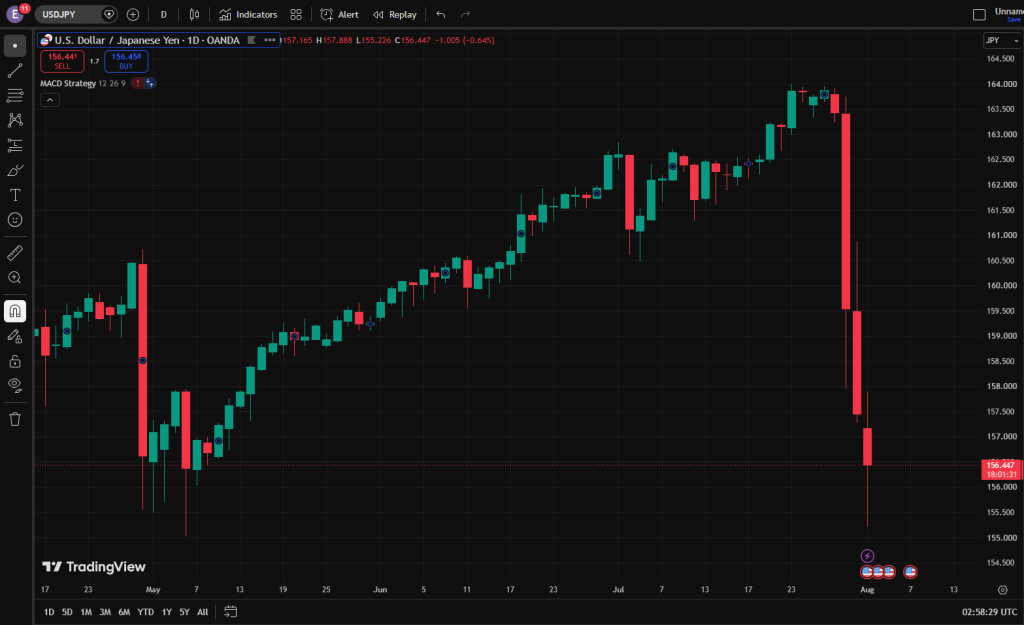
The pair declined below the 157.00 area as traders reacted to the rare bilateral action aimed at stabilising the Yen after USDJPY climbed to multi-decade highs.
Japan’s Finance Ministry said it remains prepared to take further action if needed, while maintaining close communication with US authorities.
US Treasury Secretary Scott Bessent also confirmed the coordinated action, highlighting the significance of the move as both countries sought to address disorderly currency movements.
The Yen had faced prolonged pressure from wide interest-rate differences between Japan and the US, elevated energy costs and concerns over Japan’s fiscal outlook.
The latest development has shifted market focus towards whether further official action could limit additional Yen weakness.
Why Traders Are Watching USDJPY
USDJPY remains highly sensitive to monetary policy expectations from both Japan and the United States, with currency intervention now becoming a key market driver.
The previous Yen weakness increased concerns over higher import costs and inflation pressures, adding pressure on authorities to respond to excessive market volatility.
The confirmation has increased caution among traders holding short Yen positions, as markets reassess the risk of further official action.
Beyond intervention risks, USDJPY remains influenced by the interest-rate gap between Japan and the United States.
Federal Reserve expectations, US Treasury yields and upcoming labour market data will remain important factors affecting the Dollar side of the pair.
Key Trading Levels
| Price Level | What Traders Are Watching |
| 158.5 | Recovery resistance if buyers regain momentum |
| 157.5 | Near-term resistance after the recent decline |
| 157 | Key psychological level and immediate resistance |
| 156.5 | Current trading area after the sharp pullback |
| 155.5 | Immediate support zone |
| 155 | Key psychological support |
| 154.5 | Deeper support if selling pressure continues |
USDJPY is trading around the 156.50 area after a sharp decline from recent highs near the 164.00 region.
The pair is testing whether sellers can maintain control following the intervention-driven move.
A recovery above 157.00 could improve short-term momentum and bring 157.50 and 158.50 resistance levels into focus.
However, a break below 155.50 may increase downside pressure towards 155.00 and 154.50.
Bullish and Bearish Setups
| Setup | Trigger | Potential Market Reaction |
| Bullish Recovery | Break above 157.00 | USDJPY may retest the 157.50 resistance area |
| Bullish Continuation | Move above 157.50 | The pair may target 158.50 |
| Range Consolidation | Hold between 155.50 and 157.00 | Price may stabilise after recent volatility |
| Bearish Breakdown | Break below 155.50 | Selling pressure may increase towards 155.00 |
| Bearish Extension | Fall below 155.00 | USDJPY may move towards 154.50 |
USDJPY remains under pressure after the sharp reversal following intervention confirmation.
The bullish scenario requires buyers to regain control above 157.00, which could signal a recovery towards higher resistance levels.
The bearish scenario strengthens if the pair breaks below 155.50, as continued Yen strength could push USDJPY towards the 155.00 and 154.50 support areas.
Trade USDJPY CFDs With VT Markets
USDJPY remains one of the most actively traded currency pairs, influenced by central bank policies, interest-rate expectations, economic data and government intervention risks.
With VT Markets, traders can access USDJPY CFDs alongside forex pairs, indices, commodities, shares and other global CFD markets through MT4, MT5 and the VT Markets App.
Traders can use charting tools to monitor USDJPY price movements, technical levels and major market events affecting currency markets.
Start trading forex CFDs with VT Markets.
Why Trade USDJPY CFDs With VT Markets?
USDJPY CFDs allow traders to gain exposure to movements between the US Dollar and Japanese Yen without owning the underlying currencies.
The pair is closely monitored because it reflects differences in monetary policy between two major economies.
Factors including Bank of Japan decisions, Federal Reserve expectations, inflation data, US yields and currency intervention risks can influence USDJPY movements.
CFD trading involves risk, and leverage can magnify both potential gains and losses.
What to Watch Next
USDJPY’s next direction will depend on how markets balance intervention risks, central bank expectations and changes in the US-Japan interest-rate outlook.
Key factors that may influence the pair include:
- Further intervention risks: Markets will monitor whether authorities take additional action if the Yen weakens again or currency volatility increases. Any further signals from policymakers could create renewed volatility in USDJPY.
- Bank of Japan policy: Traders will watch whether the BOJ continues its gradual policy normalisation path. Future rate decisions, inflation trends and policymaker comments may influence expectations for further tightening.
- Federal Reserve expectations: The Dollar side of USDJPY remains sensitive to changes in Fed policy expectations. A stronger outlook for US rates could support the Dollar, while a more cautious stance may limit upside pressure.
- US labour market data: Upcoming employment figures will be closely watched for signs of economic strength or weakness and may influence expectations for the Fed’s next policy move.
- Treasury yields: Changes in US bond yields remain an important driver, as shifts in the interest-rate gap between the US and Japan can affect demand for the Dollar relative to the Yen.
- Risk sentiment: Broader market uncertainty and geopolitical developments may influence demand for safe-haven currencies.
From a technical perspective, traders are watching whether USDJPY can stabilise above the 155.50 support area or whether continued Yen strength pushes the pair towards lower support levels. A recovery above 157.00 could indicate improving momentum, while a sustained move below 155.50 may increase downside pressure.
Frequently Asked Questions
Why did USDJPY fall?
USDJPY declined after Japan confirmed coordinated FX intervention with the United States, which increased demand for the Yen.
Can Japan intervene again?
Japanese authorities have indicated they remain prepared to take further action if excessive currency movements continue.
What affects USDJPY?
USDJPY is influenced by Bank of Japan policy, Federal Reserve expectations, interest-rate differences, inflation data, US yields and intervention risks.
Why is currency intervention important for USDJPY?
Intervention can create significant short-term volatility as traders adjust positions based on the possibility of further government action.
What are the key USDJPY levels to watch?
Traders are monitoring 157.00 and 158.50 as resistance levels, while 155.50 and 155.00 remain important support areas.
Start trading now — click here to create your real VT Markets account.








