





Key Takeaways:
- To pick an ETF well, start with the index it tracks, not the ticker or the brand.
- The headline fee is only part of the story. Total cost of ownership decides your net return.
- Two funds tracking the same index can finish the year in very different places.
- Fund domicile, replication method and sharing class quietly change what you keep.
- With VT Markets, traders can access ETF exposure through CFDs on MetaTrader 4 and MetaTrader 5.
Choosing a fund feels simple until you open a screener and find several thousand options. Most traders then default to the cheapest one on the list. That is an instinct, not a method.
This guide shows how to pick an ETF using the checks a professional would run. You will see where costs hide and why identical-looking funds diverge. As of the end of June 2026, the global ETF industry held a record US$23.09 trillion in assets across 17,404 ETFs, representing 33,613 listings worldwide.
Thus, knowing how to pick an ETF is increasingly more crucial than before.
What An ETF Is And Why It Matters When You Pick An ETF
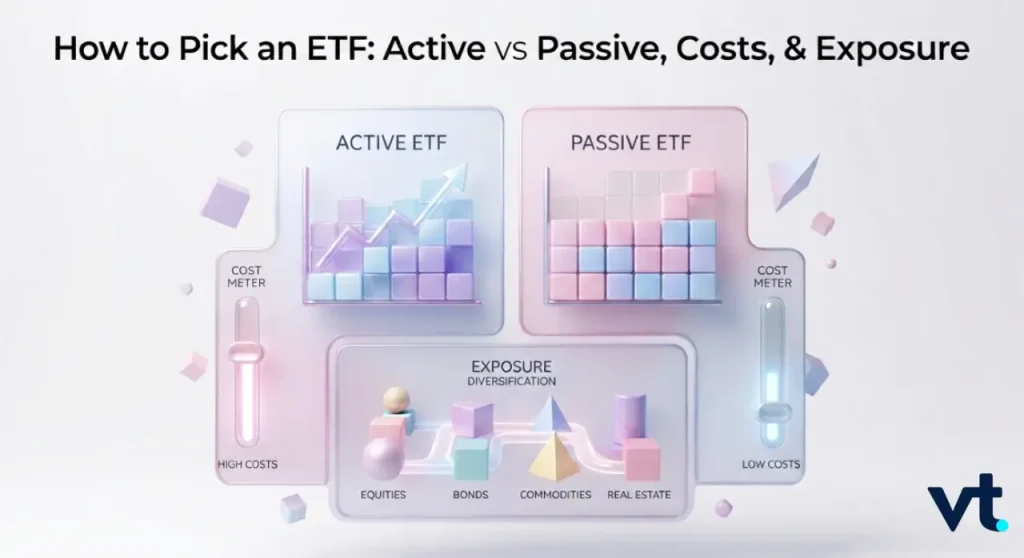
Before you compare tickers, it helps to understand what an ETF actually is and how ownership works. The first part below covers how an ETF is built and traded, what you own when you buy one, and why two funds tracking the same index can still deliver different returns.
How An ETF Is Built And Traded
An exchange-traded fund is a basket of assets that trades on an exchange like a single share. Authorised participants create and redeem units in bulk. This keeps the market price close to the fund’s net asset value. Two prices therefore exist at once:
- The net asset value (NAV), or what the underlying holdings are worth
- The market price you deal at, which can sit above or below NAV
- The gap between them, known as the premium or discount
What You Actually Own When You Buy An ETF
You own units in a fund, not the shares inside it. The fund holds the assets. You hold a claim on them. That distinction drives real outcomes. These outcomes include dividends reaching the fund first, then reaching you in cash or getting reinvested.
Voting rights sit with the fund manager, not with you. The fund’s legal structure determines your tax treatment. With ETF CFDs, you own no units and simply trade the price movement.
Why Two ETFs Tracking The Same Index Deliver Different Returns
Two funds can follow the same index and finish a year apart. Before you pick an ETF, know where that gap comes from:
- Different total expense ratios (TER)
- Different securities lending revenue returned to the fund
- Different withholding tax treatment on dividends
- Different sampling choices inside the portfolio
Pro tip: Compare five-year net returns, not fee tables. The fee is an input. The net return is the result.
How To Pick An ETF: Seven Checks That Matter
Run these seven checks in order. They take about ten minutes per fund.
1. Check The Index And Its Methodology Before You Pick An ETF
The index does most of the work. Two funds both labelled “world” can hold very different things.
Look for:
- Number of constituents and country weights
- Weighting method, whether market-cap, equal or factor-based
- Rebalancing frequency, since turnover costs you
- Any screens applied, such as ESG exclusions
2. Check Total Expense Ratio Against Total Cost Of Ownership
The expense ratio is the annual charge deducted from fund assets. It is visible, easy to compare, and incomplete.
In 2025, index equity ETFs registered under the US Investment Company Act of 1940 had an asset-weighted average expense ratio of 0.14%, while index bond ETFs averaged 0.09%.
Anything well above that on a plain broad-market fund deserves a question.
3. Check Fund Size And Track Record
Assets under management (AUM) signal viability. Small funds close, and closure forces a sale at a time you did not choose.
- Under USD 50 million: elevated closure risk
- USD 50–100 million: viable, but watch the trend
- Above USD 100 million with three years of history: comfortable
4. Check Liquidity, Average Volume And Spread
An ETF’s real liquidity comes from its underlying holdings, not just its own turnover. Even so, thin volume costs you money. Check the 30-day average daily volume.
Note the typical bid-ask spread in normal conditions, not at the open. Treat a persistently wide spread as a permanent tax on activity.
5. Check Tracking Difference And Tracking Error
Tracking difference is how far the fund’s return sat from the index. Tracking error is how consistently it drifted. A small negative tracking difference is normal and reflects costs. Large or erratic gaps suggest a structural problem. Compare both over three and five years, never one.
6. Check Replication Method
Physical replication means the fund holds the actual securities. Synthetic replication uses a swap with a counterparty.
- Full physical: cleanest, best suited to liquid large-cap markets
- Sampled physical: holds a representative subset, common in bond funds
- Synthetic: tracks hard-to-access markets tightly, adds counterparty exposure
7. Check Domicile, Structure And Reporting Status
Fund domicile is not paperwork. It changes your net outcome, as the next section shows.
- Confirm the domicile, commonly Ireland or Luxembourg for UCITS ETFs
- Check reporting or distributor status in your jurisdiction
- Note the share class, since one fund often lists several
What An ETF Really Costs To Hold
Understanding the true cost of an ETF goes far beyond the headline fee. Here is a look at how total cost of ownership, bid-ask spreads, and currency conversion impact your long-term returns.
TER Compared With Total Cost Of Ownership
Here is the calculation most people skip. Take GBP 10,000 held for 20 years at 7% gross annual growth.
| TER | Net annual return | Value after 20 years |
| 0.07% | 6.93% | GBP 38,194 |
| 0.20% | 6.80% | GBP 37,276 |
| 0.45% | 6.55% | GBP 35,569 |
The gap between cheapest and dearest is GBP 2,625. Same index, same market, different funds.
Bid-Ask Spread And When It Erodes Returns
The spread is a real cost, paid on entry and again on exit. On a GBP 2,000 trade:
- A 0.05% spread costs about GBP 1
- A 0.30% spread costs about GBP 6
- Twelve monthly buys at 0.30% cost roughly GBP 72 a year
Trivial once a year. Painful monthly on a thematic fund.
Currency Conversion And FX Drag
Buying a USD fund with GBP triggers a conversion. At 0.5% each way, a GBP 5,000 round trip costs about GBP 50 in FX alone. Choose a listing on your home exchange where possible.
Batch contributions rather than converting small amounts often. Check your provider’s FX markup, often larger than the fund’s fee.
Common ETF Trade-Offs, Compared
Choosing the right ETF involves balancing structural features against your investment strategy. The below sections describe the key trade-offs to consider. These stem from accumulating versus distributing wrappers and replication methods to broad market exposure, thematic bets, and currency hedging.
| Choice | Suits | Watch out for |
| Accumulating | Long-term compounding | No cash income |
| Distributing | Income needs | Reinvestment friction |
| Physical | Simplicity, transparency | Slight sampling drift |
| Synthetic | Hard-to-access markets | Counterparty exposure |
| Broad market | Core holdings | Feels unexciting |
| Sector or thematic | Conviction views | Concentration, higher fees |
Accumulating Compared With Distributing
An accumulating ETF reinvests income automatically. A distributing ETF pays it out. Holdings are identical, so this is a wrapper decision, not a market call.
Physical Compared With Synthetic Replication
Physical is the default for most investors. Synthetic tracks some markets more tightly, but adds a counterparty relationship you should understand first.
Broad Market Compared With Sector And Thematic
Broad funds spread risk across hundreds of companies. Sector and thematic ETFs concentrate it deliberately.
- Broad market: lower fees, lower turnover, dull by design
- Thematic: higher fees, narrower exposure, timing-sensitive
- Thematic funds often launch after the theme has already run
Developed Compared With Emerging Market Exposure
Emerging market exposure brings higher potential growth alongside currency swings, political risk and wider spreads. Treat it as a satellite, not a core.
Currency Hedged Compared With Unhedged
A currency hedged ETF removes FX movement but adds a hedging cost. Hedging usually earns its keep on bond exposure. On long-horizon equities, many investors leave it unhedged. Hedging costs rise when interest rate differentials widen.
Matching An ETF To Your Goal And Timeframe
How do I choose the right ETF for me? The fund follows the goal. Decide the job first, then pick an ETF to do it:
1. How To Pick An ETF For A Long Holding Period
Favour broad, low-cost funds with deep assets under management (AUM). Prefer accumulating share classes for uninterrupted compounding. Prioritise domicile efficiency over a two-basis-point fee saving.
2. How To Pick An ETF For Income
Check distribution frequency and payment dates against your needs. Look at yield sustainability, not just headline yield. Beware funds chasing yield through concentrated sectors.
3. How To Pick An ETF For Shorter-Term Or Tactical Exposure
Here the priorities are inverted. Dealing costs outweigh annual fees, because you will not hold long enough for the TER to matter. Prioritise tight spreads and high daily volume.
Ignore small TER differences entirely. Traders using ETF CFDs on VT Markets watch spread and overnight financing instead, since no units change hands.
4. How Many ETFs One Portfolio Needs
Fewer than most people think. Overlap is the enemy of clarity.
- One or two funds: a complete global core
- Three to five: core plus deliberate tilts
- More than eight: usually duplication dressed up as diversification
5. What Changes When The Contribution Size Is Small
Fixed costs dominate at small ticket sizes:
- A GBP 5 commission on a GBP 100 purchase is 5%
- The same fee on GBP 1,000 is 0.5%
- Contribute less often in larger amounts
Warning Signs To Check Before You Buy
Which ETF should I pick? Often, the faster route is deciding which to reject. These five signals do most of the filtering:
1. Low Assets Under Management And Closure Risk
Funds below roughly USD 50 million after two years are closure candidates. You get your money back, but on the provider’s timetable.
2. Thin Volume And Persistently Wide Spreads
A spread that stays wide across normal sessions means market makers see little interest. Your exit will cost more than your entry suggested.
3. Hidden Concentration Inside A Diversified Label
Open the holdings list before you buy. A “global technology” fund can hold 45% of assets in five companies. Check the top ten weights, not just the number of holdings. Two funds you own may share the same top five names.
4. Leveraged And Inverse Products
These reset daily. Held over weeks, returns can diverge sharply from the index they reference. They are trading tools, not holdings.
5. Newly Launched Thematic Funds
A record 1,397 new ETF products were listed globally from January through the end of May 2026, across 33 exchanges. Many arrive after a theme has run, so let them build a track record first.
How To Read An ETF Factsheet And Holdings List
Managing your portfolio means knowing when to stay put and when to make a change. Below is a quick look at how to handle international exposure, conduct your annual ETF review, and identify the right triggers for switching or exiting a position.
The Five Lines That Matter On Any Factsheet
Ignore the marketing copy and find these:
- Index name and full methodology
- TER plus any additional ongoing charges
- AUM and inception date
- Replication method and domicile
- Distribution policy, whether accumulating or distributing
Reading The Top Holdings And Concentration Figures
Check the top ten weight. Above 40% in a fund marketed as diversified is a concentration decision, and one you should make consciously.
Running A Like-For-Like Comparison Before You Pick An ETF
Put two candidates side by side over identical periods:
- Compare net returns over three and five years first
- Then total costs, including spread and FX
- Then structure, domicile and AUM
Placing The Order And Choosing An Order Type
Use limit orders rather than market orders, especially on smaller funds. Avoid the first and last fifteen minutes of the session, when spreads widen. Check the underlying market is open before dealing on international exposure
Reviewing Your ETF Once A Year
An annual review is enough. Confirm four things:
- AUM is stable or rising
- Tracking difference is unchanged
- The fee has not quietly increased
- The index methodology has not been altered
When Switching Or Exiting Makes Sense
Switch for structural reasons, not performance envy. Valid triggers are a fee increase, a closure notice, a methodology change or a persistent tracking problem.
Frequently Asked Questions (FAQs)
Q1: How do I pick an ETF as a beginner?
Start with a broad index fund with high AUM and a low expense ratio. Most guidance on how to choose an ETF for beginners overcomplicates the first decision. One global equity fund is a legitimate starting portfolio.
Q2: What is a good expense ratio for an ETF?
For broad developed-market equity exposure, anything at or below roughly 0.20% is competitive, with index equity ETFs averaging 0.14% in 2025. Specialist and active funds fairly charge more, so judge the fee against its peer group.
Q3: How many ETFs should I hold in one portfolio?
Between one and five for most people. A single global equity fund already holds hundreds of companies. Any additional fund should add exposure you do not already own.
Q4: Is a larger ETF always the better choice?
No, but size reduces specific risks. Large funds close less often, trade with tighter spreads and have longer track records. A smaller fund can still win on a better index or a more efficient domicile.
Q5: What is the difference between an accumulating and a distributing ETF?
An accumulating fund reinvests dividends automatically. A distributing fund pays them out as cash. Holdings are identical, so the choice rests on whether you need income now or compounding later.
Start Your ETF Journey With VT Markets
Knowing how to pick an ETF is a skill that compounds quietly. Check the index first. Look past the headline fee to the full cost stack. Confirm the fund is large enough, liquid enough and sensibly structured. Then match the exposure to your timeframe, and leave it alone.
For traders who want exposure without owning units, ETF CFDs offer another route. You can go long or short, size positions precisely, and trade the same broad-market and sector themes covered here.
With VT Markets, you get over 50 global ETFs on MetaTrader 4 and MetaTrader 5, competitive spreads, and a demo account to rehearse how you pick an ETF before you commit capital.
Open a VT Markets account, and put your checklist to work.








