





Key Takeaways
- To review your trades is to study your closed positions so you can repeat what works and drop what does not.
- A simple trading journal turns scattered trades into clear, usable data.
- The metrics that matter most are win rate, risk-reward, R-multiple and expectancy.
- A daily, weekly and monthly rhythm keeps your trade review honest and consistent.
Most traders spend hours hunting for the next trade. Far fewer spend time on the trades they have already made. That is a costly gap. When you review your trades, you turn raw experience into a real edge.
A trade review is simply the habit of studying your own results with honesty. It shows you what works, what does not, and why.
This guide explains how to review your trades in a clear, repeatable way. You will learn what to measure, how often to do it, and how to stop repeating the same mistakes. The steps use MetaTrader 4 and MetaTrader 5, the platforms most CFD traders already trust.
What It Means to Review Your Trades
To review your trades means to look back at your closed positions with a clear, forthright eye. It is not about celebrating wins or dwelling on losses. It is about spotting patterns. A good trade review treats your trading history as data, not emotion.
Trade Review and the Trading Journal Explained
The trade review is the process. The trading journal is the tool that makes it work. Your journal is where you record each trade and the thinking behind it. Without a record, memory fills the gaps, and memory leans towards the trades you would rather remember.
- The setup and the reason you entered
- Entry, exit, stop-loss and take-profit levels
- Position size and the risk taken
- The result in money and in R-multiple
- A short, honest note on what you did well or badly
Pro tip: Run a trade ideas review too. This looks at the setups you spotted but skipped, not just the trades you took. Your missed and avoided trades teach you as much as your live ones.
Post-Trade Analysis Compared With Backtesting
Post-trade analysis and backtesting sound similar, but they are not the same. Post-trade analysis studies the real trades you placed with real money. Backtesting tests a strategy on historical data before you risk anything. Both are useful. They simply answer different questions.
| Feature | Post-trade analysis | Backtesting |
| What it uses | Your real, closed trades | Historical price data |
| Main question | How am I actually trading? | Would this strategy work? |
| Captures psychology | Yes | No |
| Best for | Fixing habits and execution | Validating a strategy idea |
Why You Should Review Your Trades
Reviewing is where improvement actually happens. Anyone can place trades. Few take the time to learn from them. That habit is what separates traders who grow from traders who simply repeat.
How Trade Review Compounds Your Performance
The value of one trade review compounds. Fix one recurring mistake, and the benefit repeats across every future trade. A small gain in your average result adds up quickly over hundreds of trades.
- Cleaner entries and exits
- Better position sizing and risk control
- Fewer repeated errors
- Stronger trading discipline under pressure
In other words, picture this like a compounding interest. A tiny edge, applied consistently, grows into a large difference over time. Say your review lifts your expectancy from zero to +0.10R per trade. Over 200 trades a year, that alone is +20R of extra performance, all from fixing a single habit.
The Hidden Cost of Not Reviewing Your Trades
The cost of skipping review is quiet but real. You keep making the same mistake without noticing. EU regulators have found that most retail CFD accounts lose money (with historical studies showing that approximately 74% to 89% of retail accounts recorded losses.)
When you review your trades honestly, you at least fix what you can control.
- You keep repeating the same mistake
- You cannot state your win rate from memory
- You judge trades by feeling, not by data
- You have no written trading plan to check against
How to Review Your Trades Step by Step
Knowing how to review trade performance comes down to a simple, repeatable routine. You do not need fancy software. You need consistency and honesty. Here is a routine you can start this week.
Building a Simple Trade Review Routine
- Export your trade history from your platform at the end of the week.
- Record every trade in your trading journal, with notes.
- Tag each trade by setup, session and outcome.
- Calculate your key metrics: win rate, R-multiple and expectancy.
- Write one clear lesson and one action for next week.
The last step matters most. A review with no action is just reading. One concrete change a week is enough to compound over a year.
How to Review Your Trades on MetaTrader 4 and 5
MetaTrader 4 and MetaTrader 5 make this easy. Both let you export a full account statement in a few clicks. That statement is the raw material for your review.
- Open the Terminal in MT4 or the Toolbox in MT5, then the Account History tab.
- Highlight the period you want, right-click, and choose Save as Detailed Report.
- The report shows profit, profit factor, maximum drawdown and more.
- Open it in a spreadsheet or a journal app for deeper analysis.
On MT4 and MT5 with VT Markets, your full trade history and account statement are always a few clicks away, so building the habit is simple.
Setting Up Your Trading Journal
Your trading journal can be a spreadsheet or a dedicated app. Both work. A spreadsheet gives you full control and costs nothing. A dedicated app saves time by pulling in your trades and charts automatically.
The best one is the one you will actually keep up to date. Hence, pick whichever you open every week. Start simple. You can always add details later.
| Date | Instrument | Direction | Risk | Result | Note |
| 12 Jun | XAU/USD | Long | 1R | +2R | Followed plan, clean entry |
| 13 Jun | EUR/USD | Short | 1R | -1R | Chased price, no valid setup |
| 14 Jun | US30 | Long | 1R | +1.5R | Good, but exited a little early |
Notice the notes column. Numbers tell you what happened. Notes tell you why. Together they turn a trade review into lessons you can act on.
What to Measure When You Review Your Trades
The right metrics turn a journal full of trades into a clear picture of your strength. You do not need dozens of them. A handful, tracked well, will tell you almost everything.
1. Core Metrics That Matter (Win Rate, Risk-Reward, R-Multiple, Expectancy)
- Win rate: the share of your trades that end in profit.
- Risk-reward ratio: how much you aim to make against what you risk in each trade.
- R-multiple: your result measured in units of risk. Make twice your risk and the trade is +2R.
- Trading expectancy: the average result you can expect per trade, across many trades.
- Profit factor: gross profit divided by gross loss. Above 1.0 means you are net positive.
Of these, expectancy is the one to watch. A high win rate looks good. Nevertheless, it can still lose money if your losers are far bigger than your winners.
2. A Worked Example: Calculating Win Rate and Expectancy
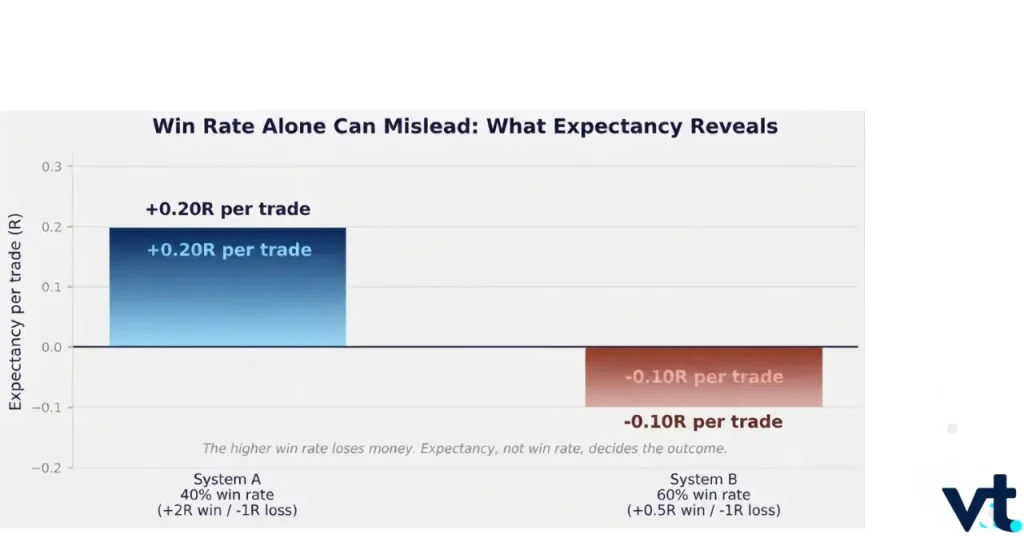
Here is a simple worked example. Say you place 20 trades. Eight win and twelve lose. Your average win is +2R and your average loss is -1R.
- Win rate = 8 wins divided by 20 trades = 40%.
- Loss rate = 12 divided by 20 = 60%.
- Expectancy = (0.40 times 2R) minus (0.60 times 1R) = 0.80R minus 0.60R = +0.20R per trade.
So even with a 40% win rate, this system makes money. If one R equals $100, your expectancy is +$20 per trade. Across those 20 trades, that is about +$400. The chart below shows why win rate on its own can mislead.
| Item | Value |
| Trades placed | 20 |
| Wins / losses | 8 / 12 |
| Win rate | 40% |
| Average win / average loss | +2R / -1R |
| Expectancy | +0.20R per trade |
| Value at $100 per R | +$20 per trade (about +$400 over 20 trades) |
How Often to Review Your Trades
Consistency beats intensity. A short review you actually do every week is worth far more than a deep review you do once a year. Build a rhythm and stick to it.
Daily, Weekly and Monthly Review Cadence
| Frequency | Time needed | Focus |
| Daily | 5 to 10 minutes | Did you follow your plan? Any obvious errors? |
| Weekly | 30 to 45 minutes | Update metrics, tag setups, spot patterns |
| Monthly | 1 to 2 hours | Check your edge, equity curve and drawdown |
Each layer answers a different question. The daily check keeps you disciplined. The weekly review finds patterns. The monthly review tells you whether your edge is holding.
When to Review an Individual Trade
Some trades deserve attention the same day, not at the weekend. Review them while the detail is still fresh in your mind. By the weekend, you will have forgotten exactly what you saw and felt in the moment.
- Any trade where you broke your own rules
- Your biggest win and biggest loss of the week
- Any trade whose result genuinely surprised you
Find out about how traders read market depth as it can help you be a better trade reviewer and boost your trade performance.
How to Learn From Your Trades and Avoid Repeat Mistakes
The whole point of review is change. Insight with no action is a diary, not a trade review. This final step turns what you learn into how you trade.
1. Reviewing Losing Trades Without Emotion
Losses are data, not verdicts. The hard skill is to separate the decision from the outcome. A good trade can still lose. A bad trade can still win. Judge the process first, and the results tend to follow.
This mindset also protects your confidence. A single loss is just noise. It is the pattern across many trades that actually matters.
- Ask whether the setup was valid, not just whether it lost
- Separate your process from the outcome
- Focus only on what you could actually control
- Never place a revenge trade to win it back
2. Turning Review Notes Into Trading Rules
When the same note appears three times, it is no longer a note. It is a rule. This is how a trading journal quietly rewrites your trading plan for the better.
- No new trades in the first minute after major news
- Never move a stop-loss further from your entry
- Only take setups that match my written plan
Each rule closes a leak. Over time, fewer leaks means a stronger, steadier edge.
Note: Most traders missed this important trading practice. It is walk-forward testing. It can also help you review and improve your trades.
Frequently Asked Questions (FAQs)
Q1: What does it mean to review your trades?
To review your trades means to study your closed positions to see what worked and what did not. It uses a trading journal and a few simple metrics to turn past trades into clear lessons, so you can repeat good habits and fix weak ones.
Q2: Why should you review your trades?
Reviewing your trades is how you improve. It reveals your real patterns, sharpens your risk control, and stops you repeating mistakes. Most retail traders lose money, so learning from your own results is one of the few edges fully within your control.
Q3: How do you review your trades on MT4 or MT5?
Open the Account History tab in MetaTrader 4 or 5, then right-click and save a detailed report. It lists your profit, profit factor and drawdown. Import that statement into a spreadsheet or journal app, then tag each trade and calculate your key metrics.
Q4: What metrics should you track when reviewing your trades?
Track win rate, risk-reward ratio, R-multiple and expectancy. Win rate shows how often you win, and R-multiple measures results in units of risk. Expectancy is the most important, as it shows your average expected result per trade across many trades.
Q5: How often should you review your trades?
Review daily, weekly and monthly. A five-minute daily check keeps you disciplined. A weekly review updates your metrics and finds patterns. A longer monthly review shows whether your edge and drawdown are healthy. Consistency matters more than how long each session takes.
Start Reviewing Your Trades With VT Markets
When you review your trades with intent, every trade becomes a lesson, not just a result. You now have a routine, the metrics that matter, and a clear way to turn mistakes into rules.
The next step is putting it into practice on a platform built for the job. VT Markets gives you full trade history, detailed account statements, and fast execution on both MetaTrader 4 and MetaTrader 5. The tools you need to review your trades are already at your fingertips.
Create a live VT Markets account today to access our platform features, including market insights and educational content.








