


Key Takeaways
- C3.ai is an enterprise software company that helps large organisations build, deploy, and operate artificial intelligence applications at scale.
- It was founded in 2009 by Thomas M. Siebel, the entrepreneur behind Siebel Systems, which was acquired by Oracle in 2006.
- Its core technology turns scattered business data into unified, AI-driven insights that companies can act on.
- C3.ai serves customers in energy, manufacturing, financial services, healthcare, and government, including the US Department of Defense.
- The company operates in a high-growth sector with strong long-term potential, but also faces real competition and execution challenges.
Artificial intelligence has become one of the most important technology shifts of the decade, with businesses across nearly every industry exploring how to use it. The growing corporate appetite for AI has also drawn rising investor interest toward the software companies building the systems behind it.
C3.ai is one of the names that consistently comes up in these conversations. This guide explains what the company is, what it does, and where it fits into the wider AI industry.
C3.ai Company Overview
C3.ai is a software company based in Redwood City, California. It builds tools that help large organisations design, run, and manage artificial intelligence applications inside their businesses.
The company was founded in 2009 by Thomas M. Siebel, known for building Siebel Systems, a major customer relationship management software company that Oracle bought in 2006. Siebel started C3 because he saw an opportunity in helping enterprises bring AI into their daily operations long before the technology became a mainstream topic.
The company has also changed its focus several times along the way:
- It initially started as C3 Energy, focusing on smart electricity grids.
- It then rebranded to C3 IoT, expanding its scope to connected devices and sensors.
- Finally, it adopted the name C3.ai to clearly reflect its focus on enterprise artificial intelligence.
Enterprise AI explained
Most people already interact with artificial intelligence in their daily lives, whether through chatbots, voice assistants, or personalised recommendations on apps and websites. This everyday version of the technology is known as consumer AI, and it is designed for individual users.
Enterprise AI is different. It is built for large organisations rather than individual people, and it is designed to handle the scale, complexity, and security demands of running inside a real business.
The table below sets out the main differences between the two:
| Aspect | Consumer AI | Enterprise AI |
| Who uses it | Individuals at home or work | Large organisations |
| Examples | Chatbots, voice assistants, photo apps | Predictive maintenance, fraud detection, supply chain tools |
| Data it uses | What the user types or uploads | The company’s own internal business data |
| How it is bought | A few clicks online | A long approval process involving IT, security, and legal teams |
| What it must handle | One conversation at a time | Millions of records, strict security, and constant uptime |
C3.ai operates entirely in the enterprise category, working with organisations that need this level of scale and reliability built into their software.
C3.ai Products and Platform
C3.ai’s products are designed to work together as a connected system. Each layer serves a different purpose, from the underlying technology that powers everything to the ready-made applications that solve specific business problems.
Below are the four main product lines that make up the company’s portfolio:
1. C3 Agentic AI Platform
The core foundation of the company’s offering. It handles the underlying work of connecting to a company’s data, organising it, training AI models, and running applications. Organisations with unique requirements can use the platform to build their own custom AI tools from the ground up.
2. C3 AI Applications
Ready-made software products built to address specific business problems. The range includes applications for predicting equipment failures, detecting money laundering in banking transactions, optimising supply chains, and managing customer relationships.
3. C3 Generative AI
A newer product line that allows employees to interact with their own company’s data using natural language. Rather than asking a public chatbot a general question, a manager can query their own business data directly. For example, asking which suppliers had the most delays last quarter and receiving an answer drawn from internal records.
4. C3 Code
The most recent addition to the portfolio. It enables non-technical users to describe what they need in plain English, after which AI agents design, build, and deploy the application automatically. The product reflects a wider industry shift toward agentic AI, where software can plan and complete tasks rather than respond to one question at a time.
Together, these products give customers the flexibility to build something custom, install a ready-made application, or combine both approaches depending on their needs.
How C3.ai Technology Works in Practice
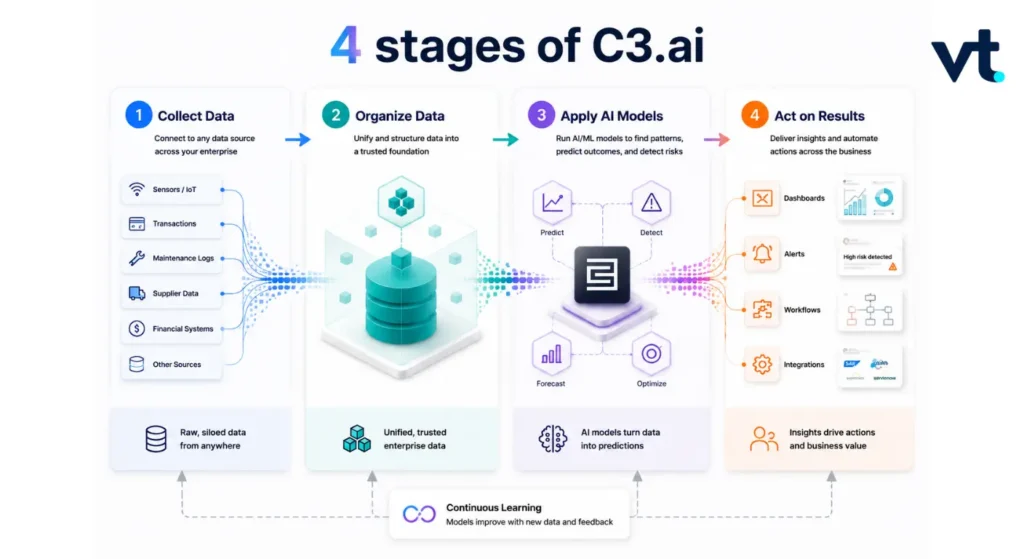
C3.ai’s platform turns raw business data into useful predictions and decisions. The process can be broken down into four clear stages:
1. Collecting the data
Large organisations generate huge volumes of data every day, but this information usually sits in separate systems that were not built to work together. C3.ai connects to these sources, including sensor data, transaction records, maintenance logs, supplier databases, and financial software, regardless of where the information lives or how it is structured.
2. Organising the data
Once collected, the data is combined into a single unified view. Every record, reading, and entry exists within a consistent structure that the rest of the platform can use. This step is often the hardest part of any AI project, which is why C3.ai treats it as a central part of its product.
3. Applying AI models
The platform then runs machine learning models that look for patterns in the unified data. These models can detect anomalies, forecast future outcomes, and identify early warning signs of problems before they happen. C3.ai offers a library of pre-built models for common business problems, alongside tools for building custom ones.
4. Acting on the results
The outputs are delivered through dashboards, alerts, and automated workflows that business teams use to make decisions. Whether it is flagging a suspicious transaction, predicting an equipment failure, or recommending a schedule change, the platform turns insight into action that employees can respond to directly.
The same workflow applies across very different settings, even though the data and the business question change completely.
C3.ai Revenue Model
C3.ai’s revenue comes from three main sources, which together form a business model typical of large enterprise software companies:
- Subscription revenue: The largest source of income for the company. Customers pay a recurring fee, usually annually, for access to the C3.ai platform, the applications they use, and ongoing technical support. Subscription contracts can be substantial, with individual deals sometimes worth several million dollars per year.
- Professional services: A smaller share of revenue comes from services such as setup, implementation, training, and tailored configuration work. These services help customers get value from the software faster, particularly in industries with complex data environments.
- Strategic partnerships: C3.ai works closely with major technology and industry partners including Microsoft, Google Cloud, Amazon Web Services, Baker Hughes, and Raytheon. These partnerships extend the company’s reach into customers it could not easily address alone, and they often involve building joint solutions for specific industries.
A defining feature of the business is the length of its sales cycle. A typical customer journey includes technical reviews, a paid trial lasting around eight to 16 weeks, and a formal contract decision. Once a customer is established, the relationship tends to grow over time as additional applications are introduced across different parts of the business.
Industries Served by C3.ai
C3.ai’s customers concentrate in industries where small efficiency gains translate into significant financial value. The table below shows the main industries it serves and the kinds of problems each one is trying to solve:
| Industry | Typical problems C3.ai helps with | Examples of public customers |
| Energy | Equipment monitoring, demand forecasting, grid optimisation | Shell, ENGIE |
| Manufacturing | Predictive maintenance, quality control, production scheduling | Koch Industries |
| Defence and government | Logistics, equipment readiness, intelligence support | US Air Force, US Department of Defense |
| Financial services | Fraud detection, anti-money laundering, customer churn prediction | Bank of America |
| Healthcare | Patient flow, operational efficiency, clinical research support | Various hospitals and life sciences groups |
What links these industries is a shared appetite for AI tools that can deliver measurable improvements in efficiency, accuracy, and decision-making at scale.
Why C3.ai Has Gained Market Attention?
The drivers behind C3.ai’s growing visibility reflect bigger shifts happening across the global economy:
- Production-grade AI adoption: after years of small pilot projects, more organisations are now deploying AI in ways that directly affect revenue and customer experience.
- Pressure to automate: labour shortages, rising costs, and the need to do more with smaller teams have pushed automation high on the priority list in nearly every industry.
- Rapid AI maturity: tools that were once limited to research labs are now ready for commercial use, including agentic AI systems that handle more complex tasks than earlier generations of software.
- Growing corporate budgets: the total amount of money flowing into enterprise AI software has expanded considerably, which benefits established vendors in the category.
Taken together, these trends help explain why companies like C3.ai are attracting growing attention across both corporate and investor circles.
How to Trade C3.ai Stocks
C3.ai is listed on the New York Stock Exchange under the ticker symbol AI.
There are two main ways to trade it, each suited to a different style of market participation.
Option 1: Buy C3.ai shares directly
The most straightforward approach is buying C3.ai shares outright through a licensed brokerage that provides access to the New York Stock Exchange. When you buy shares directly, you become a part-owner of the company and participate fully in any price gains or losses over time.
C3.ai does not currently pay a dividend, so returns from direct share ownership come primarily from changes in the share price. This option tends to suit investors who want long-term ownership of the stock and are comfortable holding a position over an extended period. Some brokerages now support fractional share trading, which means you do not need to buy a full share to get started.
Option 2: Trade C3.ai as a CFD
The second option is to gain exposure to C3.ai through Contracts for Difference (CFD) on a platform such as VT Markets. A CFD is a financial instrument that lets you speculate on price movements without owning the underlying asset. Instead of buying the shares outright, you open a contract with your broker to exchange the difference in price between when you enter and exit the position.
While C3.ai is not currently part of the VT Markets product range, traders can still gain exposure to the stock through index and ETF CFDs that include C3.ai as a constituent:
- US Small Cap 2000 index CFD (US2000): C3.ai is part of the Russell 2000, an index that tracks around 2,000 of the smallest publicly listed companies in the US. Trading the US2000 index CFD gives you exposure to the overall performance of this group of companies, including C3.ai.
- iShares Russell 2000 ETF CFD (IWM): This CFD follows IWM, an exchange-traded fund (ETF) that mirrors the Russell 2000 index. It works in a similar way to the US2000 index CFD, but the price reflects the ETF rather than the index itself.
CFDs also allow you to go long if you expect the price to rise, or go short if you expect it to fall, giving you flexibility across different market conditions. Because CFDs use leverage, gains and losses can both be amplified relative to the size of the deposit, so a clear risk management strategy is essential before opening any position.
If you want to explore the wider AI stock market beyond C3.ai, you may also find these guides useful:
Risks and Challenges Facing C3.ai
A balanced view of any company means looking honestly at the challenges as well as the opportunities.
The most important ones to keep in mind are:
- Competition: enterprise AI is a busy market. Big cloud providers, established enterprise software vendors, and well-funded start-ups all target similar problems. Staying ahead requires constant investment in product development and customer success.
- Pace of change: new techniques and tools can appear within months, and companies built around one generation of technology must continually adapt to the next.
- Profitability: C3.ai has historically operated at a loss, reflecting heavy spending on research, sales, and customer acquisition. The company has announced cost-cutting and restructuring plans to improve efficiency, and progress on those plans is something to follow over time.
- Dependence on enterprise spending: large organisations cut software budgets when the economy weakens or when government priorities shift. The long sales cycles in AI make this especially visible.
- High expectations: AI is a topic that generates a lot of excitement, and that enthusiasm can create pressure when results fall short of optimistic forecasts. Companies in the AI space often see sharper sentiment swings than the rest of the software sector.
C3.ai’s Role in the Future of Enterprise AI
The long-term importance of any enterprise AI software company depends on how broadly and how quickly large organisations bring AI into the way they actually run their operations. Several signs suggest that adoption has a long runway ahead:
- From pilots to production: more businesses are moving AI out of small experiments and into systems that run live operations every day.
- AI-first transformation: digital transformation programmes are increasingly built around AI from the start, rather than added on later.
- The rise of agentic AI: software that can plan and complete multi-step tasks is opening up applications that were not practical even a few years ago.
In this environment, companies that build the software businesses use to run their AI applications occupy a strategically useful position. They sit between the AI model developers and the end users, helping organisations turn AI into real business results.
Whether C3.ai captures a large share of this opportunity ultimately depends on execution. The company needs to keep winning new customers, deepen its industry applications, expand its cloud partnerships, and convert its strong government presence into broader commercial adoption. The future of artificial intelligence will continue to evolve, but companies like C3.ai remain closely watched as enterprises move from talking about AI to running their operations on it.
Get Ahead of the AI Opportunity
Open a live account with VT Markets today and get exposure to leading AI stocks, forex, indices, and commodities, all from one trading platform.
Frequently Asked Questions
1. What does C3.ai do?
C3.ai builds enterprise software that helps large organisations design, deploy, and operate artificial intelligence applications. Its technology connects to a company’s existing data systems, organises that data into a unified structure, applies machine learning models, and delivers the results through dashboards, alerts, and automated workflows.
2. Who founded C3.ai?
C3.ai was founded in 2009 by Thomas M. Siebel, a long-standing Silicon Valley entrepreneur best known for founding Siebel Systems, a customer relationship management software company acquired by Oracle in 2006.
3. What is the difference between consumer AI and enterprise AI?
Consumer AI is built for individual users and includes products such as chatbots, voice assistants, and recommendation engines. Enterprise AI is built for large organisations and is designed to handle the scale, security, governance, and integration requirements of running inside a business.
4. What products does C3.ai offer?
C3.ai offers four main product lines: the C3 Agentic AI Platform, C3 AI Applications, C3 Generative AI, and C3 Code. Together they let customers either build custom AI applications, install ready-made ones, or combine both approaches.
5. How does C3.ai generate revenue?
C3.ai earns revenue primarily through software subscriptions, with smaller contributions from professional services and joint go-to-market work with strategic partners such as Microsoft, Google Cloud, Amazon Web Services, Baker Hughes, and Raytheon.
6. Which industries use C3.ai?
C3.ai’s main customer industries include energy, manufacturing, financial services, healthcare, defence, and government. Public customers have included Shell, ENGIE, Bank of America, Koch Industries, and the US Air Force.
7. Is C3.ai an AI company or a software company?
It is both. C3.ai is a software company whose products are built around artificial intelligence. It does not build foundation models like the ones that power public chatbots. Instead, it builds the platform and applications that allow large organisations to use AI inside their own operations.
8. Who are C3.ai’s main competitors?
C3.ai competes with several types of companies, including major cloud providers such as Microsoft and Amazon Web Services, data and analytics platforms such as Palantir and Databricks, and a wide range of specialised enterprise software vendors offering AI tools for specific industries.
9. What are the main risks of investing in C3.ai?
The main considerations include strong competition across the enterprise AI market, the speed at which AI technology continues to change, the company’s historical losses and ongoing path to profitability, its dependence on enterprise and government spending cycles, and the broader volatility that often affects AI-related companies.










