






Snowflake (SNOW) just posted 30% revenue growth and a record $400M deal. With AI demand accelerating, discover where SNOW sits in the AI life cycle — and why it could be a compelling CFD opportunity.
The Software Company Enabling Enterprise AI
Most investors know Nvidia for chips. Most know Amazon, Microsoft, and Google for cloud. But fewer are talking loudly enough about Snowflake (SNOW) — the data platform that sits directly between those infrastructure giants and the AI applications built on top of them. A unique position for Snowflake in the tech sector today.
In a world where data is the raw material of artificial intelligence, Snowflake supplies the factory floor.
Key Products and Capabilities of Snowflake in AI and Data
- Data Engineering — Separates compute from storage for fast, petabyte-scale query performance. Handles structured and unstructured data across the Bronze → Silver → Gold pipeline. Customers pay only for compute, storage, and data transfer consumed.
- Analytics — Cloud-native warehousing supporting BI, data science, forecasting, and real-time reporting at scale — the core engine behind enterprise intelligence workloads.
- AI—Snowflake Intelligence (AI agent framework) and Cortex AI let enterprises build and run AI-native applications directly on governed data—no movement, no duplication. Adoption doubled sequentially in Q4 FY2026, surpassing 2,500 active accounts.
- Applications & Collaboration — Secure cross-cloud data sharing across AWS, Azure, and Google Cloud without copying data. As of January 2026, 40% of customers have an active sharing edge; 3,678 Marketplace listings, up 21% YoY.
Snowflake FY2026 Q4 Report
Snowflake’s Q4 FY2026 results on 25 February 2026 beat estimates on almost every aspect. Market shares were up more than 5% after hours, reflecting genuine relief and renewed optimism, particularly given how much pressure and scepticism the stock had faced heading into print, as the race for AI was in question.
Key Earnings and Growth Insights:
- Non-GAAP operating margin hit 10.5% — up 400+ bps year-over-year
- FY2027 margin guidance raised to 12.5%
- Stock-based compensation trending meaningfully lower
- The financial discipline narrative is beginning to hold
- More new customers and increased customer spending attributing $10M in spend
- Focus remains on operational rigor to support sustained long-term growth
Source: Snowflake Investor Relations — Q4 & Full Year FY2026 Earnings Release
Arguably, the most closely watched metric, Snowflake’s Remaining Performance Obligations (RPO), reflects enterprises signing larger, longer-term commitments to its software platform, driven in large part by AI workloads.
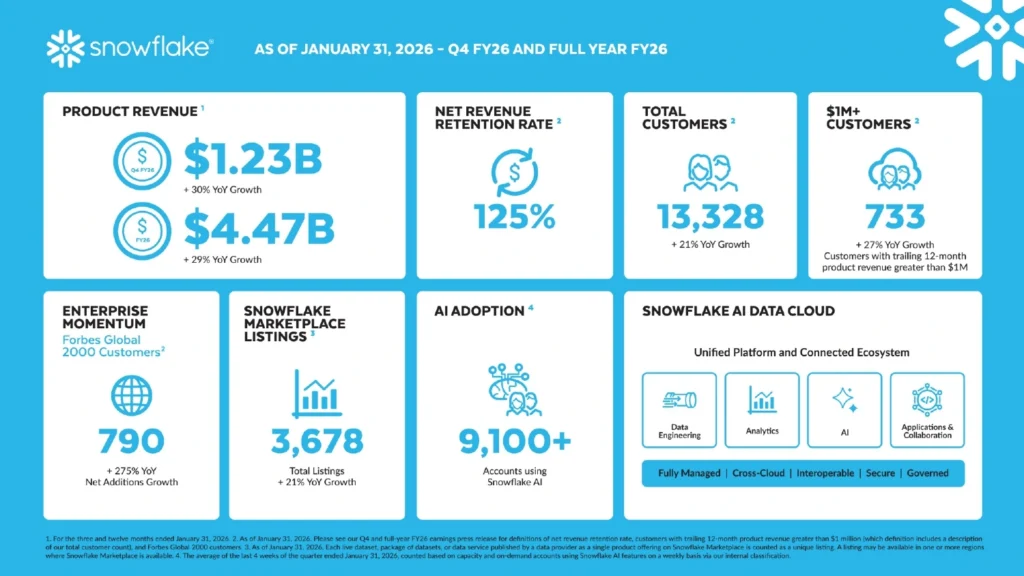
Snowflake’s report highlights an extended partnership with Anthropic, Google Cloud, and OpenAI, emphasising its core significance in the AI race. It also supports the milestone contract deal of over $400 million with an undisclosed partner, which has yet to be revealed.
Promising Innovation in Platform and Software
Snowflake is in the midst of a platform evolution. What began as a data warehousing solution is rapidly becoming the layer where enterprises run AI agents and workflows. Snowflake Intelligence and Cortex Code are the headline products. Enabling developers to build production AI applications directly within Snowflake’s governed data environment, reducing the complexity and risk of stitching together multiple tools.
Snowflake against the Tech and AI Landscape
Where exactly does Snowflake sit in the AI Pipeline?
To understand Snowflake’s strategic value, it helps to visualise the full AI stack.
Every AI application ultimately traces its lineage through a pipeline of enablers:
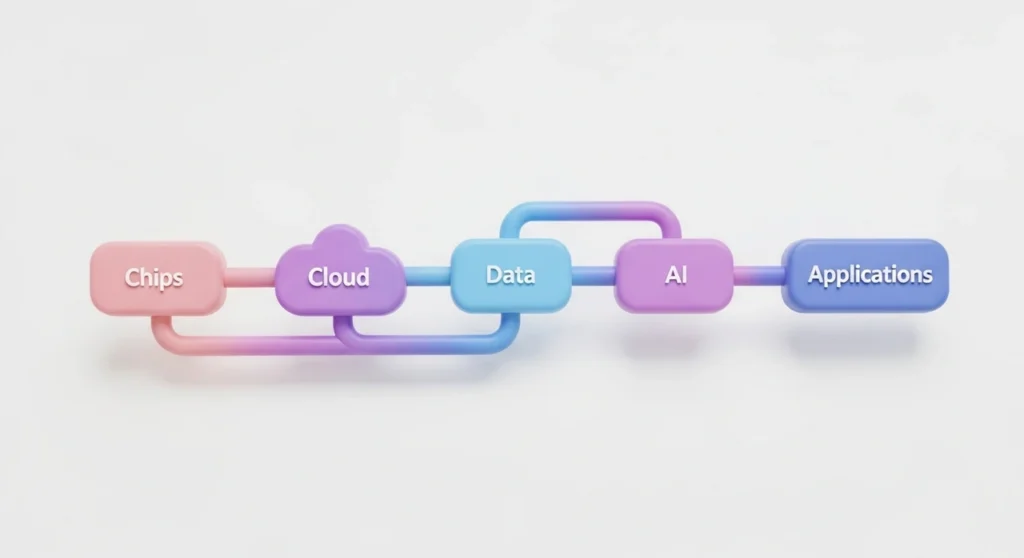
Snowflake occupies the third layer, sitting between cloud infrastructure and the AI models that consume it and further AI progress. Without clean, accessible, well-governed enterprise data, AI models produce unreliable outputs. SNOW is the layer that solves that. It is not building the models; it is making them usable at enterprise scale.
Snowflake and Innovators in the AI Stack
Snowflake occupies a unique position in the AI and cloud space, but its momentum can be influenced by others in the AI race, most specifically, legacy cloud giants and specialised AI firms. In such conditions, we address how Snowflake faces unique challenges and unique opportunities.
Cloud Giants: Competitive Growth Opportunities
Snowflake runs on the very cloud infrastructure provided by its most formidable competitors, so its growth is closely linked to the infrastructure of major cloud players, whose data centers power its platform. This is a durable position.
| Cloud Giant | Their Data Product | Relationship to SNOW |
| Amazon (AWS) | Amazon Redshift | SNOW runs on AWS; Redshift is a direct rival |
| Google (GCP) | BigQuery | SNOW runs on GCP; BigQuery competes for the same workloads |
| Microsoft (Azure) | Azure Synapse Analytics | SNOW runs on Azure; Synapse targets the same enterprise buyers |
| Oracle (ORCL) | Oracle Autonomous Database | Competes on legacy enterprise databases migrating to cloud AI |
Snowflake’s growth is therefore partly dependent on the continued expansion of these cloud data centers— yet it also competes with each of them for enterprise wallet share.
Despite this reliance, Snowflake’s precise capabilities focus on data governance and ease of integration positions it well in the evolving AI landscape.
- Cloud Neutrality: Snowflake runs natively across all giants, giving enterprises flexibility that no single cloud provider can match.
- Vendor Lock-In Avoidance: Many large enterprises are wary of concentrating on all data operations with a single hyperscaler. Snowflake presents as a neutral, independent alternative.
- Pure-Play Focus: Unlike Microsoft or Google, Snowflake’s entire business is optimising the data and AI platform layers. That focus translates into faster iteration and deeper feature development.
Its cloud-agnostic platform integrates with multiple environments, providing a durable foundation for AI usage, regardless of which model provider, and stands to gain market share.
For CFD Shares traders, the cloud giants offer stability but limited price leverage; they are diversified, large-cap businesses where a single product’s performance rarely moves the needle.
SNOW, as a pure-play data platform, carries more concentrated exposure to enterprise AI adoption cycles, and therefore, more opportunity in momentum.
Snowflake vs Datadog: Core Data vs Monitoring in the AI Pipeline
With specialised firms, understanding their core differences will help you identify how they will stand to benefit in different trends of AI innovations. Analysts have pitted Snowflake against Datadog in discussions of data and AI infrastructure, but they serve distinct roles within the AI pipeline:
| Dimension | Snowflake (SNOW) | Datadog (DDOG) |
| Primary Role | Core data platform builder | Observability & monitoring layer |
| Main Use Case | Store, query, and share enterprise data | Monitor performance of cloud apps & infrastructure |
| AI Relationship | Hosts and governs data that trains/runs AI | Monitors AI model performance and reliability |
| Revenue Model | Consumption-based (data usage) | Subscription + consumption hybrid |
| Position in Stack | Data layer (upstream of AI) | Support/enablement layer (across stack) |
In essence, SNOW builds the foundation; DDOG monitors what runs on it. In the context of the AI pipeline, Snowflake is the data backbone, while Datadog ensures that the pipeline doesn’t silently break.
For traders, this distinction matters: SNOW’s revenue is more directly tied to the volume and complexity of AI workloads, whereas DDOG’s revenue is more closely tied to the breadth of cloud deployments being monitored.
An Opportunistic Stock
The AI investment story is fundamentally about the pipeline: chips enable compute, cloud hosts it, data platforms govern and serve inputs, and AI models consume outputs. Snowflake sits at the intersection of cloud and data, transforming enterprise information into processed information that AI models can use. With strong Q4 2025 earnings, the company’s AI transition is no longer just a strategy—it’s reflected in consumption metrics.
To factor risks, if macroeconomic conditions weaken or digital transformation budgets get delayed, AI-related workloads may expand more slowly. As Snowflake operates on a consumption-based model, reduced usage would also directly affect revenue growth. Traders can watch for margin pressure if cost rises, making AI workloads more resource-intensive.
Regardless of whether AI demand accelerates or faces macro challenges, Snowflake remains a critical player in the AI life cycle. Such companies tend to reward careful attention. For traders, SNOW offers growth potential but also profitability challenges and may appear to pale in comparison with tech giants, but with precision, exhibits the volatility sought by active traders.
At VT Markets, SNOW is available as a CFD Share for trading on price movements without owning the stock. To dive deeper, explore How AI is reshaping Tech Stocks
Disclaimer: This article is for informational purposes only and does not constitute financial advice. Trading CFDs involves significant risk and is not suitable for all investors. Past performance is not indicative of future results. Please ensure you fully understand the risks involved and seek independent advice if necessary.
Quick Refresher
- Is Snowflake an AI company?
No, Snowflake is a cloud-based data platform, not an AI company. It enables AI by providing clean, governed data necessary for training and deploying AI models. - How does Snowflake integrate into the AI ecosystem?
Yes, Snowflake fits into the AI stack by managing and centralising data, making it accessible for AI models. It integrates with other AI tools to ensure smooth data flow. - What is the relationship between AI, technology, and data?
AI relies on data for training models and technology for data processing. The combination of data infrastructure and computational power is essential for AI’s functionality. The relationship between AI, tech, and data is symbiotic and connects chips, clouds, data, AI, with applications. - Can VT Markets’ assets be used to build an AI stack?
Yes, VT Markets’ data platforms, APIs, and real-time market information can be used to build an AI stack for tasks like automated trading and predictive modelling. The core of such an AI stack would involve gathering clean, real-time data, processing it using AI algorithms, and then using the insights for decision-making in trading. Data from asset classes like stocks, commodities, and crypto can be used to train models and optimise trading strategies, helping traders make data-driven decisions. - Why should Snowflake CFDs be considered a trading opportunity?
Trading Snowflake CFDs allows investors to capitalise on the company’s growth in cloud-based data services, especially as AI adoption increases, without owning the stock. As demand for cloud-based data platforms increases (especially with the rise of AI, machine learning, and big data analytics). Snowflake is positioned to benefit from this trend.










