






At a Glance:
- Copying more than one provider is a proven way to reduce single-trader risk and smooth your returns over time.
- VT Markets copy trading lets you follow multiple signal providers simultaneously through the VT Markets App.
- Spreading capital across 3 to 5 providers with different strategies and asset classes is the recommended starting point.
- Diversifying providers does not mean more work; it means smarter, more resilient portfolio management.
- Monitoring, rebalancing, and setting clear risk limits per provider are the habits that separate successful copiers from the rest.
Why One Provider Is Rarely Enough
If you have just started using VT Markets copy trading, the first temptation is to find one great signal provider and go all in. It feels simple. It feels decisive. However, here’s the reality: even the best traders have losing months.
Even a provider with a 12-month track record of solid returns can hit a rough patch. Additionally, if your entire account is riding on one person’s decisions, that rough patch becomes your rough patch too.
The question is not just whether you should copy more than one provider. The question is how to do it properly. Therefore, you are genuinely diversified, not just scattered.
This guide walks you through the logic, the mechanics, and the actionable steps behind building a multi-provider copy trading portfolio that can actually hold up in real market conditions.
Can Copy Trading Be Profitable with Multiple Providers?
The short answer is yes. Nevertheless, the question of can copy trading be profitable depends almost entirely on how you structure your approach.
Copying a single provider is like putting all your funds in one stock. It might work out splendidly. Or it might not. Copying multiple providers across different strategies and markets is more like building a portfolio. It spreads risk while maintaining the growth potential.
Here is why the multi-provider approach makes sense mathematically:
Table 1: Single Provider vs Multi-Provider Copy Portfolio — Simulated Monthly Performance
| Month | Single Provider Return | 3-Provider Portfolio Return |
| January | +60.2% | +50.1% |
| February | -80.5% | -30.2% |
| March | +40.1% | +40.8% |
| April | -110.0% | -20.9% |
| May | +70.8% | +50.5% |
| Net (5 months) | -10.4% | +90.3% |
Simulated illustration. Past performance is not indicative of future results.
In this example, the single provider had two sharp drawdown months that wiped out gains. The 3-provider portfolio, which included one conservative forex trader, one gold specialist, and one indices trader, buffered those losses significantly.
That buffering effect is the core argument for multi-provider copy trading. It is not about finding three providers who all go up together. It is about finding providers who do not all go down together.
How VT Markets Copy Trading Works Across Multiple Providers
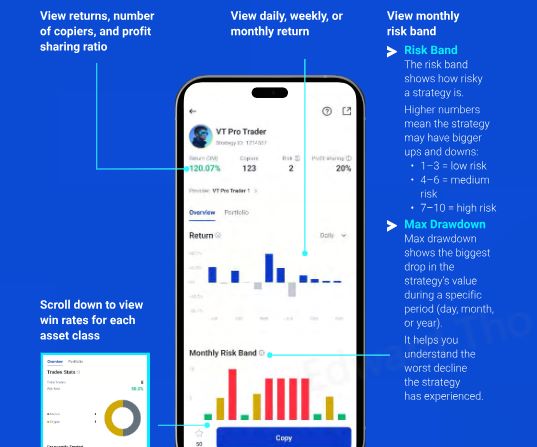
The VT Markets App is designed specifically to make multi-provider copy trading manageable. Rather than juggling different platforms or manually tracking positions, you can view and manage all your copied portfolios from a single dashboard.
Here is how the process works in practical terms:
- Open the VT Markets App and navigate to the Copy Trading section.
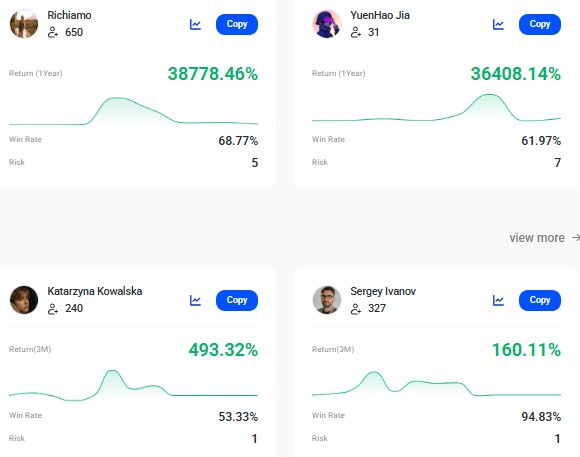
- Browse the provider leaderboard, which displays key performance metrics including periodic return, maximum drawdown, win rate, risk band and trading history.
- Select your first provider and set your capital allocation. For instance, USD30 out of a USD100 copy trading balance.
- Repeat the process for your second and third providers, adjusting allocation per your risk profile.
- Set a maximum drawdown limit per provider so that copying stops automatically if losses exceed a defined threshold.
- Monitor weekly, not daily. Short-term fluctuations are normal. Give strategies room to breathe.
The key advantage is that you remain in control. You can pause copying from any provider at any time, rebalance allocations, or add a new provider if market conditions change.
How Many Copy Trading Providers Should You Follow?
Industry research and practical experience both point to the same range: 3 to 5 providers is the optimal number for most retail copiers.
Fewer than 3 leaves you exposed. More than 5 creates complexity that is difficult to monitor and often leads to over-correlated strategies that cancel each other out.
The 3-to-5 range allows you to:
- Cover different trading styles (scalping, swing trading, position trading)
- Cover different asset classes (forex, gold, indices, commodities)
- Combine different risk levels (one conservative, one moderate, one growth-oriented)
- Avoid excessive overlap that reduces the diversification benefit
When building your provider mix, think of it like a team. You want players with different strengths, not five forwards on a football pitch.
Choosing the Right Mix: What to Look for in Each Provider
Before allocating any capital, evaluate each provider against these criteria:
Table 2: Provider Evaluation Framework
| Metric | What to Look For | Red Flag |
| Track record | 12+ months of verified history | Less than 1 month of data |
| Max drawdown | Under 35% ideally | Over 60% consistently |
| Win rate | 55%+ for swing traders | Very high win rate + low profit factor |
| Trade frequency | Consistent, not erratic spikes | Long inactivity then sudden burst |
| Assets traded | Matches your desired exposure | Unexplained asset switches mid-run |
| Leverage used | Moderate, within platform norms | Consistently max leverage on all trades |
A provider who has an 80% win rate but a single catastrophic loss that wiped out six months of gains is not a safe bet. Always look at the full picture, not just the headline return figure.
Copy Trading Tips: How to Allocate Capital Across Providers
Capital allocation is where most new copiers make their biggest mistakes. The general guideline from financial experts is to allocate no more than 20% of your copy trading capital to any single provider. This ensures that one bad run does not derail your entire portfolio.
Here is a practical example using a USD100 copy trading balance:
Table 3: Sample Capital Allocation — USD 100 Copy Trading Portfolio
| Provider Type | Allocation | Amount ($) | Rationale |
| Conservative forex trader | 30% | USD30 | Stability anchor |
| Gold/commodities specialist | 25% | USD25 | Inflation hedge, low correlation |
| Indices swing trader | 25% | USD25 | Growth exposure |
| Higher-risk growth provider | 15% | USD15 | Upside potential, capped risk |
| Reserve / unallocated | 5% | USD5 | Flexibility for rebalancing |
This structure keeps your single-provider exposure capped, ensures you have a defensive core. Above all, it still gives you meaningful growth exposure through the higher-risk allocation.
As you gain experience and your account grows, you can refine the ratios. The key is starting with clear rules and sticking to them, even when one provider is outperforming and you are tempted to overweight them.
The Best App for Copy Trading: What to Expect from a Quality Platform
Finding the best app for copy trading goes beyond leaderboard rankings. The platform itself needs to give you the tools to manage a multi-provider portfolio without making it feel like a second job.
When evaluating any copy trading app, look for these features:
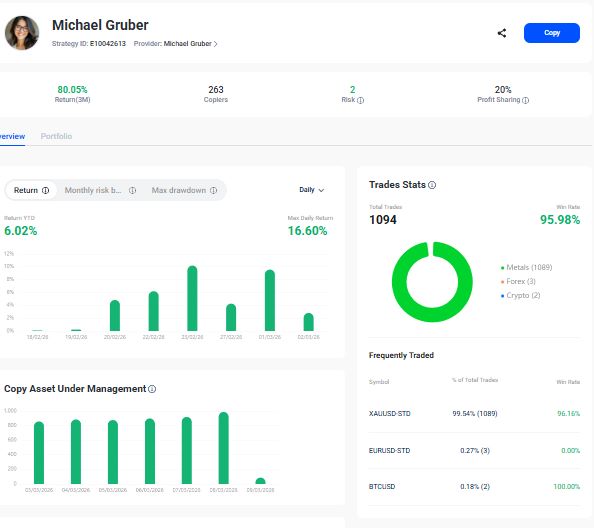
- Provider performance analytics: Detailed metrics beyond just percentage returns, including drawdown curves, trade logs, and risk scores
- Flexible capital allocation: The ability to set different amounts per provider, not just a blanket percentage
- Automatic stop-loss per provider: Capping losses from any single source with minimal manual intervention
- Real-time portfolio overview: One screen that shows you all providers, their open positions, and your overall exposure
- Pause and resume functionality: Temporarily stop copying from a provider without losing your settings or history
- Mobile-first design: Market conditions change and you need to act from anywhere
VT Markets offers all of these through the VT Markets App, which is available on both iOS and Android, as well as the in-browser Client Portal. The interface is designed for copiers of all experience levels. Thus, this makes it straightforward to set up your multi-provider portfolio without needing a background in trading.
How to Manage a Copy Trading Portfolio Like a Professional
Once you have selected your providers and set your initial allocations, the real work begins. Managing a multi-provider copy trading portfolio is not passive. It does not need to be time-consuming if you follow a clear routine.
Weekly Actions
- Review overall portfolio performance, not individual providers in isolation
- Check whether any provider has triggered or is approaching your drawdown limit
- Note any significant market events that may have affected specific asset classes
Monthly Actions
- Compare each provider’s performance against the previous month and against their own historical average
- Assess whether your current allocation still reflects your risk tolerance
- Consider whether any provider has changed their strategy or trading frequency significantly
- Look at whether any new providers on the platform warrant a small trial allocation
Quarterly Actions
- Conduct a full portfolio review, such as return, risk-adjusted performance, and provider correlation
- Rebalance allocations if one provider has grown significantly relative to others
- Replace underperforming providers who have failed to meet your stated criteria over a sustained period
The biggest mistake most copiers make is reviewing too frequently and reacting to short-term noise. A provider having a bad week is not a reason to stop copying. A provider who has been consistently losing capital for three months despite diverse market conditions probably warrants a reassessment.
VT Markets Copy Trading: Setting Realistic Expectations
Copy trading is a tool, not a guaranteed income stream. Understanding what realistic returns look like helps you make better decisions and avoid the trap of chasing high-return providers who are taking on excessive risk to generate those numbers.
Table 4: Monthly Win Rate Expectations for Copy Trading Portfolios
| Performance Level | Monthly Win Rate | What It Typically Indicates |
| Learning phase | -100% to +20% | Finding your provider mix |
| Consistent performance | 20% to 50% | Solid multi-provider structure |
| Strong performance | 50% to 80% | Experienced allocation & oversight |
| Exceptional yet unsustainable | 100%+ consistently | High risk, investigate carefully |
The above table stats are for illustrative purposes only. Disclaimer: Win rates are indicative only. Copy trading carries the risk of loss. Past performance is not indicative of future results.
If a provider is consistently delivering above an 80% win rate per month, ask yourself how. In most cases, the answer involves extreme leverage, grid strategies, or Martingale-style position management.
All of those carry significant blowup risk. A diversified portfolio of lower-return, lower-risk providers will outperform an all-in bet on a high-return provider over any meaningful time horizon.
Common Mistakes to Avoid When Copying Multiple Providers
Even experienced copiers fall into these traps. Being aware of them in advance gives you a real advantage.
1. Choosing Providers with Overlapping Strategies
If three of your five providers all trade the same currency pairs using the same directional bias, you have not diversified, you have just tripled your exposure. Always check the asset breakdown and strategy notes for each provider before committing capital.
2. Chasing Recent Top Performers
A provider who topped the leaderboard last month may have done so by taking outsized risks during a trending market. Leaderboard rankings reset. A provider’s risk-adjusted track record over 3+ months is far more reliable than a single headline month.
3. Ignoring Drawdown Limits
Every provider will have losing periods. The question is how deep those losses go before recovery. If you do not set a maximum drawdown limit per provider, you may find yourself down 30% or more on a single allocation before you notice and act. Use the VT Markets App’s built-in risk controls to set these limits from day one.
4. Over-Complicating Your Portfolio
Following ten providers is not better than following five. Beyond a certain point, the marginal diversification benefit diminishes while the complexity of monitoring increases. Stick to 3 to 5 well-chosen providers and master them before expanding.
5. Stopping Too Early
Copy trading requires patience. A provider who has a negative month in a difficult market but has a strong long-term track record is not necessarily a provider you should abandon. Make decisions based on patterns and data, not on one-week results.
Your Multi-Provider Copy Trading Journey Starts Here
Whether you are new to VT Markets copy trading or already following one provider and wondering whether to expand, the evidence points clearly in one direction: a well-structured multi-provider portfolio is more resilient, more consistent, and more likely to deliver the kind of returns that actually matter over time.
The copy trading market is growing fast, active copiers are becoming more sophisticated, and the tools available to manage multi-provider portfolios have never been better. This is the right time to build a smarter copy trading strategy.
Start with 3 providers. Set your allocations. Define your drawdown limits. Review monthly. Adjust quarterly. And let the strategy do the work.
Start Copy Trading with VT Markets Today
If you are ready to explore copy trading, VT Markets provides access to tools and platforms to help you get started. Trade on the robust VT Markets app, designed for speed, reliability, and advanced trading features.
For ongoing support, our Help Centre offers resources and platform guidance to help you build confidence as you learn.
Open your account with VT Markets today and access secure, transparent, and competitive copy trading across some of the world’s most popular markets.
Create your VT Markets copy trading account or log in now.
FAQs
Q1: Should you copy multiple traders in copy trading?
Yes. Copying multiple providers can reduce the impact that a single trader’s losses may have on your overall account. By allocating capital across several providers using different strategies or asset classes, traders can spread risk more effectively.
While one strong provider can generate impressive returns in a favourable period, a single losing streak can erase months of gains. A diversified multi-provider approach smooths those peaks and troughs.
Q2: What is the ideal number of copy trading providers?
Many experienced copy traders follow between three and five providers. This range generally provides enough diversification while still keeping the portfolio manageable.
Q3: Can copying too many providers reduce profits?
Yes, it can. While diversification is important, following too many providers may lead to over-diversification, where the strategies begin to offset each other or dilute overall performance.
Managing a large number of providers can also make it harder to monitor risk and evaluate strategy changes. Many traders find that maintaining a focused portfolio of three to five well-selected providers is easier to manage and more effective over the long term.
Q4: How much capital do I need to copy multiple providers?
Most copy trading platforms, including VT Markets, allow you to start with as little as USD10. However, to allocate meaningful amounts across 3 to 5 providers while maintaining proper risk management, a starting balance of USD50 or more gives you greater flexibility.
You can always start with two providers and add a third as your balance grows.
Q5: How often should I review my copy trading providers?
A weekly review is sufficient for most copiers. Checking too frequently encourages reactive decisions based on short-term noise. A monthly performance review and a quarterly rebalancing are the habits that separate disciplined copiers from those who constantly switch providers and never give any strategy time to perform.
Q6: What should I do if one copy trading provider is consistently underperforming?
Give any provider at least 2 to 3 months before drawing conclusions, unless they have triggered your pre-set maximum drawdown limit.
If underperformance persists over a longer period and is not explained by broad market conditions, it is reasonable to pause copying and evaluate whether the provider’s strategy still aligns with your goals.
Use the VT Markets App’s pause function to stop copying without losing your performance history.








