






Key Takeaways:
- Copy trading allows beginners to mirror successful traders’ strategies, but common mistakes can undermine profitability and lead to losses.
- Setting unrealistic expectations is the most frequent error, as copy trading is not a guaranteed path to instant wealth.
- Poor risk management, including inadequate capital allocation and ignoring stop-loss strategies, can lead to significant losses.
- Over-diversification dilutes returns whilst under-diversification concentrates risk, so finding balance is crucial.
- VT Markets copy trading offers robust tools, competitive spreads, and educational resources to help you avoid these pitfalls.
Copy trading has transformed how beginners enter financial markets. It offers a practical way to participate without years of trading experience.
The concept is straightforward. You trace experienced traders with proven track records, then automatically replicate their positions in your own account. When they buy or sell, your account does the same proportionally.
However, here’s the reality: knowing what is copy trading is not the same as understanding how to profit from copy trading successfully. For beginners considering copy trading, avoiding common pitfalls makes the difference between consistent profits and disappointing results.
This guide examines five critical mistakes that sabotage copy trading success and provides actionable strategies to sidestep them. Whether you are exploring copy trading for the first time or refining your approach, understanding these mistakes prevents costly errors.
Mistake 1: Setting Unrealistic Expectations in Copy Trading
The most damaging mistake in copy trading involves misaligned expectations about returns, timeframes, and effort required. Many traders enter copy trading believing it delivers passive income with minimal oversight. This fundamental misunderstanding sets the stage for disappointment and poor decision-making.
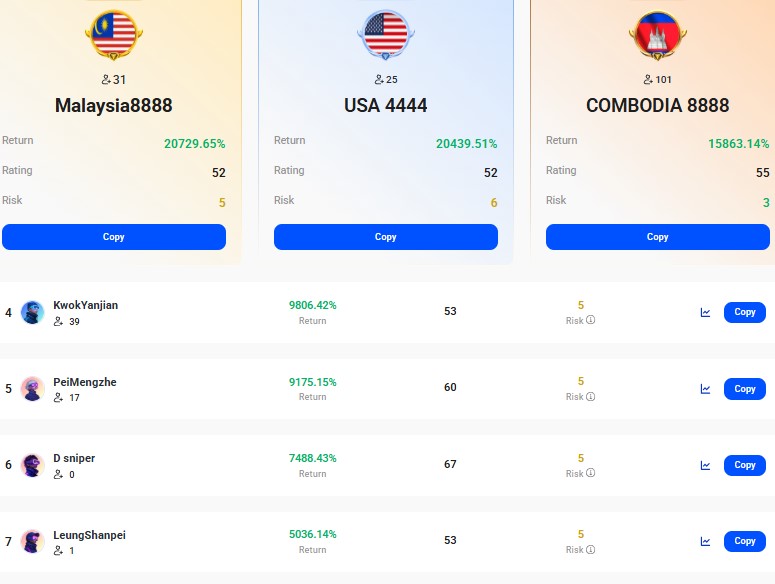
The VT Markets copy trading leaderboard isn’t just a ranking. It’s a verified snapshot of real trader performance. Here’s what each data point actually means.
- Total Return: Shows the cumulative gain a provider has built since joining the platform. VT Markets’ top providers’ gains currently range from 2,000% to over 20,000% — attained through real market conditions over time, not simulated results. These figures represent a sustained track record, not a single lucky month.
- Rating Score: Reflects overall performance quality across consistency and reliability. Scores among top providers range from 52 to 92. The highest-rated provider on the leaderboard has also attracted the most copiers, signalling long-term trust over short-term spikes. Note that a higher rating doesn’t always mean a higher return.
- Risk Band: Measures how much exposure a provider takes on, with lower numbers indicating more conservative trading. The risk band is divided into 1-10, with 1-3 being low-risk, 4-6 being medium-risk, and 7-10 being high-risk. Top providers usually sit between 3 and 6, and notably, some of the highest returns on the leaderboard carry a risk band as low as 3.
- Number of Copiers: Shows how many traders are currently following a provider. A large copier base paired with a strong rating is a useful signal of sustained community trust.
How to Choose the Right Copy Trading Provider Based on Your Goals
| Your Goal | What to Prioritise | Why This Fits |
| Capital preservation | Low risk band (3–4) + high rating | Lower-volatility strategies help protect capital and limit drawdowns, while a high rating signals stable, consistent performance. |
| Balanced growth | Risk band 5 + high total return | Moderate risk aims for steady gains with controlled volatility, suitable for sustainable long-term growth. |
| Aggressive growth | Risk band levels between 6–10 | Higher-risk bands reflect more volatile, opportunity-seeking strategies that can deliver larger returns, but also bigger losses. |
Therefore, use these metrics together, not in isolation, to find a provider that matches your goals.
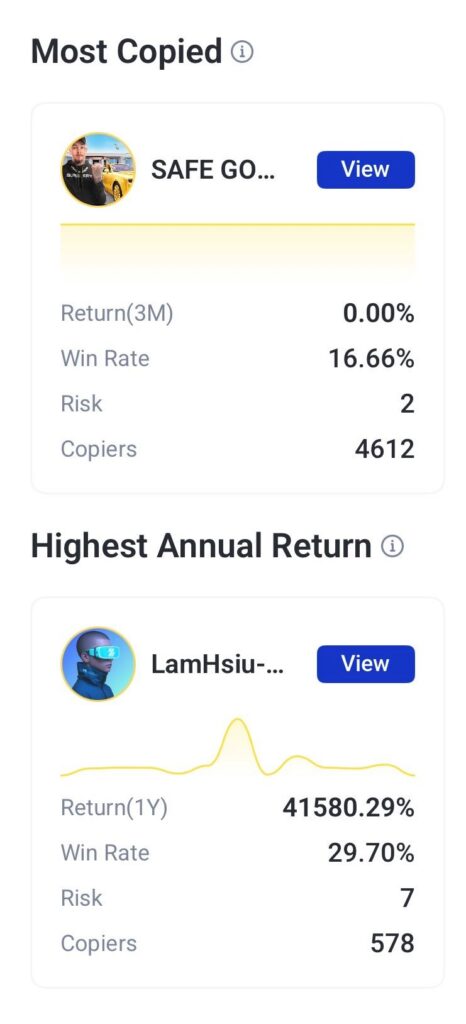
Note: VT Markets may offer copiers access to providers with very high headline figures (e.g., 88–100% win rates and 3-month returns above 1,000%), but these metrics are short-term snapshots and do not guarantee future results. Copy trading involves CFDs, which carry high risk and leverage can magnify losses (including losses beyond initial capital), so users should assess risk tolerance and do their own due diligence before copying any provider.
The Time Investment Reality
Whilst copy trading requires less active management than manual trading, it is not passive income. The most successful copy trading copiers understand they are delegating execution, not abdicating responsibility.
Successful copy traders invest time in:
- Selecting a provider that easily fits your trading style and risk tolerance
- The research can be easily done on VT Markets’ intuitive and user-friendly app or web interface.
- Monitoring performance and market conditions (2-3 hours weekly)
- Rebalancing allocations based on changing performance (monthly reviews)
- Understanding market fundamentals affecting copied strategies
These time commitments differentiate successful copy trading from failed attempts. Traders who neglect ongoing monitoring often find themselves copying outdated strategies or providers who have changed their approach without notice. The most profitable copy trading relationships involve active participation rather than passive observation.
Pro Tip: Manage Your Expectations
Set conservative targets initially. Aim for 2-4% monthly returns rather than 10-15% as a starting point. This psychological framework helps you:
- Appreciate good months without becoming overconfident
- Weather poor months without panic
- Make rational decisions based on long-term performance
- Avoid chasing unrealistic performance promises
Neglecting Proper Risk Management in Copy Trading
Risk management determines whether copy trading builds wealth or destroys capital. Unfortunately, this critical component receives insufficient attention from beginners.
Capital Allocation Mistakes
The fundamental error involves allocating excessive capital to single-strategy providers. This concentration risk remains one of the most common copy trading mistakes. Consider this practical example:
ABC has USD50 to invest in copy trading. This copier finds a provider with an impressive 45% annual return and allocates her (ABC) entire USD50 without setting a stop loss. A week later, the provider experiences a severe drawdown period, losing 90% rapidly. ABC’s account hit a stop loss and lost her margin.
Had ABC allocated her capital across different traders with varying strategies and had a risk management strategy in place, her loss might be contained and controlled.
Stop-Loss Strategy Implementation
Unlike manual trading, where stop-losses protect individual positions, copy trading requires portfolio-level stop-loss strategies. Many platforms offer automated stop-loss features for copy trading relationships.
Effective stop-loss configurations include:
- Equity-based stops: Automatically close the position when your copy account loses a specified percentage (Recommended: 15-30% per provider)
- Time-based reviews: Manual assessment periods (weekly or fortnightly) to evaluate whether strategy alignment continues
- Drawdown duration limits: Stop copying or unfollow if a trader underperforms for consecutive months (typically 2-3 months)
Mistake 3: Over-Diversification or Under-Diversification in Copy Trading
In copy trading, finding the optimal balance in diversification is a nuanced challenge. Both extremes, whether copying too many or too few traders, can undermine performance.
The Over-Diversification Problem
Copying 15-20 different traders might seem prudent for risk reduction. This approach mirrors traditional investment diversification principles. However, copy trading operates under different dynamics than stock portfolio diversification. Excessive diversification creates specific problems:
- Diluted returns: Outstanding performance from individual traders becomes mathematically insignificant across large portfolios
- Management complexity: Monitoring 20 traders effectively requires substantial time investment
- Strategy overlap: Multiple traders often take similar positions, creating hidden concentration risk
- Increased costs: More relationships mean higher cumulative fees and spreads
As a general rule of thumb, following and copying 3 to 10 providers might deliver optimal risk-adjusted returns. Beyond 10 providers, additional diversification provides minimal risk reduction whilst significantly complicating management.
The Under-Diversification Risk
Conversely, copying just one or two traders concentrates risk excessively. Consider the copy trading pros and cons in this scenario:
| Scenario | Single Trader Portfolio | 5-Trader Portfolio |
| The provider has an exceptional month (+30%) | Portfolio gains 30% | Portfolio gains ~6% |
| The provider experiences severe drawdown (-25%) | Portfolio loses 25% | Portfolio loses ~5% |
| The provider becomes unavailable or changes strategy | Complete portfolio disruption | 20% portfolio needs adjustment |
The Optimal Diversification Framework
Research-backed diversification for copy trading portfolios suggests:
- Minimum of 3-4 traders (reduces single-trader dependency whilst maintaining focused copy trading oversight)
- Maximum of 8-10 traders (maintains manageability without excessive dilution)
- Sweet spot of 5-7 traders for most retail copy traders
Beyond counting traders, effective diversification requires strategy variety:
- Time frames: Mix scalpers (minutes-hours), day traders (intraday), and swing traders (days-weeks)
- Market focus: Combine forex specialists, commodity traders, and index traders
- Trading styles: Balance trend followers with range traders and breakout specialists
- Risk profiles: Include both conservative (low drawdown) and moderate (higher return potential) traders
Pro Tip: Check for Hidden Correlation
Even when copying traders with different stated strategies, verify whether they are not highly correlated. Review their equity curves side-by-side.
If two traders’ performance graphs move in lockstep, they offer less diversification than their strategy descriptions suggest.
Mistake 4: Insufficient Research Before Copying Providers
Rushing into copy trading relationships without thorough due diligence ranks among the costliest mistakes. The accessibility of copy trading platforms creates the illusion that selecting traders requires minimal analysis.
Essential Metrics for Trader Evaluation
Effective provider research extends far beyond glancing at recent returns. Conduct a comprehensive analysis across these criteria:
- Track Record Duration and Consistency
Don’t pick a provider based on a short winning streak. Check if they have a longer track record (not just 1–3 months) and whether their results are steady over time, with manageable losses/drawdowns. VT Markets also stresses the use of key metrics to assess consistency and risk, not just recent returns.
- Drawdown Analysis
Drawdown metrics reveal how a provider handles losing periods, which inevitably occur in copy trading. Understanding these patterns helps you anticipate the emotional and financial challenges ahead.
- Risk-Adjusted Returns
Raw returns mislead without a risk context. For example, a provider delivering 40% annual returns with 35% maximum drawdown offers higher risk-adjusted performance than one achieving 25% returns with 12% drawdown.
Red Flags That Should Disqualify Traders
Certain warning signs eliminate traders from consideration:
- Martingale or grid strategies: These involve doubling position sizes after losses, creating catastrophic failure risk
- Lack of stop-losses: Traders who hold losing positions indefinitely, hoping for reversals
- Dramatic equity curve irregularities: Smooth growth followed by sudden catastrophic drops
- Extremely short track record with exceptional returns: Likely unsustainable or cherry-picked timeframes
- No communication or transparency: Traders who do not explain their approach or respond to questions
Pro Tip: The 3-Month Observation Test
Before committing real capital, track potential traders for 90 days. Record their performance as if you had copied them.
This eliminates recency bias (being swayed by recent exceptional or poor performance) and allows you to observe how they handle different market conditions. Only proceed with traders who maintain consistent performance across this observation period.
Mistake 5: Ignoring Platform Fees and Trading Costs in Copy Trading
Trading costs represent silent profit killers in copy trading. Many beginners focus exclusively on gross returns whilst overlooking the fees and spreads that erode net performance.
Understanding the complete cost structure separates profitable copy trading from disappointing results that fail to meet expectations despite following successful traders.
The Complete Cost Structure
Copy trading involves multiple cost layers:
- Profit Sharing
Many traders charge performance fees ranging from 10-30% of profits generated. Some platforms structure these as:
- High-water mark fees: Charged only on new profit peaks (fairer for copiers)
- Monthly profit fees: Charged on any monthly gain regardless of overall position
- Tiered structures: Higher percentages for greater profit levels
- Platform Subscription Fees
Some copy trading platforms charge monthly subscriptions (USD15-50) for access to premium traders or advanced features. On smaller accounts, these fixed costs significantly impact percentage returns. On the other hand, VT Markets does not charge any platform subscription fees.
- Slippage
Execution delays mean your copied trades might fill at slightly different prices than the master trader’s. High-frequency strategies suffer particularly from slippage. This potentially erodes 1-3% of returns annually.
Calculating True Net Returns
Consider this realistic scenario comparing gross and net returns:
- Provider’s return: 36% annually (3% monthly average)
- Performance fee (20% of profits): Reduced to 28.8% (36% × 0.8)
Other miscellaneous costs to be aware of:
- Spread: For instance, the difference between buy and sell prices is measured in pips. For major pairs like EUR/USD, these are generally very small.
- Slippage: When a trade executes at a slightly different price than expected, this varies by market and strategy, so there’s no fixed figure to pin down.
Strategies to Minimise Trading Costs
- Choose brokers with competitive spreads: Research shows spread differences of 0.5-1.0 pip can impact annual returns by 3-5% for active strategies
- Favour medium-frequency traders: Strategies executing 20-50 trades monthly balance opportunity, and cost efficiency better than high-frequency approaches
- Scale appropriately: Fixed subscription fees become negligible on larger accounts
- Use platforms with fast execution: Reducing slippage can significantly improve your profitability
Key Takeaways on Becoming a Successful Copy Trading Follower
Successful copy trading requires more than simply connecting to high-performing traders. It demands realistic expectations, disciplined risk management, intelligent diversification, thorough research, and cost awareness.
The difference between profitable copy trading and disappointing results often lies in avoiding these fundamental mistakes.
The five common pitfalls outlined above — unrealistic expectations, poor risk management, diversification errors, insufficient research, and ignoring costs — account for the majority of copy trading setbacks. Fortunately, each of these mistakes can be avoided through education, careful planning, and disciplined execution.
Copy trading can be a powerful way to participate in the financial markets, especially for those building their experience. However, like any trading approach, long-term success depends on preparation, patience, and continuous learning.
Start with conservative allocations, carefully evaluate traders using clear performance criteria, maintain balanced diversification within an optimal range of five to seven traders, and always calculate your net returns after fees and spreads. When approached strategically, copy trading becomes a structured method of market participation rather than a speculative gamble.
VT Markets’ copy trading solution offers transparent cost structures and competitive spreads, helping traders better manage overall costs.
Start Copy Trading with VT Markets Today
If you are ready to explore copy trading, VT Markets provides access to tools and platforms to help you get started. Trade via the web or the VT Markets App, designed for speed, reliability, and advanced trading features. For ongoing support, our Help Centre offers educational resources and platform guidance to help you build confidence as you learn.
Open your account with VT Markets today and access secure, transparent, and competitive CFD trading across some of the world’s most popular markets.
FAQs
Q1: What are the most common mistakes to avoid in copy trading?
The five most common copy trading mistakes are:
- Setting unrealistic return expectations
- Neglecting risk management (e.g., poor capital allocation, no stop-loss strategy)
- Over-or under-diversifying across providers
- Insufficient research before copying a trader
- Ignoring platform fees and trading costs that erode net returns
Q2: How many traders should you copy for optimal diversification?
For most retail copy traders, copying 5–7 traders is recommended. You can copy at least 3–4 to avoid concentration risk. On the other hand, you can copy a maximum of 8–10 providers to prevent excessive complexity and return dilution.
Copying fewer than three increases the risk. Generally, copying more than 10 providers does not enhance risk-adjusted returns and can complicate management.
Q3: What return should you realistically expect from copy trading?
A conservative starting target is 2–4% monthly returns. Aiming for 10–15% monthly is usually unrealistic and may lead to poor decisions or chasing unsustainable performance.
Q4: What red flags should disqualify a copy trading provider? Avoid providers who:
- Use martingale or grid strategies
- Hold losing positions without stop-losses
- Show dramatic equity curve irregularities
- Have very short track records with exceptional returns
- Offer no transparency about their trading approach
Q5: How do fees and spreads affect copy trading profitability?
Trading costs can significantly reduce your net returns. For example, a provider generating 36% returns annually might drop to 28.8% after a 20% performance fee, before spreads and slippage.








