






Trade tensions between Washington and Ottawa escalated quickly last week. After negotiations broke down on Friday, 21 August, the US introduced tariffs of up to 50% on a range of Canadian goods. Canada later confirmed it would match those measures from 8 September.
The market reaction was far quieter than the headlines suggested.
The Canadian dollar weakened from around 1.376 to 1.38 against the US dollar, a move of roughly one-third of a percent. For traders watching currencies, the immense tariffs don’t seem to attribute to price point movements.
The political escalation has been immediate and visible. The economic impact is slower, and so far more limited. Currency markets are focused on the economic impact.
Find specific price movement analysis in our Daily Market Analysis.
Markets look beyond the tariff headline
To determine its impact on a currency, we look at the amount of trade affected.
The latest US measures cover around US$27.6 billion of Canadian goods. That represents roughly 5% of Canada’s annual exports to the United States. The targeted products include furniture, plywood, plastics, electrical equipment, wine, cement, clothing, cameras and hockey sticks.
Canada’s response, beginning 8 September, will apply tariffs of 15%, 25% and 50% on a similar value of US imports. The measures focus on products including steel, dairy, appliances, agricultural equipment, pulp and paper, and electronics. Ottawa has also announced a C$7.5 billion support package for affected businesses.
For companies directly exposed to these tariffs, the impact could be significant. Higher costs can pressure margins, disrupt supply chains and reduce demand.
Why tariffs do not move currencies directly
At the national level, however, the impact is more contained. Most Canada-US trade continues under the USMCA framework, with many goods still moving tariff-free.
Currency markets price the overall economy, not individual industries. A tariff on furniture or construction materials matters to those sectors, but it does not automatically translate into a major currency repricing.
The transmission works broadly like this:
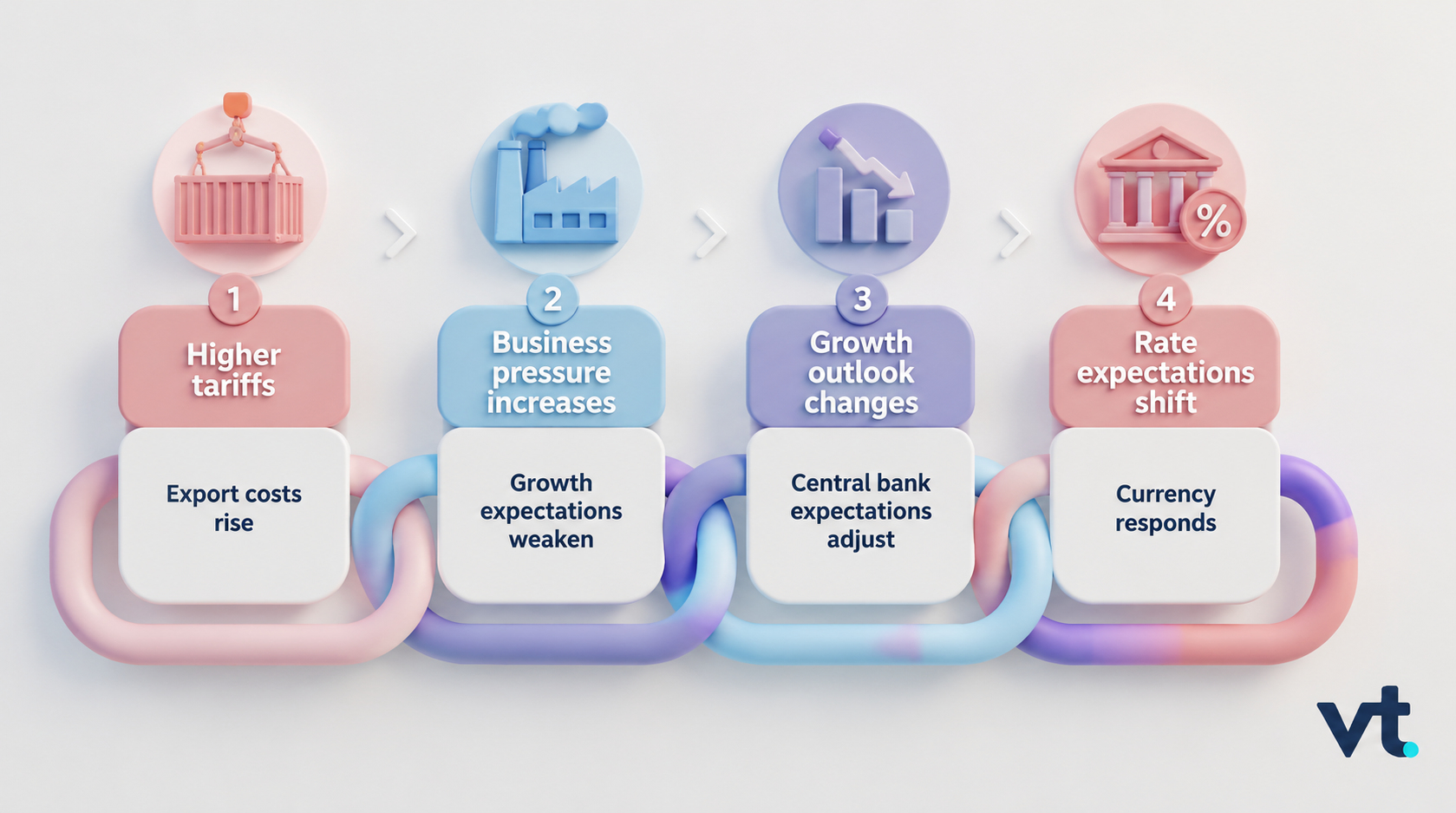
Currencies are heavily influenced by relative interest rate expectations. When investors expect one country to offer better returns through higher rates, demand for that currency can increase.
For Canada, the tariff dispute created a more complicated policy environment.
Before the escalation, the Bank of Canada was already balancing inflation risks with concerns about economic momentum. Higher energy prices supported inflation pressures, but weaker trade conditions created a stronger argument for caution on rates.
The tariffs therefore affected the Canadian dollar through the interest rate channel. However, because the expected economic damage remains limited, the impact on rate expectations has also been limited.
That is why the currency moved, but only slightly.
Bigger risks lie ahead
The market is paying closer attention to potential future measures than the tariffs already introduced.
The US has indicated that tariffs on Canadian vehicles, automotive parts and steel could rise to 50% from January 2027. Those industries carry much greater economic weight because they are central parts of Canada’s export base and rely on deeply connected North American supply chains.
A broader move against autos and steel would represent a much larger economic shock than the current measures.
For now, markets appear to be assuming that a negotiated settlement will be reached before those tariffs take effect. That expectation is supported by the view that neither side benefits from a prolonged disruption to closely linked supply chains.
However, this creates a risk: markets are positioned around an outcome that has not yet happened.
If negotiations continue and the January measures are avoided, the current tariffs may remain a sector-specific issue. If those broader tariffs become reality, the currency reaction could be significantly larger.
Three Factors That Could Move USD/CAD
Three areas are likely to shape the Canadian dollar outlook:
- Bank of Canada’s policy outlook: remains the main transmission channel for trade risks. The tariff impact ultimately flows through growth and interest rate expectations. Any change in expectations around future rates could influence CAD more than the tariff headlines themselves.
- Auto and steel negotiations: These sectors would create a much larger economic impact if targeted
- Crude oil prices: Energy exports remain an important influence on the Canadian dollar. Canada is the largest oil exporter to the United States, and the Canadian dollar has historically shown sensitivity to movements in crude markets. On some days, energy prices may matter more for CAD than developments in trade negotiations.
Markets are pricing avoidance, not damage.
The tariff escalation is significant, but the currency response has been limited because the measures currently affect only a small portion of Canada’s overall trade relationship with the US.
The market is not simply pricing the existence of tariffs. It is pricing the likelihood that broader measures will be avoided.
For now, traders appear to be betting that negotiations will prevent the dispute from reaching the industries where the economic damage would be much larger. That expectation remains the main factor to watch.
Watch latest news on Tariffs with VT Markets.
Tap for TL;DR
Why did the Canadian dollar barely move after the US imposed 50% tariffs?
The Canadian dollar weakened only around 0.3% because markets focused on the economic impact of the tariffs, not the headline rate alone.
How much of Canada’s trade is affected by the new tariffs?
The measures cover around US$27.6 billion of goods, representing roughly 5% of Canada’s annual exports to the US. Most Canada-US trade remains unaffected.
How do tariffs affect USD/CAD?
Tariffs influence the currency mainly through growth expectations and interest rate forecasts. A weaker economic outlook can change expectations for Bank of Canada policy and impact CAD.
What could cause a bigger move in the Canadian dollar?
Broader tariffs on Canadian autos, automotive parts and steel could create a larger economic impact and trigger a stronger market reaction.
What should traders watch for the Canadian dollar next?
Markets are watching Bank of Canada rate expectations, US-Canada trade negotiations and crude oil prices, which remain important drivers of CAD.
Start trading now — click here to create your real VT Markets account.








