






Gold prices have extended their decline as investors prepare for the release of the Federal Reserve’s October meeting minutes, following stronger-than-expected US consumer inflation and mixed producer price data. With the US dollar approaching a 19-month high and expectations of another interest rate increase strengthening, the precious metal faces renewed pressure ahead of an important monetary policy announcement.
Spot gold fell to approximately $3,788 per ounce on 18 November, its lowest level in more than a year, as rising Treasury yields and expectations of tighter monetary policy continued to discourage buying. Meanwhile, financial markets were pricing in a roughly 96% probability of a 25-basis-point Federal Reserve rate increase in December, leaving investors particularly sensitive to any indication that policymakers could maintain restrictive conditions into 2027.
The immediate question for gold traders is whether the upcoming FOMC minutes will reinforce the bearish outlook or provide sufficient evidence of a less aggressive policy stance to encourage a recovery.
US CPI and PPI: Why Inflation Remains a Concern
The latest US inflation reports have presented a complicated picture of the American economy, with consumer prices remaining stronger than anticipated despite some signs of moderation in producer inflation.
According to the October Consumer Price Index report released on 10 November, headline inflation increased by 0.4% month-on-month, exceeding economists’ expectations of 0.3%. Although this represented a slowdown from September’s 0.6% increase, the reading suggested that inflationary pressures were proving more persistent than markets had anticipated.
Core CPI, which excludes volatile food and energy prices, increased by 0.3%, above the expected 0.2%. This was particularly important because underlying inflation provides policymakers with a clearer indication of whether price pressures are becoming entrenched across the broader economy.
The Producer Price Index report, released on 13 November, offered a somewhat more encouraging headline reading. Producer prices increased by 0.3% month-on-month, below the 0.4% forecast and substantially slower than September’s revised 1.4% increase. However, annual producer inflation accelerated to 6.5%, its highest level since November 2022, while the measure excluding food, energy and trade services increased by 0.5% for a second consecutive month.
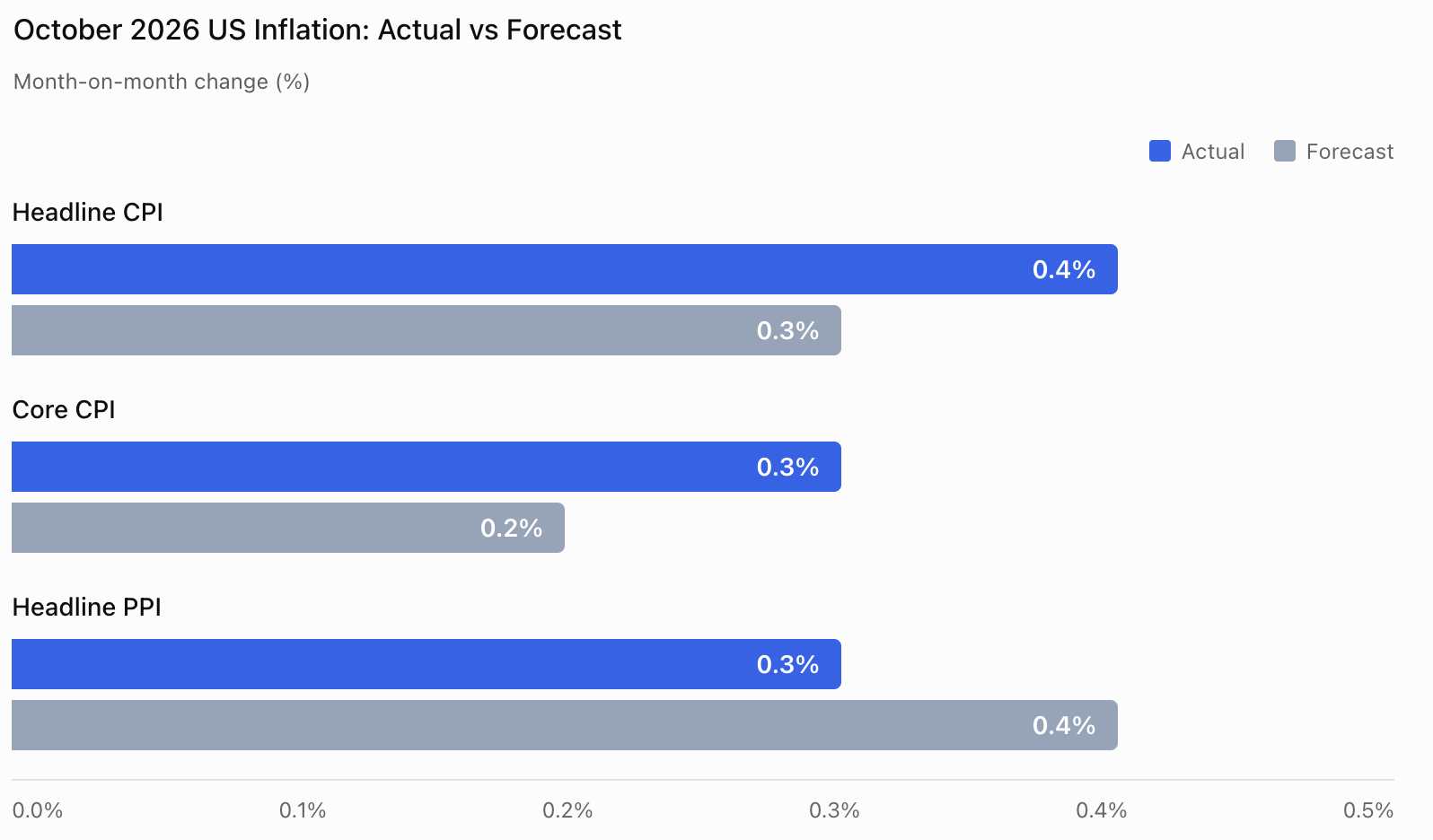
October US Inflation Snapshot
| Indicator | Actual | Forecast |
| Headline CPI (MoM) | 0.40% | 0.30% |
| Core CPI (MoM) | 0.30% | 0.20% |
| Headline PPI (MoM) | 0.30% | 0.40% |
Taken together, these figures suggest that inflation has not moderated consistently enough to remove concerns about further monetary tightening. Although softer monthly producer inflation offers some encouragement, persistent underlying cost pressures could eventually feed into consumer prices, particularly if businesses continue passing higher expenses on to households.
For financial markets, the central issue is whether the Federal Reserve believes existing interest rates are sufficiently restrictive or whether additional increases will be necessary to bring inflation sustainably towards its 2% target. Understanding the relationship between PPI and core PCE inflation can also help traders assess how producer-level price changes influence the central bank’s preferred inflation measures.
FOMC Minutes Today: What Will the Federal Reserve Reveal?
Attention now turns to the FOMC meeting minutes scheduled for 18 November at 2:00 PM Eastern Time, corresponding to 3:00 AM Malaysia time on 19 November.
The minutes will provide a more detailed account of the Federal Reserve’s 27–28 October meeting, when policymakers maintained the federal funds target range at 3.75% to 4.00%. The decision was not unanimous, with two officials favouring an immediate 25-basis-point increase, highlighting disagreements over how aggressively the central bank should respond to inflation.
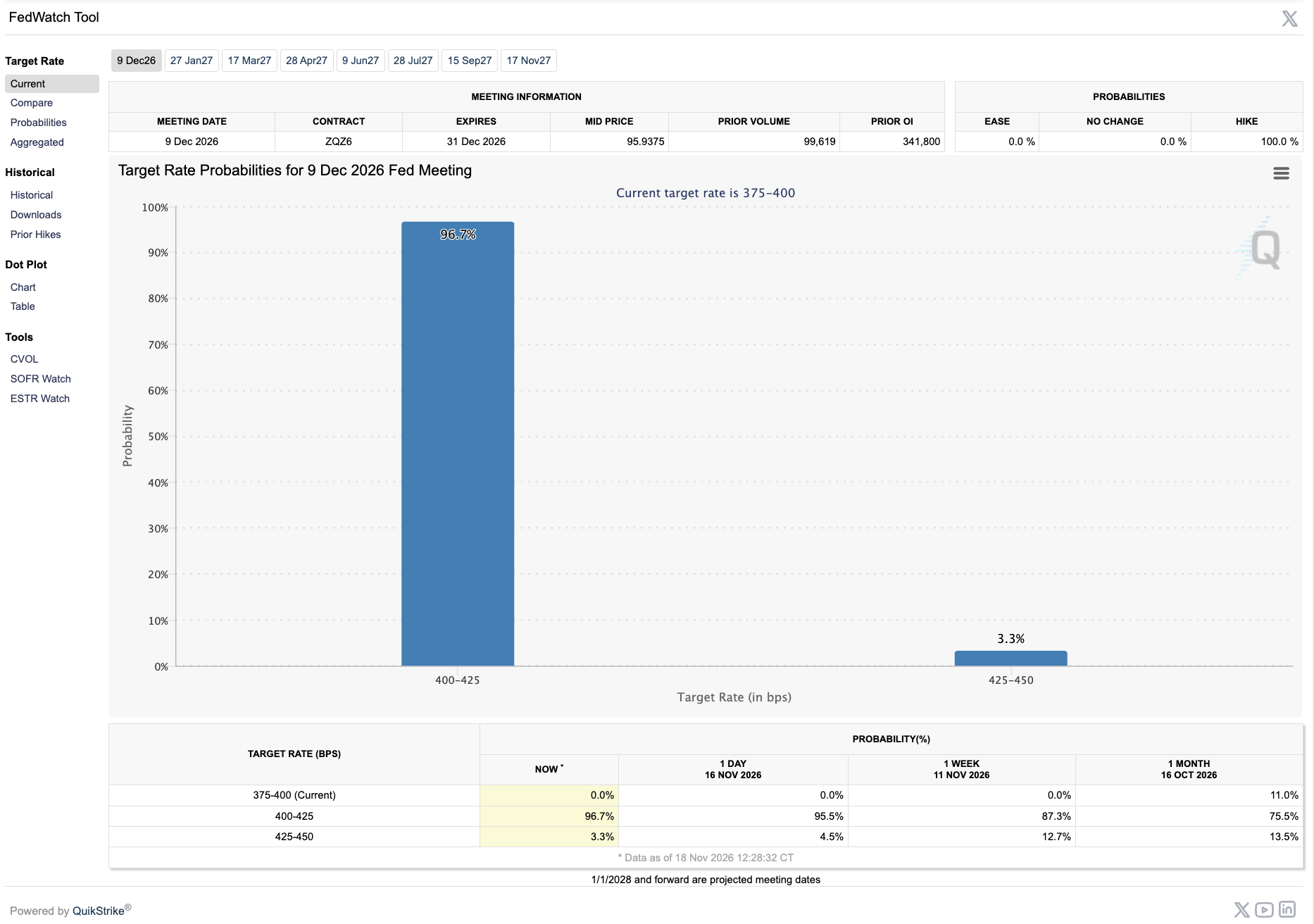
Importantly, these minutes reflect discussions that took place before the latest CPI and PPI releases. Nevertheless, they could help investors understand how concerned policymakers were about inflation even before the most recent economic figures became available.
Three developments will be particularly important. First, traders will examine how many policymakers supported additional tightening and whether those discussions suggested a preference for gradual increases or a more aggressive approach. Second, the minutes could reveal how officials assessed the resilience of the labour market and whether economic conditions were considered strong enough to withstand higher borrowing costs. Finally, investors will look for clues about how long interest rates might need to remain restrictive.
The December meeting is already attracting significant attention, with market expectations strongly favouring a quarter-point increase. However, the direction of gold may depend less on whether another increase occurs and more on what policymakers signal about the subsequent interest rate path.
If the minutes reveal widespread support for further tightening into 2027, Treasury yields and the US dollar could strengthen further. Conversely, evidence of growing concern about economic growth or the cumulative effects of previous increases could encourage markets to reconsider the longer-term policy outlook.
For traders seeking to understand how central bank decisions affect financial markets, the Federal Open Market Committee (FOMC) plays a central role in determining US monetary policy and shaping interest rate expectations.
Why Gold Prices Are Falling Despite Softer PPI
Gold’s recent decline reflects a combination of stronger US interest rate expectations, rising bond yields and a dollar that remains attractive to international investors.
Unlike government bonds or interest-bearing deposits, gold does not generate regular income. When Treasury yields rise, investors can obtain higher returns from relatively low-risk dollar-denominated assets, increasing the opportunity cost of holding the precious metal.
This relationship becomes especially important when markets expect the Federal Reserve to maintain elevated interest rates for an extended period. Higher real yields, which account for inflation expectations, can make gold less attractive even when broader economic uncertainty remains elevated. Understanding the relationship between US Treasury yields and gold prices can provide additional insight into why precious metals sometimes decline even when inflation remains elevated.
The US dollar has compounded these pressures. On 18 November, the Dollar Index traded around 103.65, close to its highest level since April 2025. A stronger dollar generally makes gold more expensive for buyers using other currencies, potentially weakening international demand. Traders can also monitor the US Dollar Index chart to assess whether dollar momentum supports or contradicts movements in gold.
The combination has pushed gold below several important psychological and technical levels, with the latest decline extending a broader correction that intensified following the CPI release.
Nevertheless, the relationship between gold and interest rates is not absolute. Heightened geopolitical uncertainty, financial instability or concerns about economic growth can support safe-haven demand even during periods of restrictive monetary policy.
For now, however, the dominant market narrative remains focused on inflation and the possibility of additional Federal Reserve tightening.
Gold Price Forecast: Key XAUUSD Levels to Watch
Gold’s latest decline towards $3,788 has weakened its near-term technical outlook, placing greater emphasis on whether buyers can defend the psychological $3,800 region or establish a meaningful recovery above previously broken support levels.
The $3,800 level represents an immediate reference point following the latest selloff. A sustained move back above this threshold could suggest that selling pressure is beginning to moderate, although stronger confirmation would require gold to recover towards the former $3,850–$3,870 support region.
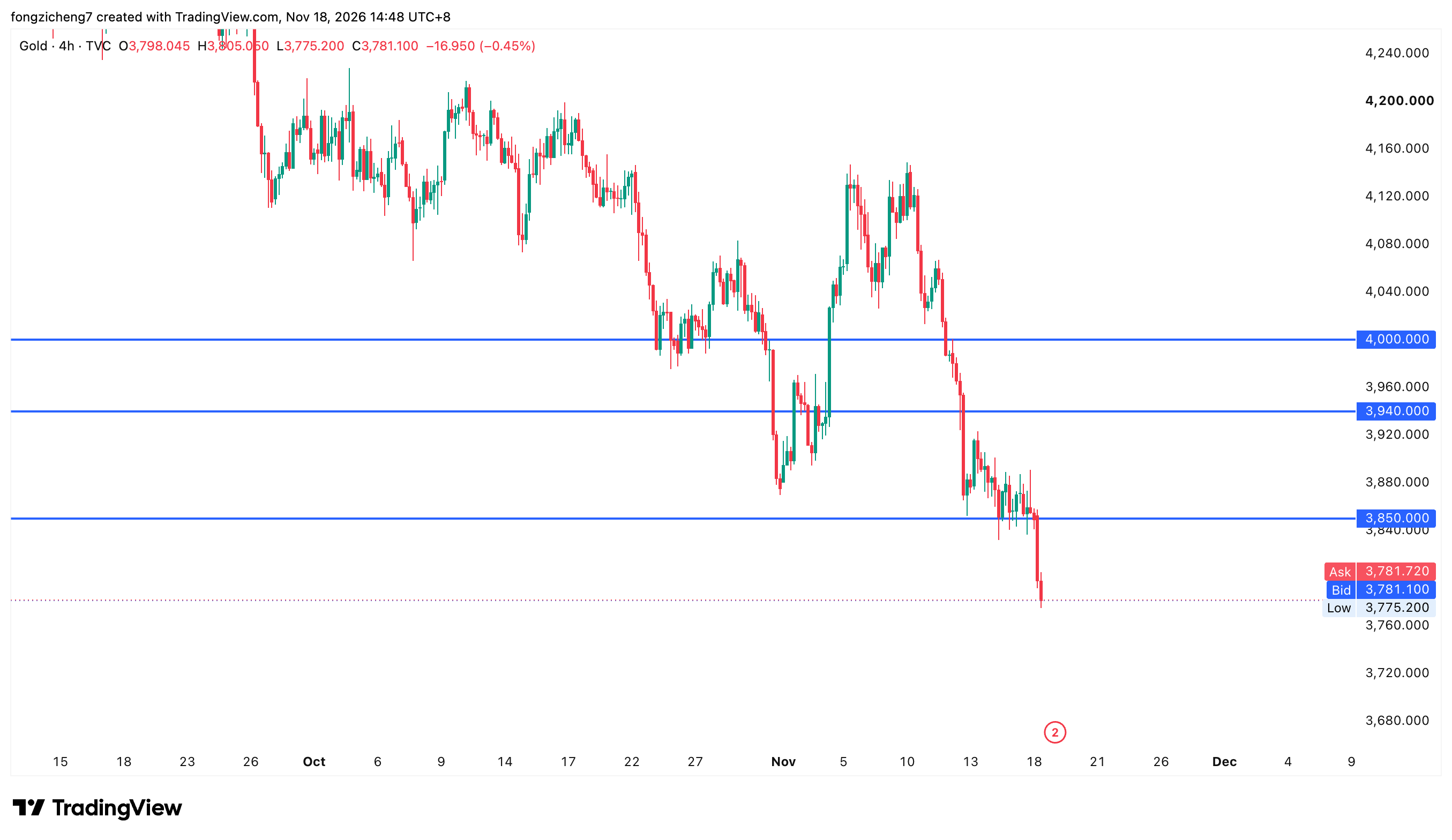
On the upside, $3,900 remains an important resistance level, followed by the broader $3,940–$4,000 zone. A convincing recovery through these areas would indicate improving buying momentum and could challenge the prevailing bearish structure.
However, if gold remains below $3,800 and continues establishing lower highs, sellers may retain control. A sustained breakdown beneath the latest lows could expose the market to further downside, although additional support levels would need to be identified from updated price action.
Key Gold Price Levels
| Price Zone | Technical Significance |
| $3,940–$4,000 | Major resistance zone |
| $3,900 | Initial recovery resistance |
| $3,850–$3,870 | Former support, potential resistance |
| $3,800 | Psychological pivot |
| Below $3,788 | Potential bearish continuation |
Traders should also monitor the US Dollar Index and Treasury yields alongside XAUUSD. A gold recovery accompanied by a weaker dollar and falling yields would provide stronger confirmation than a temporary price rebound driven primarily by short covering. Those examining the broader market can explore what correlates with gold to better understand the relationships between precious metals, currencies and other financial assets.
Three Possible Gold Price Scenarios After the FOMC Minutes
The release of the FOMC minutes could generate several different market reactions, depending on how investors interpret policymakers’ discussions relative to existing expectations.
Scenario 1: Hawkish Minutes Extend Gold’s Decline
If the minutes indicate broad support for further interest rate increases, markets could strengthen their expectations of restrictive monetary policy extending into 2027.
Such an outcome may push Treasury yields and the dollar higher, maintaining pressure on gold. A failure to reclaim $3,800, accompanied by renewed selling below recent lows, would reinforce the bearish outlook.
Scenario 2: Dovish Signals Encourage a Gold Recovery
A less hawkish interpretation could emerge if policymakers expressed greater concern about slowing economic activity, financial conditions or the risks of excessive tightening.
If investors subsequently reduce expectations for future rate increases, declining yields and a weaker dollar could encourage buying interest in gold. Under this scenario, traders may initially monitor a recovery towards $3,850–$3,870 before assessing whether momentum is sufficient to challenge $3,900.
Scenario 3: Mixed Signals Lead to Volatile Trading
The minutes could also reveal disagreements among policymakers without providing a decisive signal about the future interest rate path.
With a December increase already heavily priced in, an outcome that largely confirms existing expectations may produce only a temporary market reaction. Gold could experience sharp movements in both directions before investors refocus on upcoming economic data.
During major economic announcements, traders should also account for execution risks. Sudden price movements can create wider spreads and slippage in trading, particularly when liquidity becomes temporarily limited.
What Comes Next for Gold Before December’s Fed Meeting?
Although the FOMC minutes represent an important near-term catalyst, they are unlikely to settle the broader debate over the direction of US interest rates.
The next major inflation indicator will be the October Personal Consumption Expenditures price index, scheduled for 25 November. As the Federal Reserve’s preferred inflation measure, PCE could provide further evidence of whether underlying price pressures are moderating or remaining persistent.
The same day will also bring updated third-quarter GDP figures, offering additional insight into the resilience of the US economy. Investors will then turn towards the Federal Reserve’s 8–9 December meeting, when policymakers are scheduled to release their latest interest rate decision and updated economic projections.
For gold traders, the interaction between inflation, Treasury yields and the dollar will remain central to the outlook. Persistent inflation combined with resilient economic activity could strengthen the case for additional tightening, while weaker growth and easing price pressures may eventually create more favourable conditions for gold.
With volatility elevated and important technical levels already breached, traders should remain attentive to potential changes in liquidity, spreads and price momentum around major announcements. Applying appropriate position sizing when trading gold CFDs can help traders manage exposure when markets experience sudden price fluctuations.
Frequently Asked Questions
- Why is gold falling after the US CPI and PPI reports?
Gold has declined as stronger-than-expected consumer inflation and persistent underlying producer price pressures have reinforced expectations of further Federal Reserve tightening. Higher Treasury yields and a stronger US dollar have increased the opportunity cost of holding gold.
- When will the FOMC minutes be released?
The Federal Reserve will release the minutes from its October meeting on 18 November 2026 at 2:00 PM Eastern Time.
- Can gold recover after the FOMC minutes?
Gold could recover if investors interpret the minutes as less hawkish than anticipated, particularly if Treasury yields and the US dollar weaken. However, a sustained recovery would require improving technical momentum and stronger buying interest.
- What are the key gold price levels to watch?
The $3,800 region is an important near-term reference point following the latest decline. Resistance levels include $3,850–$3,870 and $3,900, while a sustained breakdown beneath recent lows could increase the risk of further selling.
Start trading now — click here to create your real VT Markets account.



