


Scroll through social media and you’ll see traders sharing gold, forex and index trades that seem to move fast. Most of them are trading CFDs. But what is CFD trading, how does it really work, and what should you take note of before placing your first trade?
This guide explains CFD trading in plain language, with worked examples, cost tables, 2026 statistics and a step-by-step walkthrough.
Key takeaways
- CFD trading means trading the price movement of an asset (forex, gold, indices, shares, oil and more) without owning the asset itself.
- You can go long (buy) if you expect a price to rise or short (sell) if you expect it to fall.
- CFDs are leveraged, so a small deposit (margin) controls a larger position. This amplifies gains and losses.
- Main costs to take note of: spreads, commissions and overnight financing (swaps).
- In 2026, regulator data still shows that most retail CFD accounts lose money, so a trading plan, stop losses and a demo account are sensible first steps.
- Choose a broker that is regulated, transparent about costs and clear about how client funds are protected.
What is CFD trading?
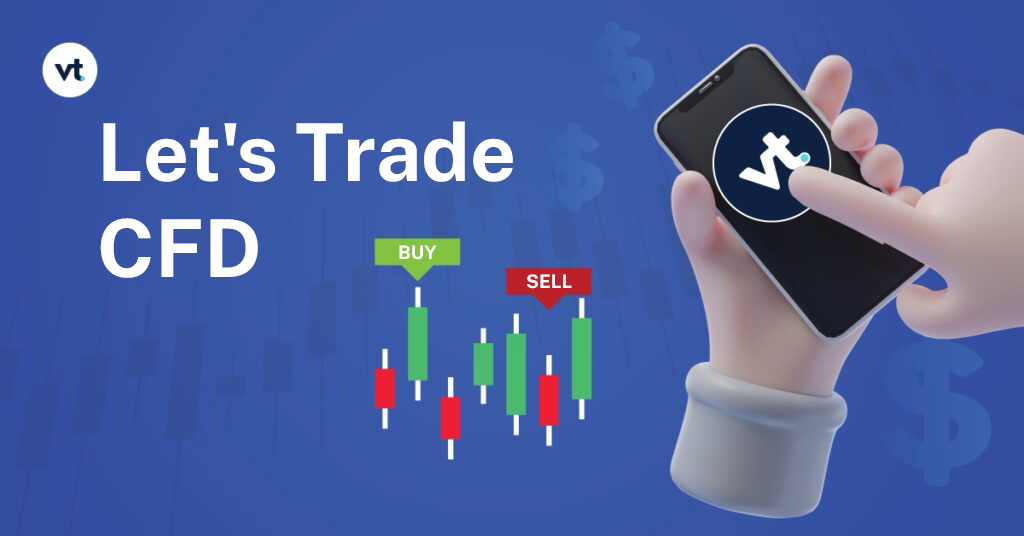
CFD trading is a way to speculate on whether an asset’s price will rise or fall, without buying the asset itself. CFD stands for contract for difference: an agreement between you and a broker to exchange the difference in an asset’s price between the moment you open a trade and the moment you close it.
If the price moves in your favour, you receive the difference. If it moves against you, you pay it. You never take ownership of the underlying gold bar, share or barrel of oil. You’re trading the price movement only.
For a deeper definition, see our guide: What Is a CFD? The Complete Guide to Contract for Difference.
A simple analogy
Imagine you and a friend disagree on where Bitcoin’s price will be in 15 minutes. You think it will rise; your friend thinks it will fall. You agree that whoever is wrong pays the other the price difference. If Bitcoin rises by 10 units, your friend pays you 10. Neither of you owns any Bitcoin. You’ve simply settled the difference. That’s the core idea behind a CFD.
How does CFD trading work?
Every CFD trade comes down to four building blocks:
| Element | What it means |
|---|---|
| Direction | Buy (go long) if you expect the price to rise; sell (go short) if you expect it to fall |
| Position size | Measured in lots or contracts, which sets how much you gain or lose per price move |
| Margin | The deposit required to open the position, a fraction of its full value |
| Profit or loss | (Closing price − opening price) × position size, minus trading costs |
Because you can sell first, CFDs let you take a view on falling markets as well as rising ones. This two-way flexibility is one of the main reasons traders use them. Learn how this compares with buying shares outright in CFD vs Traditional Investing: What’s the Difference?
Worked example: a share CFD trade
Suppose a company’s share price is $100 and you buy a CFD on 100 shares.
- Notional value: 100 × $100 = $10,000 (see notional value explained)
- Margin at 20%: $2,000 deposited to open the trade
| Scenario | Closing price | Price change | Result (before costs) |
|---|---|---|---|
| Price rises | $105 | +$5 | +$500 profit |
| Price falls | $95 | −$5 | −$500 loss |
Take note: the $500 profit or loss is measured against the full $10,000 position, not your $2,000 margin. A 5% move in the share price equals a 25% change relative to your deposit. That’s leverage at work. Figures are illustrative only.
Leverage and margin in CFD trading
Leverage lets you control a larger position with a smaller deposit. Leverage of 1:10 means $1,000 of margin controls a $10,000 position.
| Leverage | Margin required | $1,000 margin controls |
|---|---|---|
| 1:2 | 50% | $2,000 |
| 1:10 | 10% | $10,000 |
| 1:30 | 3.33% | $30,000 |
| 1:100 | 1% | $100,000 |
Maximum leverage varies by regulator, instrument and account type. A reminder: higher leverage means smaller price moves can have a much larger effect on your account balance. If your equity falls below the required margin, you may receive a margin call or have positions closed automatically.
Read more:
- What Is CFD Leverage? How It Works and Why It’s Risky
- A Guide to Understanding Margin Call in Forex Trading
- What Is Negative Balance Protection and How It Works
What does CFD trading cost?
Understanding costs is one of the most practical things you can do before trading. These are the main charges to look out for:
| Cost | How it works | When it applies |
|---|---|---|
| Spread | The gap between the buy (ask) and sell (bid) price | Every trade |
| Commission | A fixed fee per lot, common on raw-spread accounts | Per trade, if applicable |
| Overnight financing (swap) | A charge or credit for holding a leveraged position past the daily cut-off | Positions held overnight |
| Currency conversion | Applied when the instrument is priced in a different currency from your account | Where relevant |
As a practical guide, short-term traders tend to focus on spreads and commissions, while longer-term traders should pay close attention to swaps. Swap-free accounts are available for traders who need them.
- What Is Forex Spread and How to Calculate It?
- Rollover Fees Explained: How Forex Swap Rates & Rollover Rates Work
- What Is a Pip in Trading?
What can you trade with CFDs?
One CFD account can give you access to a wide range of global markets:
| Market | Examples | Learn more |
|---|---|---|
| Forex | EUR/USD, GBP/USD, USD/JPY | CFD vs Forex: Key Differences |
| Precious metals | Gold (XAU/USD), silver (XAG/USD) | CFD Gold Trading Guide |
| Indices | S&P 500, Nasdaq 100, Dow Jones | What Is Indices Trading? |
| Energies | WTI and Brent crude, natural gas | Oil Trading Guide |
| Soft commodities | Coffee, cocoa, sugar, cotton | Most Traded Commodities |
| Share CFDs | Apple, Tesla, NVIDIA | Trading CFD Shares |
| ETFs | Index and sector funds | What Is an ETF? |
| Bonds | Government bond futures | How to Trade Bond CFDs |
Forex remains the deepest of these markets. According to the Bank for International Settlements’ Triennial Survey, global FX turnover averaged $9.6 trillion a day in April 2025, a 28% rise on the $7.5 trillion recorded in 2022. This is still the most recent official benchmark in 2026 (BIS). track360
CFDs vs other ways to trade
| Feature | CFDs | Share dealing | Futures | Options |
|---|---|---|---|---|
| Own the asset? | No | Yes | No (contract) | No (contract) |
| Go short easily? | Yes | Limited | Yes | Yes |
| Leverage | Yes | Usually no | Yes | Built-in |
| Fixed expiry? | No (most) | No | Yes | Yes |
| Typical contract size | Flexible, from 0.01 lot | Per share | Large, standardised | Standardised |
Compare in detail: CFD vs Options and Is Share Trading and Investing the Same?
Benefits of CFD trading
- Access to many markets from one account: forex, metals, indices, energies, shares and more.
- Trade rising and falling markets: go long or short with equal ease.
- Capital efficiency: leverage means you don’t need the full position value upfront.
- No ownership hassle: no storage for gold or oil, no share registration.
- Flexible position sizes: micro lots (0.01) let you start small.
- Hedging potential: CFDs can offset exposure in an existing portfolio. See What Is Hedging?
Take note: key precautions before you trade CFDs
CFDs are flexible, but they call for care. Here are the main points to keep in mind.
Reminder 1: Leverage works both ways
Leverage magnifies losses just as it magnifies gains. Losses can exceed your initial deposit, depending on your broker’s protections. Using lower leverage and setting a stop loss on every trade are simple precautions.
Reminder 2: Most retail accounts lose money
Regulator data in 2026 continues to show that profitable CFD trading is the exception rather than the rule. ASIC’s review published in January 2026 found that 68% of Australian retail CFD accounts made net losses in the 2024 financial year, with combined losses above $458 million (ASIC). In the UK, an April 2026 aggregate of risk disclosures from 14 FCA-authorised brokers put the average share of loss-making retail accounts at 69.9% (The Investors Centre). Treat these figures as a reason to prepare well, not to rush in.
Reminder 3: Markets can move quickly
Economic releases such as Non-Farm Payrolls and FOMC decisions can cause sharp price swings and wider spreads. Check the economic calendar before you trade.
Reminder 4: Costs add up over time
Spreads, commissions and swaps can eat into results, especially on frequent trades or long-held positions. Factor them into every plan.
Reminder 5: Emotions affect decisions
Fear and overconfidence lead to common mistakes like over-trading or moving stop losses. A written plan helps you stay consistent. See A Trader’s Guide to Smart Risk Management.
What do you need to start CFD trading?
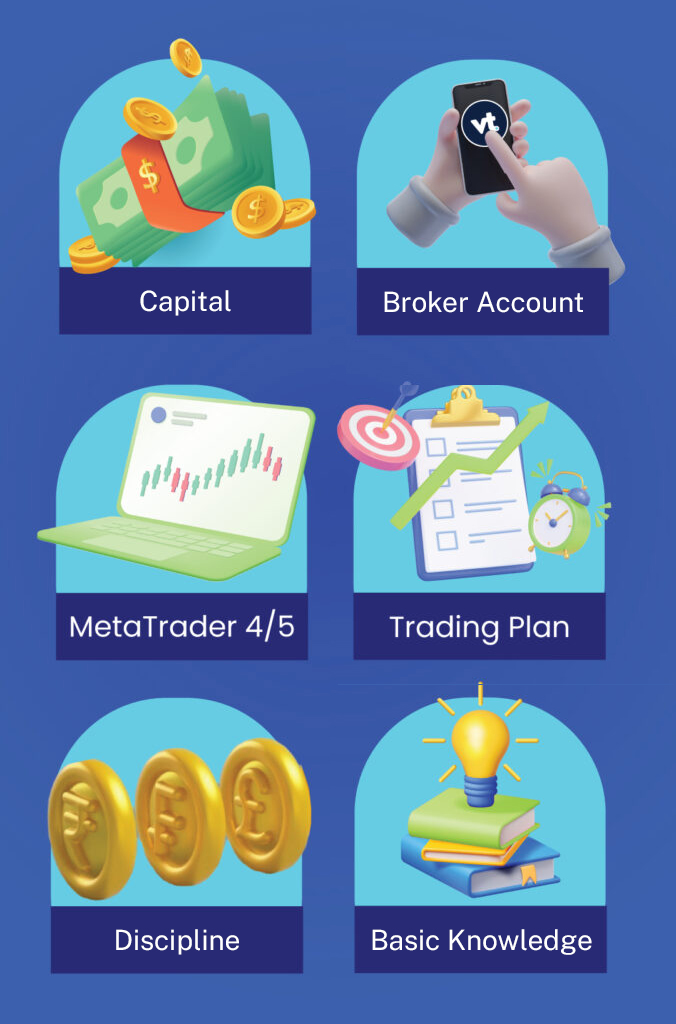
- A regulated broker account: your gateway to the markets.
- Starting capital: some accounts open from as little as $50. A cent account lets you trade in cents rather than dollars while you learn.
- A trading platform: MetaTrader 4, MetaTrader 5, a web platform or a mobile app.
- A trading plan: which markets, what timeframe, how much risk per trade (many traders use 1–2% of their account).
- Basic analysis skills: technical analysis for reading charts, and fundamental analysis for understanding economic news.
- Discipline: patience and consistency matter as much as strategy.
How to place your first CFD trade on MT4 or MT5
A practical tip: practise these steps on a demo account first.
- Log in to your trading account on MT4 or MT5 (desktop, web or mobile).
- Choose your instrument, for example EUR/USD or XAU/USD, from the Market Watch list.
- Open the chart and select a timeframe (M1 to MN, from one-minute to monthly candles).
- Analyse the market using your trading plan: trend, key levels and upcoming news.
- Open a new order and choose your volume: standard lot (1.00), mini lot (0.10) or micro lot (0.01).
- Set your stop loss and take profit. See how to calculate stop loss and take profit correctly and consider a trailing stop loss.
- Click Buy or Sell to place the trade, then monitor it in the Trade tab.
Need help with setup? Read the MetaTrader 5 download guide or MT4 download guide.
How to choose a trusted CFD broker
Use this checklist when comparing brokers:
| What to check | Why it matters |
|---|---|
| Regulation | Look for oversight from recognised authorities such as the FCA, ASIC, FSCA or FSC Mauritius |
| Client fund protection | Segregated accounts and any additional insurance |
| Transparent costs | Clearly published spreads, commissions and swaps |
| Account choice | Standard, raw-spread, swap-free and cent options suit different styles |
| Platforms | MT4, MT5, web and mobile access |
| Range of markets | More choice supports diversification |
| Deposits and withdrawals | Multiple methods and clear processing times |
| Education and support | Guides, webinars and responsive 24/7 customer service |
As an example of fund protection, VT Markets clients are automatically covered by client fund insurance of up to US$1,000,000 per account, arranged by Willis Towers Watson and underwritten by syndicates at Lloyd’s of London. Take note that this cover applies to broker insolvency and does not cover trading losses.
For a fuller comparison, read Online CFD Brokers: What They Do and How to Choose the Right One.
CFD trading in 2026: what’s changed?
- Round-the-clock gold: some brokers now offer 24/7 gold CFDs, letting traders react to weekend news. See XAUUSD247 Explained.
- More regulator transparency: regulators continue to publish loss-rate data, making it easier to understand the realities of leveraged trading.
- Copy trading growth: more beginners follow experienced strategy providers. See A Complete Beginner’s Guide to Copy Trading in 2026.
- AI-assisted tools: market summaries and sentiment tools are increasingly built into trading platforms. Read Is AI Already Trading Better Than You?
Frequently asked questions
Is CFD trading suitable for beginners?
CFD trading can be learned by beginners, but it calls for preparation. Start with a demo account, use small position sizes and set a stop loss on every trade until you understand how leverage affects your account.
Can you lose more than you deposit with CFDs?
It depends on your broker and jurisdiction. Many brokers offer negative balance protection, which means your account cannot fall below zero. Check your broker’s terms before trading.
How much money do you need to start CFD trading?
You can start with a small amount. Some accounts open from $50, and micro lots (0.01) let you trade small positions. Only trade with money you can afford to lose.
Is CFD trading legal?
CFD trading is legal in many countries, including the UK, Australia and much of Asia, but it is restricted or banned in some, such as the United States. Always check the rules where you live and use a regulated broker.
Start online CFD trading with VT Markets today
If you are ready to put your understanding of CFD trading to work in live markets, VT Markets provides access to tools and platforms to help you get started. Trade on powerful platforms like MetaTrader 4 (MT4) and MetaTrader 5 (MT5), designed for speed, reliability and advanced trading features, with access to 1,000+ instruments across forex, gold, indices, shares and more.
New to trading? Practise risk-free with a VT Markets demo account before committing to a live account. It’s an ideal way to test your first CFD trades, try out stop losses and get comfortable with leverage without financial risk.
Open your live account with VT Markets today and access secure, transparent and competitive CFD trading across some of the world’s most popular markets.
Risk warning: Trading Contracts for Difference (CFDs) carries a high level of risk and may not be suitable for all investors. The use of leverage can significantly magnify gains and losses and may result in losses exceeding your initial investment. Prior to engaging in CFD trading, you should ensure that you fully understand the risks involved, carefully consider your investment objectives, financial situation, and level of experience, and seek independent advice where necessary. Past performance is not indicative of future results.








