





Key Points
- The US Dollar Index (USDX) held near 101.4 as markets awaited the June employment report.
- Softer US private-sector hiring raised questions about labour market momentum.
- Markets continued to price in more than a 60% probability of a September Fed rate hike.
- Recovering oil flows through the Strait of Hormuz and signs of progress in indirect US-Iran talks pushed crude prices lower.
- Reserve managers are considering lower dollar exposure over the longer term, although the greenback remains the dominant reserve currency.
The US Dollar Index (USDX) was little changed near 101.4 on Thursday following a volatile previous session, as markets awaited the June employment report for clearer signals on the US labour market and the Federal Reserve’s policy outlook.
The index remained resilient despite data showing that US private-sector hiring slowed more than expected last month. Fed Chair Kevin Warsh also said inflation expectations had eased over the past month, suggesting there was less urgency to raise interest rates.
However, he reiterated the Fed’s commitment to restoring price stability. Markets continued to price in more than a 60% probability of a September Fed rate hike, keeping the dollar supported ahead of the employment figures.
Jobs Data Could Set the Dollar’s Next Direction
The June employment report may determine whether the dollar extends its recent advance or begins a deeper pullback.
A stronger reading would suggest that the labour market remains resilient, giving the Fed more room to maintain a tighter policy stance. This could strengthen the case for a September rate increase and support the dollar.
A weaker result may raise concerns about slowing labour demand. That could reduce expectations of further tightening and place pressure on DXY.
The market reaction may depend not only on headline job creation, but also on wage growth and the unemployment rate. These figures will provide a broader view of labour conditions and underlying inflation pressure.
Lower Oil Prices Temper Inflation Risk
Developments around the Strait of Hormuz are also influencing the policy outlook through their effect on energy prices.
Recovering oil flows through the route, together with signs of progress in indirect US-Iran talks, pushed crude prices lower. Softer energy costs may ease inflation pressure and reduce the urgency for additional Fed tightening.
However, the employment report remains the more immediate catalyst for USDX. A firm reading could keep the index supported even as energy-related inflation concerns ease.
Reserve Managers Tilt Away From the Dollar
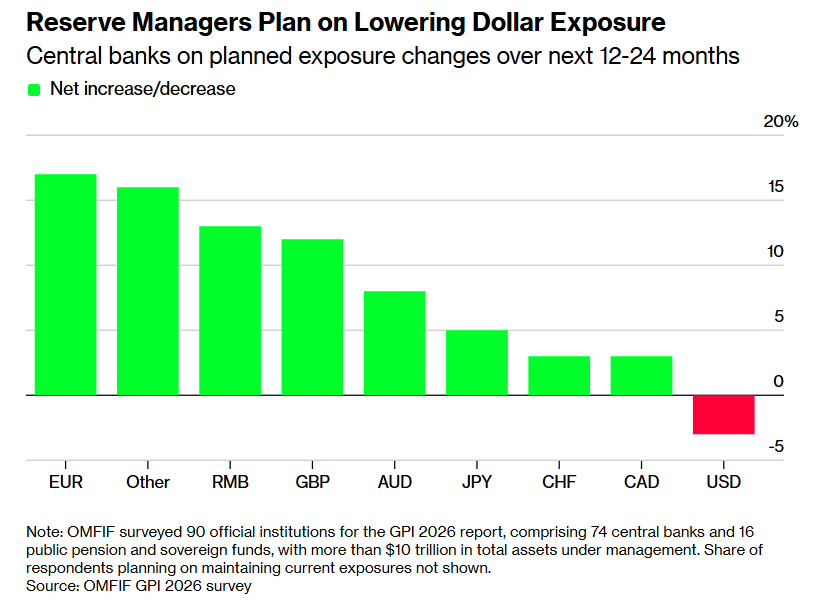
The OMFIF survey points to a gradual shift in reserve preferences over the next 12 to 24 months.
Source: Bloomberg
The euro records the strongest planned increase in exposure, followed by other currencies and the renminbi. The US dollar is the only currency shown with a net planned reduction.
This does not indicate an immediate withdrawal from dollar assets. Instead, it suggests that reserve managers are gradually broadening their allocations as geopolitical risks and concerns about the international monetary system increase.
For traders, this is a structural theme rather than an immediate USDX catalyst. Short-term movements remain more closely linked to US data, Fed expectations and Treasury yields.
Dollar Dominance Erodes Gradually
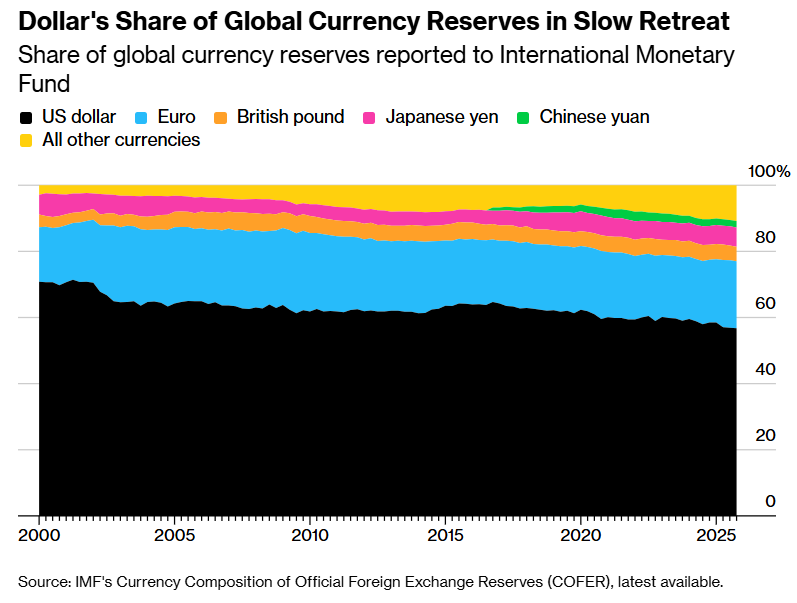
The longer-term data shows that the dollar remains the dominant reserve currency, although its share has gradually declined.
Source: Bloomberg
The dollar continues to account for the largest share of reported global reserves by a wide margin. However, its proportion has declined as central banks gradually increased allocations to the euro and other currencies.
The chart supports a gradual diversification narrative rather than a rapid loss of dollar dominance. The greenback remains central to global finance because of its liquidity, market depth and role in international trade.
IMF data showed that the dollar accounted for approximately 56.8% of global foreign exchange reserves in the fourth quarter of 2025, compared with about 20.3% for the euro and 2% for the renminbi.
Key Trading Levels
| Level | What Traders Are Watching |
|---|---|
| 102.00 | Wider breakout resistance if upward momentum strengthens |
| 101.80 | Recent swing high and key resistance |
| 101.60 | Near-term resistance within the current consolidation |
| 101.40 | Current trading area |
| 101.20 | Initial support from recent price action |
| 101.00 | Key psychological and technical support |
| 100.80 | Previous breakout area and secondary support |
| 100.50 | Wider support if the pullback deepens |
| 100.00 | Major psychological support |
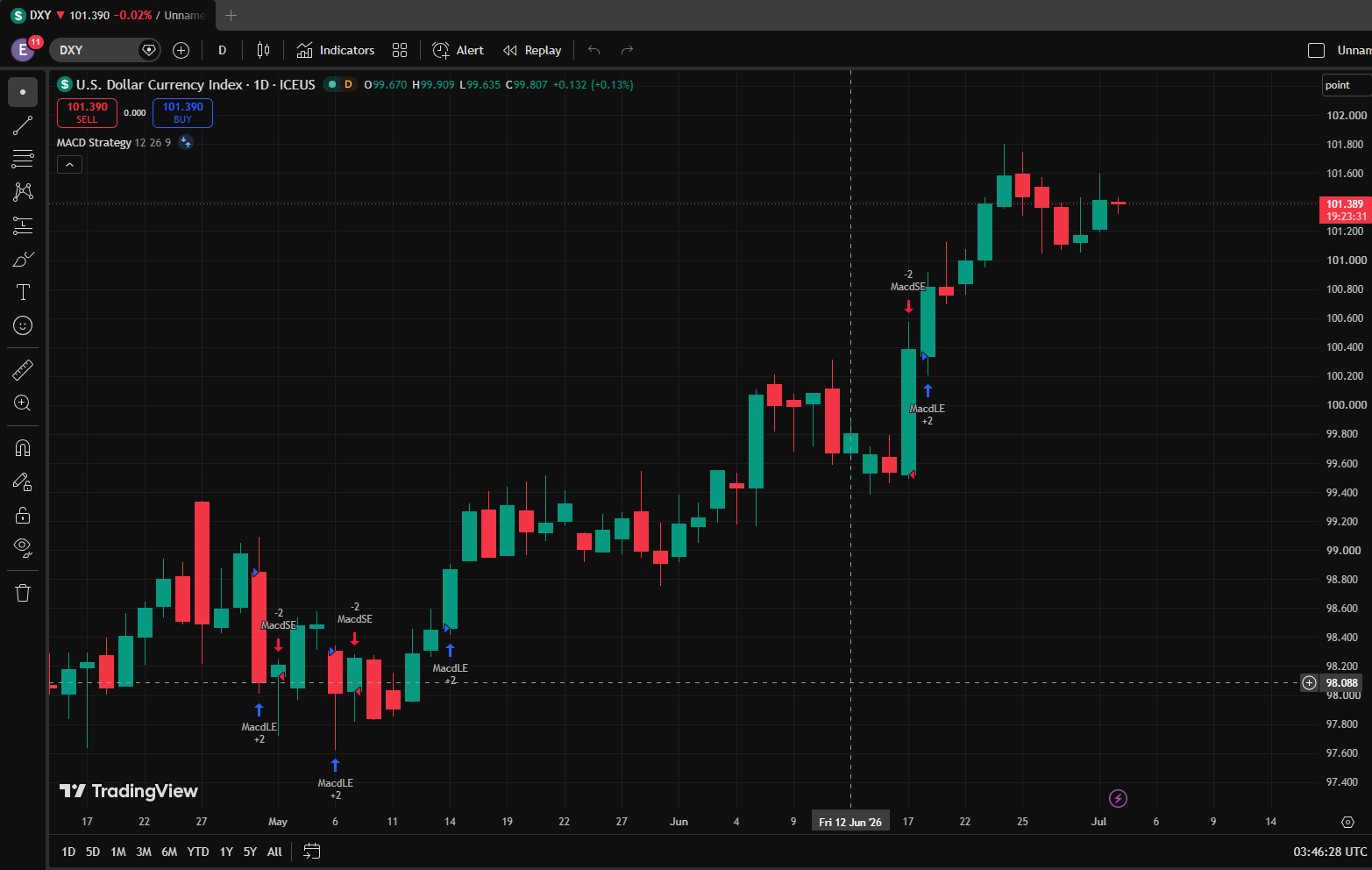
USDX is trading near 101.4, close to the upper end of its recent range. A sustained move above 101.60 may indicate renewed buying interest, while a confirmed break above 101.80 would bring 102.00 into focus.
On the downside, 101.20 is the first support level to monitor. A break below this area could expose 101.00. If the index falls beneath 101.00, the pullback may extend towards 100.80 or 100.50.
Bullish and Bearish Setups
| Setup | Trigger | Potential Market Reaction |
| Bullish Hold | Hold above 101.20 | Buyers may attempt to retest 101.60 |
| Recovery Move | Break above 101.60 | DXY may retest 101.80 |
| Bullish Breakout | Break above 101.80 | Momentum may extend towards 102.00 |
| Bearish Pullback | Fall below 101.20 | Sellers may target 101.00 |
| Deeper Correction | Break below 101.00 | DXY may weaken towards 100.80 or 100.50 |
The bullish scenario depends on DXY holding above 101.20 and recovering towards 101.60. This would indicate that buyers continue to defend the recent advance.
A stronger bullish signal would require a confirmed move above 101.80. A break beyond the recent high would bring 102.00 into focus and suggest that Fed tightening expectations continue to support the index.
The bearish scenario strengthens if USDX falls below 101.20. A break beneath this level would indicate that the current consolidation is developing into a broader pullback, placing 101.00 at risk.
A further move below 101.00 could expose 100.80 and 100.50. Traders may also monitor whether selling pressure increases during the break, as this could provide stronger confirmation of a bearish shift.
Disclaimer
The price levels and trade scenarios above reflect the author’s view at the time of writing and do not represent financial advice or an official recommendation from VT Markets. Traders should conduct their own analysis and manage risk carefully.
Trade USDX CFDs With VT Markets
The US dollar remains an important market during periods of Fed uncertainty, major employment releases, energy price movements, and geopolitical developments.
With VT Markets, traders can access forex CFDs alongside gold, oil, indices, shares, ETFs, and other global CFD markets through one platform.
VT Markets provides the tools to monitor price action, identify key levels, and respond as market conditions evolve. Whether the dollar strengthens after the employment report or retreats as rate expectations ease, traders can follow the move using advanced charting tools, flexible account options, and access to global markets.
Start trading indices with VT Markets today.
Why Trade USDX as a CFD?
CFDs allow traders to take a position on both rising and falling markets without owning the underlying asset.
This can make forex CFDs useful during periods of heightened macroeconomic volatility, particularly when employment data, Fed commentary, oil prices, and geopolitical developments drive short-term currency movements.
With VT Markets, traders can access forex and other major asset classes through one account, making it easier to monitor cross-market opportunities as they emerge.
What to Watch Next
The June employment report is the next major catalyst. A stronger reading could support expectations of tighter Fed policy and strengthen the dollar. A weaker result may reduce rate-hike expectations and place downward pressure on DXY.
Traders should also monitor wage growth, the unemployment rate, Fed commentary, Treasury yields, and oil prices. These factors will help determine whether the dollar can break above recent resistance or retreat from its current range.
Reserve diversification remains a longer-term consideration. The dollar continues to dominate global reserve portfolios, but survey data indicates that some institutions are gradually increasing exposure to alternative currencies and assets.
For now, the 101.20 to 101.80 range remains the main near-term trading zone. A break above 101.80 would strengthen the recovery outlook, while a move below 101.20 could shift attention towards 101.00 and 100.50.
Frequently Asked Questions
Why is the dollar holding near 101.4?
The dollar is holding near 101.4 as markets await the June employment report while continuing to price in a meaningful probability of a September Fed rate hike.
Why is the employment report important for DXY?
The report provides further evidence on labour market strength. Stronger employment data may support expectations of tighter Fed policy, while weaker data could reduce the case for further rate increases.
How does the Strait of Hormuz affect the dollar?
The Strait of Hormuz influences global oil flows and energy prices. Higher shipment volumes may lower crude prices, ease inflation concerns, and reduce pressure on the Fed to tighten policy.
Why are reserve managers reducing dollar exposure?
Reserve managers are seeking greater diversification as geopolitical risks rise and the international monetary system becomes more fragmented. The dollar remains dominant, although some institutions are increasing allocations to the euro, renminbi, gold, and other assets.
What are the key DXY levels to watch?
The main levels are 101.20 as near-term support and 101.80 as resistance. A break above 101.80 may strengthen the recovery outlook, while a move below 101.20 could weaken the current structure.
Can traders trade the dollar when it declines?
Yes. Forex CFDs allow traders to take a view on both rising and falling currency markets without owning the underlying asset. CFDs are leveraged products and involve risk.
Start trading now — click here to create your real VT Markets account.








