






Key Points
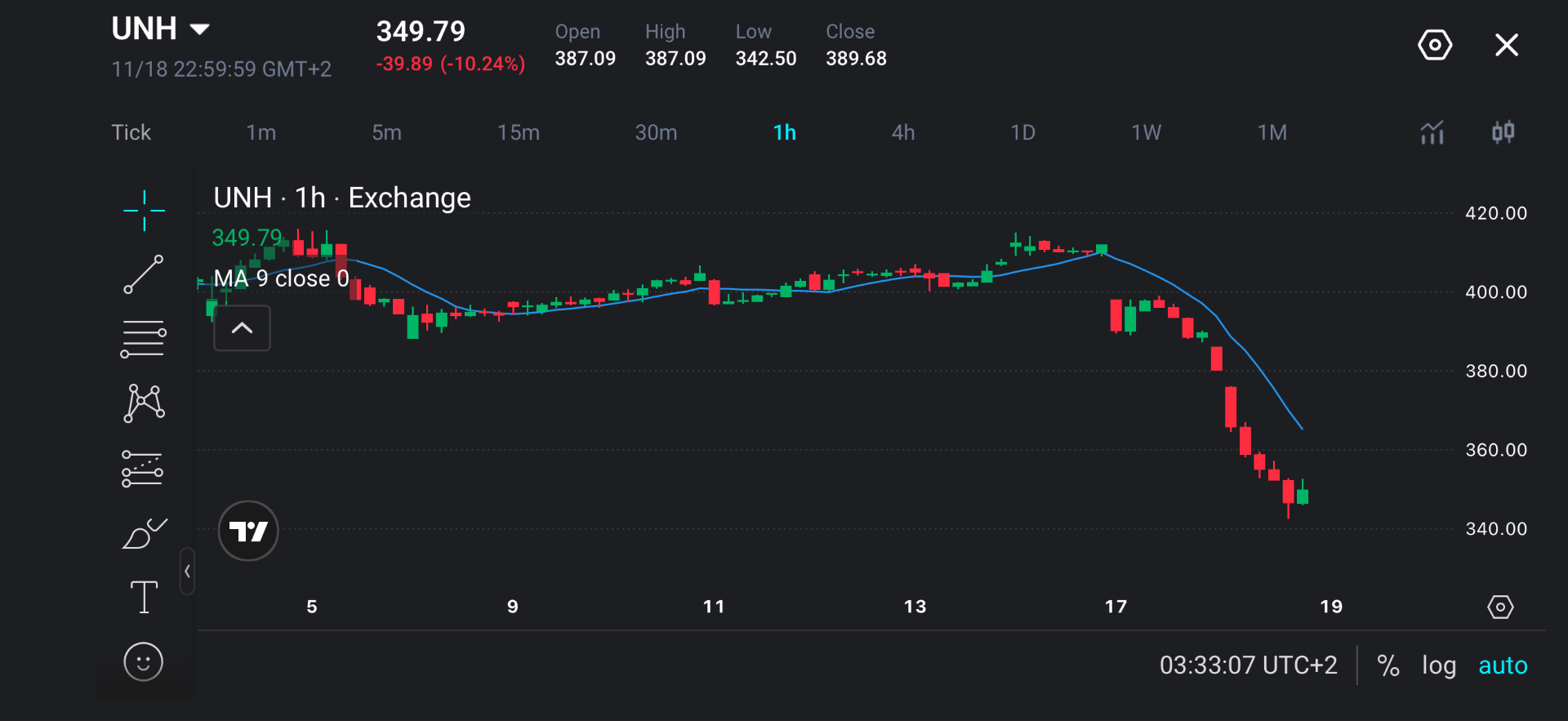
- UnitedHealth (UNH) fell 10.24% on 18 November, trading at $349.79 and ranking among the S&P 500’s biggest decliners.
- Humana (HUM) also dipped 13%, signalling broader selling pressure across US health insurance stocks.
- Proposed Medicare Advantage audits raised concerns about potential repayment obligations, adding to uncertainty surrounding insurers’ profitability.
- Rising medical costs and regulatory scrutiny could pressure earnings expectations, particularly if insurers face higher claim expenses and additional compliance costs.
- Technical levels remain under pressure, with $342–$350 providing immediate support and $370–$390 representing a potential recovery zone.
Market Move
UnitedHealth (UNH) plunged 10.24% to $349.79 on 18 November, losing $39.89 per share as selling pressure intensified across the US healthcare insurance sector. The stock opened at $387.09 before falling to an intraday low of $342.50, reflecting a sharp deterioration in investor sentiment.
The decline was not limited to UnitedHealth. Humana (HUM) also dropped 13%, suggesting that investors were reassessing risks affecting the broader health insurance industry rather than reacting solely to company-specific developments. The decline in UnitedHealth and Humana suggest investors are losing confidence as regulatory scrutiny increases.
Why Traders Are Watching
On November 16, Centers for Medicare & Medicaid Services (CMS) proposed the Comprehensive Regulations to Uncover Suspicious Healthcare (CRUSH), which would expand Medicare Advantage audits and allow findings from sampled medical records to be applied across entire plan contracts, including payment years dating back to 2018.
CMS estimates potential recoveries of $9 billion per payment year. If implemented, the measures could increase repayment obligations and pressure insurers’ profitability.
Combined with rising medical expenses and uncertainty surrounding healthcare reimbursement policies, these developments raised concerns over future earnings and profit margins.
Key Trading Levels
| Level | Significance |
| $400–$410 | Major overhead resistance near the previous consolidation and recovery highs. |
| $387–$390 | Significant resistance near the latest session’s opening price and former trading range. |
| $375–$380 | Secondary resistance around the breakdown area during the recent sell-off. |
| $365–$370 | Immediate recovery resistance near the declining nine-period moving average. |
| $349–$350 | Near-term psychological threshold around the current trading price. |
| $342–$345 | Immediate support zone around the latest session low of $342.50. |
| $340 | Psychological downside reference if the recent low fails to hold. |
UnitedHealth’s chart shows a bearish trend following its decline from the $400–$410 region. The stock is trading at $349.79, well below its declining nine-period moving average. The sequence of lower highs and lower lows indicates that sellers retain control of the short-term trend.
The $342–$350 region is the immediate decision area. Holding above the recent low could allow a short-term rebound, although the declining nine-period moving average suggests that recovery attempts may encounter selling pressure.
Bullish and Bearish Setups
| Scenario | Confirmation | Potential Outlook |
| Bullish Rebound | UNH holds $342–$350 and recovers above $355–$360. | Buyers could target $365–$370, followed by $375–$380 if momentum improves. |
| Bullish Reversal | UNH breaks above $370 and establishes higher lows. | A broader recovery towards $387–$390 becomes possible. |
| Bearish Continuation | UNH breaks below $342.50 with sustained selling pressure. | The decline could extend towards $340, with $330 emerging as a broader downside reference. |
Bullish Scenario
A recovery above $355–$360 could signal easing selling pressure, with $365–$370 as the next resistance zone near the declining nine-period moving average. A sustained break above $370 could strengthen bullish momentum and open the way towards $387–$390.
Bearish Scenario
UnitedHealth remains bearish while trading below its declining nine-period moving average. A break below $342.50 could extend losses towards $340, followed by the $330 psychological level. Continued lower highs and lower lows would reinforce the bearish trend.
Disclaimer
The price levels and market scenarios above reflect the author’s assessment at the time of writing. They do not represent financial advice or an official recommendation from VT Markets. Traders should conduct their own analysis and manage risk carefully.
UNH Prediction: What Could Drive Stocks Up or Down?
UNH could recover if Medicare Advantage audit requirements prove less financially damaging than feared, reducing concerns over potential repayment obligations. Lower medical expenses and improved profit margins could also attract buyers following the sharp sell-off. Further downside could occur if expanded audits increase repayment liabilities or healthcare claims continue rising faster than premium revenue.
Markets should watch the final Medicare Advantage audit rules, particularly whether proposed repayment requirements are reduced or challenged in court. UnitedHealth’s upcoming 2027 earnings guidance will also be critical. Investors will look for updates on medical cost trends, profit margins and potential audit-related liabilities.
Trade UNH with VT Markets
UnitedHealth’s sharp decline highlights how regulatory developments and healthcare costs can influence major US equities.
With VT Markets, traders can monitor UNH price movements, analyse technical trends and explore trading opportunities through stock CFDs in rising and falling markets. Check individual instrument availability and trading conditions on VT Markets APP.
Create a live VT Markets account today to access trading tools and educational resources.

Frequently Asked Questions (FAQ)
Why did UnitedHealth stock fall more than 10%?
UnitedHealth fell 10.24% as investors reacted to proposed Medicare Advantage audits, potential repayment obligations and concerns over healthcare insurers’ future profitability.
Did Humana shares also decline?
Yes. Humana fell 13%, reflecting broader selling pressure across US health insurance companies.
Are rising medical costs affecting UnitedHealth?
Yes. Higher treatment expenses and increased healthcare utilisation can pressure underwriting margins if claims costs grow faster than premium revenue.
Could UnitedHealth stock recover after its sharp decline?
A recovery is possible if regulatory concerns ease, earnings expectations stabilise and buyers regain control. However, the current technical structure remains bearish.
Is UnitedHealth stock a good buying opportunity?
The decline may appeal to long-term investors, but regulatory uncertainty and earnings risks remain. Investors should assess valuation, financial performance and risk tolerance rather than relying solely on the recent price drop.
Start trading now — click here to create your real VT Markets account.



