






Key Points
- Brent crude climbed above $105 as renewed attacks on Saudi Arabia and shipping risks around the Strait of Hormuz pushed supply concerns back into focus.
- Saudi Arabia’s East-West pipeline has been disrupted following drone attacks, leaving up to roughly 4% of global oil supply at risk if the outage persists.
- The Strait of Hormuz remains a major risk point, with recent shipping activity below normal levels as security concerns continue.
- Higher oil prices could add to transport, production and consumer costs, reinforcing concerns that inflation may remain elevated.
- Rising energy costs are also complicating the Federal Reserve outlook, with markets already pricing a high probability of another rate increase.
Market Move
Brent futures (UKOUSD) rose to $108.23 per barrel on Monday following new Houthi strikes on Saudi Arabia and further incidents around the Strait of Hormuz.
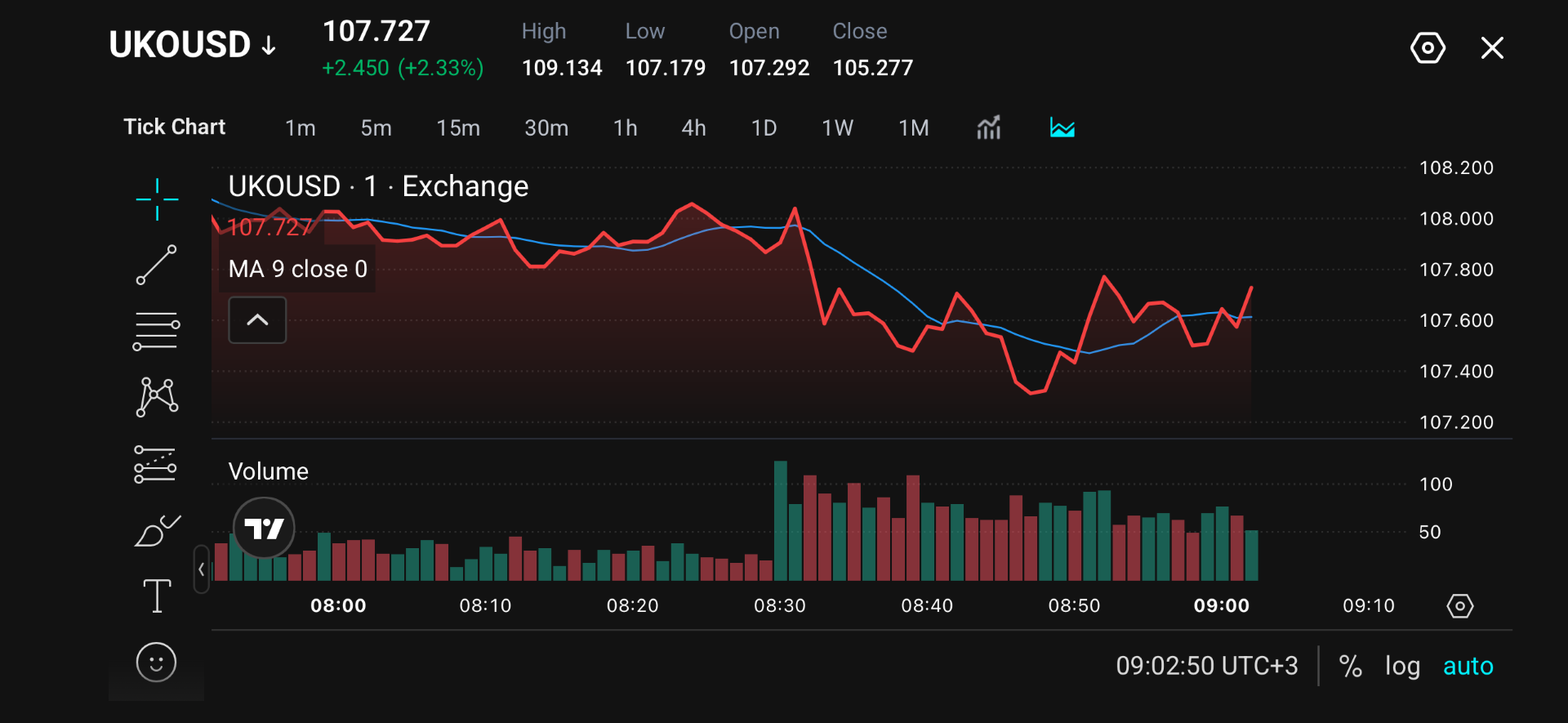
UKOUSD held close to the 108.00 level before falling sharply towards 107.30. Buyers then stepped back in, lifting UKOUSD towards 107.70.
Traders are reacting to rapidly changing geopolitical headlines and closely following markets for clues on market direction.
Why Traders Are Watching
The latest pressure centres on Saudi Arabia’s East-West pipeline, a key route used to move crude from the country’s eastern production areas to the Red Sea port of Yanbu.
The pipeline was shut after drone attacks and normally transports about 4 million barrels per day. If the disruption continues, the outage could remove supply equivalent to roughly 4% of global oil consumption.
This disruption will affect oil supply and pressure inflation.
Higher crude prices can gradually raise fuel, transport and production costs. Businesses may absorb some of those costs, but prolonged increases are likely to affect consumer prices.
This also creates complications for the Federal Reserve.
US inflation is already running above its 2% target, and higher energy prices could make inflation more persistent. Experts now expect a 25-basis-point Fed rate increase at the September meeting, with market expectations for a hike recently reaching around 87%.
Key Trading Levels
| Level | Technical Significance |
| 109.13 | Session high and major immediate resistance |
| 108.2 | Upper intraday resistance zone |
| 108 | Psychological resistance and earlier consolidation area |
| 107.8 | Near-term resistance |
| 107.6 | Short-term pivot around the 9-period moving average |
| 107.4 | Initial intraday support |
| 107.2 | Key chart support near the session low zone |
| $105.00 | Broader support after the latest breakout |
| $100.00 | Major psychological and medium-term trend level |
The 107.60 area is the immediate intraday pivot. Price has repeatedly crossed this zone, while the 9-period moving average has begun flattening nearby.
A break above 107.80 could put 108.00 to 108.20 back in focus. Beyond that, traders may look towards the session high around 109.13.
On the downside, failure to hold 107.60 could return attention to 107.40 and 107.20.
The broader picture remains centered on $100. Sustained trading above this level would keep crude within the elevated price due to the latest supply disruptions.
Bullish and Bearish Setups
| Scenario | Trigger | Levels to Watch |
| Bullish | UKOUSD holds above 107.60 and breaks 107.80 | 108.00 → 108.20 → 109.13 |
| Bearish | UKOUSD falls below 107.60 and breaks 107.40 | 107.20 → 105.00 |
| Broader bullish | Brent remains firmly above $100 | Supply-risk premium may remain supported |
| Broader bearish | Geopolitical tensions ease and supply routes reopen | $105 → $100 |
The bullish case would strengthen if the price holds above 107.60 and clears 107.80. A sustained move through 108.00 could expose 108.20, followed by the session high near 109.13.
The bearish scenario begins with a loss of 107.60. A break below 107.40 could put 107.20 under pressure. A deeper reversal would shift attention back towards the broader $105 region.
Disclaimer
The price levels and market scenarios above reflect the author’s assessment at the time of writing. They do not represent financial advice or an official recommendation from VT Markets. Traders should conduct their own analysis and manage risk carefully.
UKOUSD Prediction: What’s Next?
The short-term UKOUSD outlook remains bullish but highly headline-sensitive.
Price is holding above $105 despite sharp intraday pullbacks, while continuing disruptions to Saudi infrastructure and shipping routes provide fundamental support.
As long as Brent holds firmly above $100, traders may continue to price in a geopolitical and supply-risk premium.
Improvements in Middle East shipping conditions or restoration of Saudi pipeline flows could produce a sharper correction.
Trade UKOUSD with VT Markets
Oil markets can react quickly to geopolitical developments, inventory data, changes in global supply and shifts in monetary policy expectations.
With VT Markets, traders can access UKOUSD alongside a broad range of commodities, forex, indices, shares and other global markets through supported trading platforms.
Start trading energy CFDs with VT Markets.
Why Trade UKOUSD with VT Markets
VT Markets provides access to UKOUSD alongside tools designed to support both technical and fundamental market analysis.
Traders can monitor live price movements, apply technical indicators, review multiple timeframes and respond to changing oil-market conditions through platforms including MetaTrader and the VT Markets App.
FAQ
Why did Brent crude rise above $105?
Brent rose as renewed attacks on Saudi Arabia and incidents around major Middle Eastern shipping routes increased concerns about further oil supply disruptions.
Why is Saudi Arabia’s East-West pipeline important?
The pipeline transports roughly 4 million barrels of oil per day towards the Red Sea, allowing Saudi crude to bypass the Strait of Hormuz.
Why is the Strait of Hormuz important for oil prices?
The Strait of Hormuz is one of the world’s most important energy transit routes. Historically, around 20% of global crude oil and LNG shipments have passed through the strait, meaning disruption can quickly affect global supply expectations and prices.
Can higher oil prices affect Fed interest-rate decisions?
Yes. Sustained increases in oil and fuel costs can contribute to higher transport and production expenses, potentially adding to inflation. With US inflation already above target, persistent energy inflation could make it harder for the Fed to ease monetary policy. Markets are currently assigning a high probability to another rate increase.
What are the key UKOUSD levels to watch?
On the supplied chart, 107.60 is the immediate pivot. Resistance sits around 107.80, 108.00 and 108.20, followed by the session high at 109.13. Support appears around 107.40 and 107.20. From a broader perspective, $100 remains the major psychological level for the current bullish oil narrative.
Start trading now — click here to create your real VT Markets account.








