






Key Points
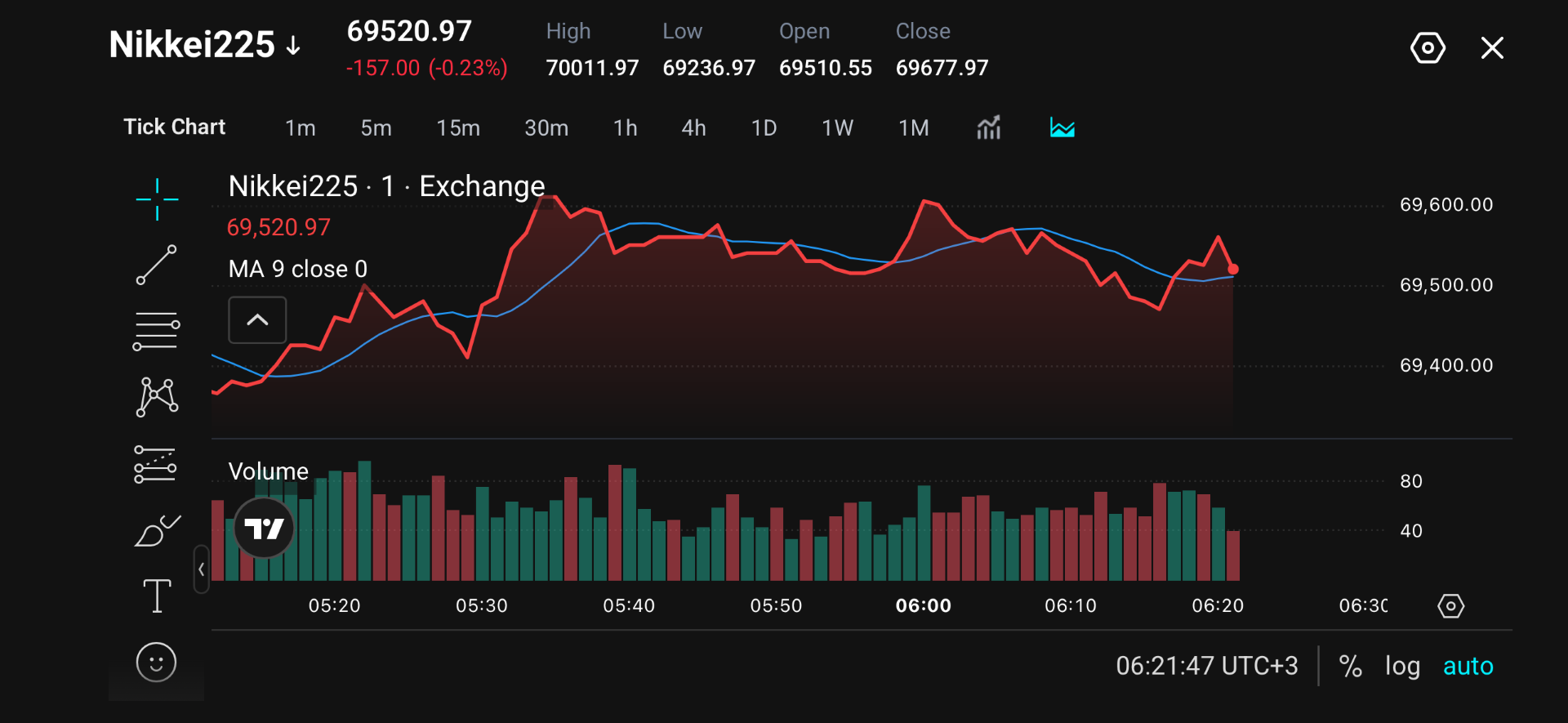
- Nikkei 225 trades near 69,520, down 0.23%, as the index struggles to regain momentum below 70,000.
- Oil prices and inflation risks weigh on sentiment, with Japan’s dependence on Middle Eastern energy imports increasing concerns over corporate earnings.
- The Bank of Japan’s uncertain interest rate path adds additional pressure to the index.
- High US Treasury yields and expectations of tighter Federal Reserve policy have contributed to a weaker global risk appetite.
- The 69,500 support level is in focus, while a recovery above 69,600 could help improve the short-term technical outlook.
Market Move
The Nikkei 225 has come under renewed selling pressure as investors reassess Japan’s economic outlook amid rising energy costs, tighter monetary conditions and geopolitical uncertainty. The index currently trades at around 69,520.97, down 157 points or 0.23%. The index experienced a session high of 70,011.97 and a low of 69,236.97. The Nikkei initially recovered from around 69,370, climbing towards 69,600 before losing momentum and failing to produce a sustained breakout.
The latest price action shows the index hovering just above 69,500, making this an important immediate support area. A move below it could expose the 69,450–69,400 region, while a recovery towards 69,600 would signal improving short-term sentiment.
Why Traders Are Watching
The latest pullback follows profit-taking across Japanese technology and semiconductor stocks. Advantest, Tokyo Electron and Kioxia were among the companies affected during Wednesday’s decline, as investors reduced exposure following an earlier rally.
Rising oil prices remain a major concern. Brent crude has traded above $100 per barrel amid continued Middle East supply disruptions. Japan imports approximately 94% of its crude oil from the Middle East, leaving domestic businesses exposed to changes in energy prices. Higher costs could squeeze profit margins, particularly among manufacturers, airlines and transport companies.
The Bank of Japan’s uncertain interest rate path adds additional pressure. Tokyo’s core consumer inflation accelerated to 2.7% in September, strengthening expectations that the Bank of Japan could hike interest rates. Higher borrowing costs may reduce business investment and place additional pressure on equity valuations. Meanwhile, elevated US Treasury yields and expectations of tighter Federal Reserve policy have contributed to a weaker global risk appetite.
Key Trading Levels
| Level | Area | Technical significance |
| 69,600 | Immediate resistance | Area of repeated intraday highs and failed upward moves |
| 69,550 | Near-term resistance | Recent rebound area where upward momentum has weakened |
| 69,500 | Immediate support | Psychological level and recent price consolidation area |
| 69,450 | Secondary support | Area of previous intraday price reactions |
| 69,400 | Lower support | Earlier recovery zone and important round-number level |
The Nikkei 225 is currently trading close to 69,520, placing it between immediate support at 69,500 and resistance around 69,550. The 9-period moving average has flattened following an earlier upward movement, suggesting that bullish momentum is fading.
A sustained break above 69,550 could open the way for another test of 69,600. However, if 69,500 fails to hold, the index may retreat towards 69,450 and subsequently 69,400.
Bullish and Bearish Setups
| Scenario | Trigger | Potential price movement |
| Bullish breakout | Break and hold above 69,550 | Could encourage a move towards 69,600 if buying momentum improves |
| Bullish recovery | Rebound from 69,500 | Buyers may attempt to reclaim 69,550 while defending immediate support |
| Bearish breakdown | Sustained move below 69,500 | Could expose 69,450, followed by 69,400 |
| Extended selling | Break below 69,400 | May increase downside pressure towards the visible low near 69,370 |
A bullish scenario would require buyers to defend 69,500 and push the index decisively above immediate resistance. Stronger buying volume would provide additional confirmation. Conversely, a breakdown below 69,500, especially alongside increasing selling activity, could signal that sellers are regaining control.
Disclaimer
The price levels and market scenarios above reflect the author’s assessment at the time of writing. They do not represent financial advice or an official recommendation from VT Markets. Traders should conduct their own analysis and manage risk carefully.
Nikkei 225 Prediction: Major Drivers?
The Nikkei 225 could face additional downside pressure if Middle East tensions intensify and crude oil prices continue rising. Higher energy costs would increase operating expenses for Japanese companies and could weaken expectations for corporate earnings. Further interest rate increases by the Bank of Japan could also weigh on sentiment. Persistent inflation, combined with higher borrowing costs, may discourage investment and put pressure on equities.
On the flip side, the Nikkei could recover if oil prices retreat or inflation stabilises. A more gradual approach to monetary tightening by the Bank of Japan could also support investor confidence. Renewed demand for technology and semiconductor shares could provide another source of support. Strong corporate earnings or a broader recovery in global equities could encourage investors to return to Japanese stocks.
Trade Nikkei 225 with VT Markets
Traders looking to follow movements in Japan’s equity market can access Nikkei 225 index CFDs through VT Markets.
Trading index CFDs allows traders to take positions on both rising and falling market prices without owning the underlying shares. Through the VT Markets trading platforms, traders can monitor market movements, apply technical indicators and manage their positions using risk management tools.
Start a live trading account today and explore Forex pairs, gold and more.
FAQ
Why is the Nikkei 225 falling?
The Nikkei 225 is facing pressure from rising oil prices, concerns over Japanese and US interest rates, and profit-taking in major technology and semiconductor stocks. Geopolitical uncertainty has also weakened global investor sentiment.
Can the Nikkei 225 recover above 70,000?
A recovery above 70,000 remains possible if oil prices stabilise, interest rate concerns ease and demand for Japanese equities improves. However, the index would first need to overcome nearer resistance levels, including 69,550 and 69,600.
How do oil prices affect the Nikkei 225?
Japan depends heavily on imported energy. Rising oil prices can increase production and transportation costs, reduce corporate profit margins and contribute to inflation. These pressures can weaken sentiment towards Japanese equities, although energy-related companies may benefit.
How does the Bank of Japan affect Nikkei 225?
The Bank of Japan influences equity markets through interest rate decisions and monetary policy guidance. Higher interest rates may increase financing costs and weigh on valuations, while a less restrictive policy outlook could support share prices.
Should I trade the Nikkei 225 now?
That depends on your strategy, risk tolerance and trading timeframe. Traders may watch for a confirmed breakout or breakdown rather than relying on a single short-term price movement.
Start trading now — click here to create your real VT Markets account.








