





Key Points
- Gold fell below $4,100 as renewed US-Iran strikes lifted oil prices and revived inflation concerns.
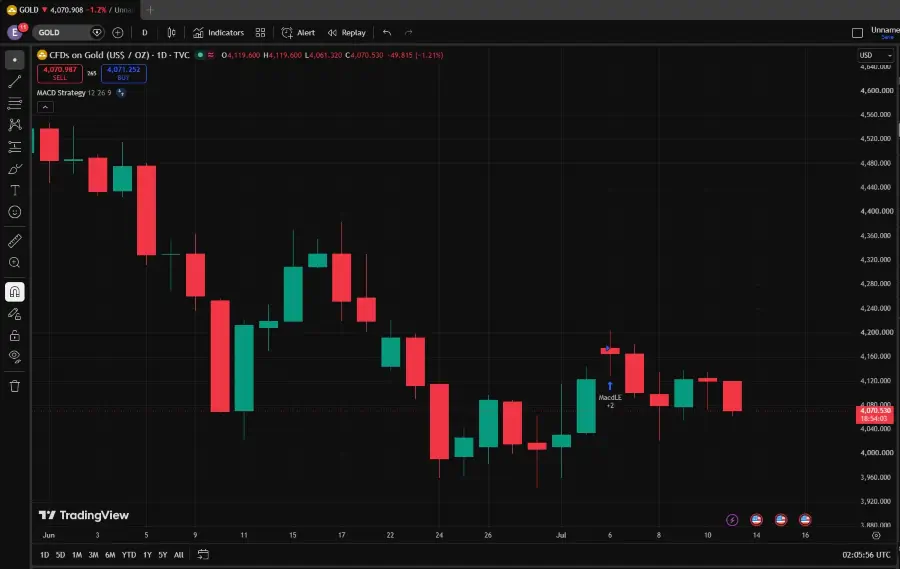
- XAUUSD traded near $4,070 on the daily chart, down around 1.2% during the session.
- Higher oil prices supported the US dollar, Treasury yields and expectations of tighter Federal Reserve policy.
- The Strait of Hormuz remains in focus because shipping disruption could add pressure to energy prices.
- The XAUUSD daily chart places immediate resistance near $4,120, while $4,060 is the first support level to monitor.
Gold fell below $4,100 per ounce on Monday as renewed military exchanges between the United States and Iran pushed oil prices higher and revived concerns about inflation.
XAUUSD traded near $4,070 on the supplied daily chart, down around 1.2% during the session. The move placed gold back under pressure after the metal failed to hold above the $4,100 area.
The decline shows that geopolitical tension does not always support gold immediately. In the latest session, traders appeared more focused on how higher oil prices could affect inflation and Federal Reserve policy.
As oil rallied, the US dollar and Treasury yields also strengthened. That created pressure on non-yielding gold, even as broader geopolitical uncertainty remained elevated.
Why Traders Are Watching Gold
Gold is currently caught between two competing market forces.
Escalating geopolitical risks can increase interest in gold as a defensive asset. However, the same conflict is also lifting oil prices and adding to inflation concerns.
Higher inflation expectations can encourage central banks to keep policy restrictive or consider additional rate increases. This tends to support bond yields and the US dollar, while increasing the relative cost of holding non-yielding gold.
For XAUUSD traders, the key issue is not only whether geopolitical tension increases. The way that tension affects oil, inflation expectations, yields and the US dollar may be more important for gold’s immediate direction.
Inflation Risks Return to Focus
Inflation is back in focus after the latest rise in oil prices.
The Federal Reserve’s latest monetary policy update showed that inflation had moved higher during recent months, with price pressures affected by tariffs, war-related energy costs and strong demand linked to artificial intelligence investment.
That backdrop helps explain why the latest oil rally placed pressure on gold instead of producing a straightforward safe-haven move.
A sustained energy shock could keep inflation expectations elevated and reduce the scope for easier monetary policy. That matters for gold because the metal does not provide an interest yield.
If markets continue to price a firmer Federal Reserve stance, gold may remain sensitive to movements in the US dollar and Treasury yields.
Strait of Hormuz Risks Add Market Uncertainty
The latest pressure on gold also reflects uncertainty around the Strait of Hormuz.
The US and Iran exchanged fresh strikes over the weekend, while Tehran again claimed that the Strait of Hormuz would be closed. The waterway remains one of the world’s most important energy shipping routes, so any disruption can quickly affect oil prices and inflation expectations.
For gold, the impact is mixed. A wider conflict may support defensive demand, but if the first market reaction is higher oil, stronger inflation expectations and rising yields, bullion can still come under pressure.
This makes verified shipping activity important. Traders will be watching whether actual flows through the strait remain stable or whether disruption risks begin to affect the physical energy market more directly.
Key Trading Levels
| Price Level | What Traders Are Watching |
| $4,200 | Wider recovery level if bullish momentum improves |
| $4,160 | Secondary resistance above the current range |
| $4,120 | Immediate resistance near the latest session high |
| $4,100 | Key short-term reference after the latest breakdown |
| $4,070 | Current chart area |
| $4,060 | Immediate support near the latest session low |
| $4,040 | Short-term support if selling continues |
| $4,000 | Main psychological support |
| $3,960 | Deeper downside reference |
The XAUUSD daily chart shows gold trading near $4,070 after opening around $4,119.60. The latest session high stood near $4,119.60, while the low was approximately $4,061.32.
The move below $4,100 keeps the short-term structure under pressure. This level is now the key reference point for traders watching whether gold can stabilise or remain vulnerable to further selling.
Immediate resistance is located near $4,120, which aligns with the latest session high. A sustained recovery above this level could bring $4,160 into focus.
A stronger move above $4,160 would shift attention towards the wider recovery area near $4,200.
On the downside, $4,060 is the first support level to monitor. A break below this area could expose $4,040.
Bullish and Bearish Scenarios
| Setup | Trigger | Potential Market Reaction |
| Recovery Attempt | Reclaim $4,100 | Gold may retest $4,120 |
| Bullish Continuation | Break above $4,120 | Momentum may extend towards $4,160 |
| Stronger Recovery | Move above $4,160 | The $4,200 area may return into focus |
| Support Hold | Remain above $4,060 | Near-term consolidation may remain intact |
| Momentum Loss | Fall below $4,060 | Gold may retest $4,040 |
| Bearish Extension | Break below $4,040 | Selling pressure may extend towards $4,000 |
| Deeper Pullback | Move below $4,000 | The $3,960 area may come into focus |
The bullish scenario depends on gold reclaiming $4,100 and holding above that level. This would suggest that selling pressure is starting to stabilise after the latest decline.
A confirmed break above $4,120 would improve the recovery setup and bring $4,160 into focus. If buyers clear that area, gold may attempt to recover towards $4,200.
The neutral scenario is consolidation above $4,060 but below $4,100. This would suggest that traders are waiting for clearer signals from oil prices, US yields, the dollar and inflation data.
The bearish scenario strengthens if gold falls below $4,060. A confirmed break could expose $4,040, followed by the psychological $4,000 area.
Disclaimer
The price levels and market scenarios above reflect the author’s view at the time of writing and do not represent financial advice or an official recommendation from VT Markets. Traders should conduct their own analysis and manage risk carefully.
Trade XAUUSD CFDs with VT Markets
XAUUSD remains active when interest-rate expectations, US dollar movement, inflation risks and geopolitical uncertainty shift at the same time.
With VT Markets, traders can access XAUUSD CFDs alongside oil, silver, forex, indices, shares, ETFs and other global CFD markets from one platform. This helps traders follow gold while also monitoring related moves in energy prices, Treasury yields and broader market sentiment.
Use VT Markets’ charting tools to monitor support, resistance, moving averages and breakout behaviour as the next XAUUSD setup develops.
Start trading gold CFDs with VT Markets today.
What to Watch Next
US inflation data will be a major focus this week. An upside surprise could strengthen expectations of tighter Federal Reserve policy, while a softer result may reduce some of the pressure on gold.
Federal Reserve Chair Kevin Warsh is also scheduled to appear before Congress on Tuesday. Traders will be listening for comments on inflation, energy prices and the conditions required for future policy changes.
Developments in the Strait of Hormuz remain important. Political statements may move markets quickly, but verified shipping activity could provide a clearer indication of the actual level of disruption.
For gold traders, the main indicators to monitor are:
- Brent and WTI crude prices
- US Treasury yields
- The US Dollar Index
- US CPI and producer inflation data
- Federal Reserve policy commentary
- Verified shipping activity through the Strait of Hormuz
For now, $4,060 to $4,100 is the main short-term range. A confirmed move above $4,100 could bring $4,120 into focus, while a break below $4,060 may expose $4,040.
Frequently Asked Questions
Why did gold fall despite renewed geopolitical tension?
Gold fell because the market focused on the inflationary impact of higher oil prices. Rising inflation concerns supported the dollar, Treasury yields and expectations of tighter Federal Reserve policy, outweighing immediate safe-haven demand.
Why do higher oil prices matter for XAUUSD?
Higher oil prices can increase transport, production and consumer energy costs. If markets expect these effects to raise inflation, interest-rate expectations and bond yields may rise. This can reduce the relative appeal of non-yielding gold.
Is $4,100 an important level for gold?
Yes. The $4,100 level is an important short-term reference because gold moved below it during Monday’s decline. A recovery above the level could indicate stabilisation, while continued trading below it would suggest that immediate selling pressure remains present.
What could help gold recover?
Gold may recover if oil prices retreat, US inflation data softens, Treasury yields fall, the dollar weakens or defensive demand strengthens. These are market scenarios rather than guaranteed outcomes.
What are the main risks for XAUUSD this week?
The main risks are unexpected US inflation readings, changes in Federal Reserve rate expectations, sharp oil-price moves and further developments affecting Strait of Hormuz shipping. These factors could produce rapid moves in either direction.
Start trading now — click here to create your real VT Markets account.








