






Global financial markets are heading into Friday’s US Non-Farm Payrolls (NFP) report following a sharp sell-off on Wall Street, leaving investors questioning whether the latest market downturn could extend further.
On 5 November, the S&P 500 plunged approximately 4.4%, while the technology-heavy Nasdaq dropped 5.5%, as concerns over artificial intelligence investments, valuations and political uncertainty triggered widespread selling.
Gold, meanwhile, has staged a recovery. After falling to a one-year low near $3,870 last Friday, the precious metal has rebounded approximately 6% to trade around $4,130, its highest level since 22 October.
With the October NFP report approaching, traders are now watching whether employment data could extend gold’s recovery or trigger another reversal.
Why Are Markets Falling Ahead of NFP?
The recent weakness in US equities reflects growing concerns surrounding technology valuations, particularly among companies linked to artificial intelligence, alongside uncertainty over interest rates and the broader economic outlook.
As investors reduce exposure to riskier assets, movements in Treasury yields and the US dollar have become increasingly important for understanding how other markets, including gold, may respond.
Although gold is often regarded as a safe-haven asset, a stock market sell-off does not automatically translate into higher gold prices. During periods of heightened volatility, investors may also liquidate gold positions to raise cash or meet margin requirements, while a stronger US dollar and rising Treasury yields can limit demand for the precious metal.
This relationship helps explain why gold can experience both sharp declines and recoveries during periods of market uncertainty. Its recent rebound has been supported not only by improving safe-haven demand but also by changes in the interest rate and inflation outlook.
As explored in why the US Dollar Index (DXY) rises during uncertain markets, periods of heightened risk aversion can also strengthen the dollar, potentially creating competing forces for gold prices.
November 2026 NFP Forecast: What Are Markets Expecting?
The October US employment report is scheduled for Friday, 6 November 2026, at 8:30 AM Eastern Time.
According to the forecasts in the analyst’s preview, the US economy is expected to have added approximately 65,000 jobs in October, improving from September’s disappointing 29,000 reading. Meanwhile, the unemployment rate is forecast to remain unchanged at 4.2%, with average hourly earnings expected to increase by 0.3% month-on-month, compared with 0.1% previously.
| Economic indicator | Previous | Forecast |
| Non-Farm Payrolls | 29,000 | 65,000 |
| Unemployment rate | 4.20% | 4.20% |
| Average hourly earnings (MoM) | 0.10% | 0.30% |
The relatively modest payroll forecast suggests that employment growth remains subdued, although recent economic indicators have provided some evidence of resilience.
ADP private employment data showed approximately 86,000 additional jobs, exceeding expectations, while relatively low layoffs suggest that labour market conditions may not be deteriorating as quickly as September’s employment figures implied.
However, the headline payroll figure will not be the only consideration for investors. Wage growth, unemployment and revisions to previous employment data could collectively influence expectations surrounding inflation and Federal Reserve monetary policy.
For example, stronger employment growth accompanied by accelerating wages could reinforce expectations that interest rates will remain elevated, while weaker hiring and slower wage growth may support a less restrictive policy outlook.
How Do NFP and Interest Rates Affect Gold Prices?
Gold prices are closely influenced by expectations surrounding US interest rates because the precious metal does not generate interest income. When Treasury yields rise, the opportunity cost of holding gold generally increases, which can reduce its relative appeal compared with interest-bearing assets.
The relationship between US Treasury yields and gold prices is particularly important when assessing real interest rates, which account for inflation expectations and can provide additional insight into gold’s performance.
The Federal Reserve currently holds its benchmark interest rate within the 3.75%–4.00% range, with the next policy meeting scheduled for 8–9 December.
Against this backdrop, Friday’s employment figures could influence expectations for the December decision, particularly if the results differ significantly from market forecasts. Understanding how interest rate expectations influence financial markets can provide additional context for interpreting gold’s reaction to economic data.
Nevertheless, the relationship between employment data and gold prices is not always immediate or consistent. During periods of economic uncertainty, safe-haven demand may offset pressure from higher yields, while weaker employment figures could also raise concerns about growth and financial market stability.
Consequently, traders may find it useful to monitor the combined movements of gold, the US Dollar Index and Treasury yields following the release rather than assessing the headline NFP figure in isolation.
Why Has Gold Rebounded Despite the Market Sell-Off?
Gold’s recent recovery has coincided with several developments that have improved the environment for precious metals.
The US Dollar Index weakened towards a one-month low near 101, while the benchmark 10-year Treasury yield eased towards 4.9%. Both movements have helped reduce some of the pressure that previously weighed on gold prices.
Meanwhile, declining oil prices, supported by hopes of progress in US-Iran diplomatic negotiations, have contributed to easing inflation concerns. Lower energy prices can reduce expectations for additional monetary tightening, indirectly supporting non-interest-bearing assets such as gold.
However, gold’s relationship with inflation is more complex than a simple rise or fall in consumer prices. As discussed in whether gold is an effective inflation hedge, its performance can also depend on real interest rates, monetary policy and broader market conditions.
These developments have helped gold recover from the $3,820–$3,870 demand zone, although the rebound has not yet produced a convincing reversal of the broader technical downtrend.
The sustainability of the recovery will therefore depend partly on whether the current environment of softer yields and a weaker dollar continues after the NFP release.
Three Possible Gold Price Scenarios Following NFP
The market reaction to Friday’s employment report will largely depend on how the actual figures compare with expectations, alongside wage growth and unemployment data. Considering multiple outcomes is particularly useful during major economic releases, as scenario analysis in CFD trading helps traders evaluate different market conditions rather than relying on a single forecast.
- Stronger NFP: Renewed Pressure on Gold
A payroll reading above 100,000 jobs, particularly alongside wage growth of 0.3% or higher, could strengthen expectations for tighter monetary policy and encourage a recovery in the US dollar and Treasury yields.
Under these conditions, gold may struggle to maintain its recent gains, with a reversal potentially exposing lower support levels. If selling pressure intensifies, the $3,820–$3,870 demand zone could return as an important area of interest.
- NFP Meets Expectations: Gold Could Consolidate
If employment growth falls within the expected range of approximately 50,000–70,000 jobs, the immediate market reaction may be relatively contained, particularly if unemployment and wage growth remain broadly consistent with forecasts.
In this scenario, revisions to September’s payroll figures could become particularly relevant, while gold may continue consolidating below the $4,220 resistance level as traders assess the broader implications for monetary policy.
- Weaker NFP: Potential Support for Gold’s Recovery
A payroll reading below 30,000 jobs or an unemployment rate rising above 4.3% could reinforce concerns about weakening labour market conditions, potentially reducing expectations for additional monetary tightening.
If accompanied by declining Treasury yields and a weaker dollar, such an outcome could support gold’s recovery towards $4,220.
A sustained move above this resistance level would bring $4,380 into focus, although the broader trend would still require further technical confirmation.
Gold Price Forecast: Key XAUUSD Levels to Watch
From a technical perspective, gold’s recovery from the $3,820–$3,870 demand zone has improved short-term momentum, but prices remain below several important resistance levels.
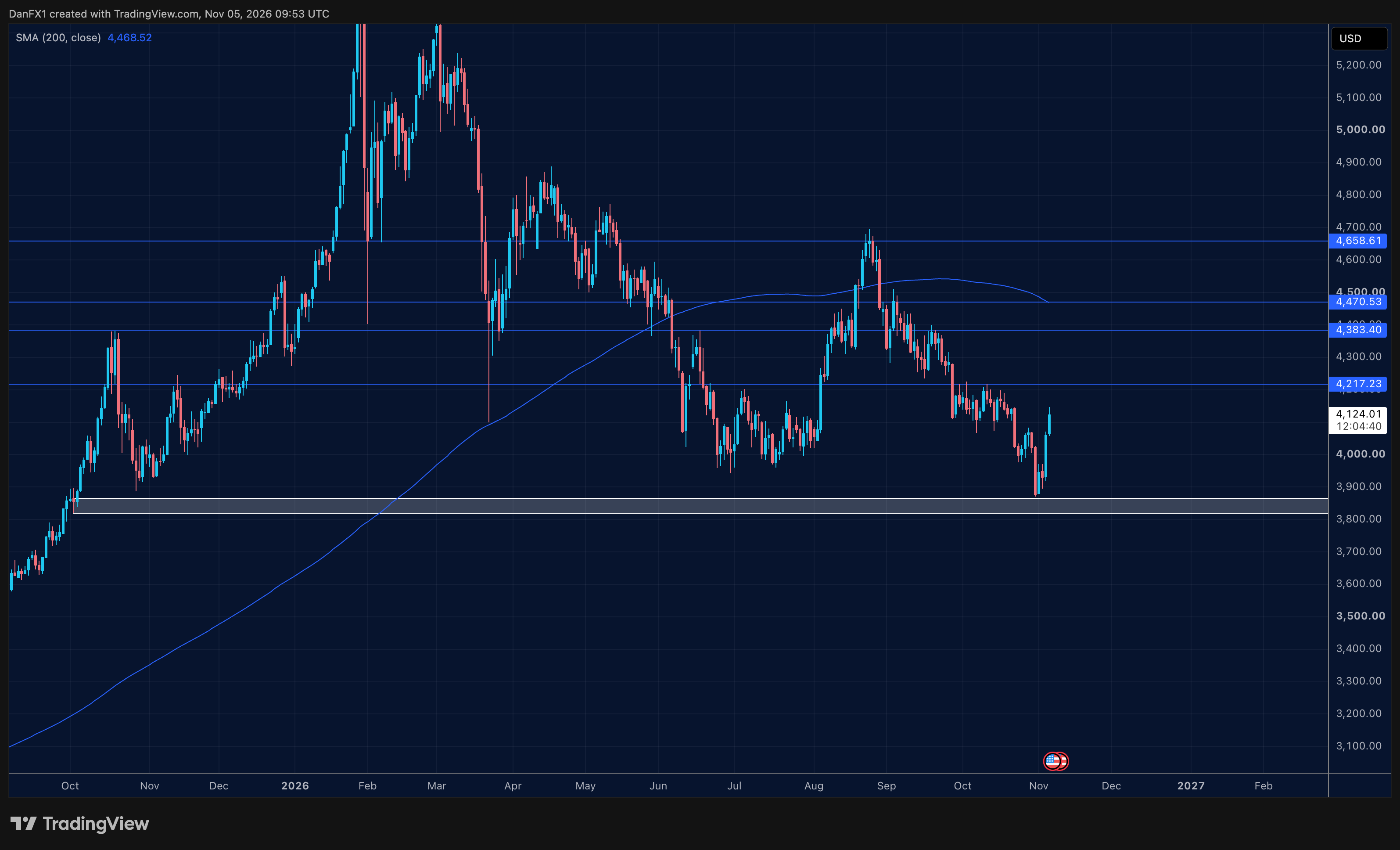
| Gold price level | Technical significance |
| $3,820–$3,870 | Major demand zone and recent support |
| $4,220 | Immediate resistance and October price ceiling |
| $4,380 | Next upside resistance |
| $4,470 | Resistance near the daily 200-period SMA |
| $4,660 | Higher resistance near the August high |
The $4,220 region represents the first significant obstacle for the current rebound, having previously limited upside movements during October. A sustained break above this area could encourage further buying interest towards $4,380.
Beyond that, the daily 200-period simple moving average sits near $4,470, making it an important technical reference for assessing whether the broader downward trend is beginning to weaken.
Conversely, an unsuccessful attempt to break above $4,220 could leave gold vulnerable to renewed selling pressure, particularly if the NFP report strengthens the US dollar and Treasury yields.
Until gold establishes a more convincing move above $4,220 and subsequently $4,380, the current recovery remains a rebound within a broader downtrend rather than a confirmed bullish reversal.
What Should Gold Traders Monitor After NFP?
While the headline employment figure will attract the most immediate attention, the broader market reaction may provide more useful information about the direction of gold prices.
Changes in average hourly earnings and revisions to September’s employment figures could influence how investors interpret the strength of the US economy. Movements in the US dollar and Treasury yields will also help indicate whether the report is reinforcing or challenging existing monetary policy expectations.
Traders assessing market movements around major economic announcements may also benefit from understanding how to trade around news releases, particularly as rapid price changes and widening spreads can increase execution risks.
Given the potential for sharp price fluctuations, maintaining appropriate position sizes and applying risk management principles remain important considerations when navigating volatile market conditions.
Beyond NFP, oil price developments and progress in US-Iran negotiations remain relevant because of their potential impact on inflation, while the Federal Reserve’s December meeting represents another important event for the gold market.
With gold trading around $4,130 following a significant recovery and US equities experiencing renewed volatility, Friday’s employment report could influence whether XAUUSD advances towards $4,220 and $4,380 or retreats towards its previous demand zone.
Understanding how employment data influences interest rate expectations, currency movements and gold prices can help traders evaluate the market’s response more effectively, particularly when volatility is elevated.
Frequently Asked Questions (FAQ)
- How does NFP affect gold prices?
The Non-Farm Payrolls (NFP) report influences gold prices by shaping expectations for US interest rates and Federal Reserve monetary policy. Stronger-than-expected employment data can support the US dollar and Treasury yields, potentially weighing on gold. Weaker employment figures may have the opposite effect, although market reactions also depend on wage growth and unemployment data.
- Why does gold sometimes rise during a stock market crash?
Gold is often considered a safe-haven asset, attracting demand when investors become concerned about economic uncertainty or financial market volatility. However, gold does not always rise during a stock market crash, as investors may sell their holdings to raise cash, while a stronger US dollar or higher Treasury yields can also pressure prices.
- What is the November 2026 NFP forecast?
According to the analyst’s pre-release forecast, the US economy is expected to add approximately 65,000 jobs in October, compared with 29,000 in September. The unemployment rate is forecast to remain at 4.2%, while average hourly earnings are expected to increase by 0.3% month-on-month.
- What are the key gold price levels to watch ahead of NFP?
Gold’s immediate resistance is around $4,220, followed by $4,380 and $4,470, where the daily 200-period simple moving average is located. On the downside, the $3,820–$3,870 region represents an important demand zone. These levels can help traders assess potential price reactions following the employment report.
- Can weaker NFP data push gold prices higher?
Weaker-than-expected NFP data could support gold if it reduces expectations for further Federal Reserve interest rate increases, leading to lower Treasury yields and a weaker US dollar. However, the direction of gold prices will also depend on other economic indicators, market sentiment and the broader monetary policy outlook.
Start trading now — click here to create your real VT Markets account.



