






Key Points
- Gold (XAU/USD) remains under pressure after breaking below the $4,300 level, with higher Treasury yields and a stronger US dollar weighing on prices.
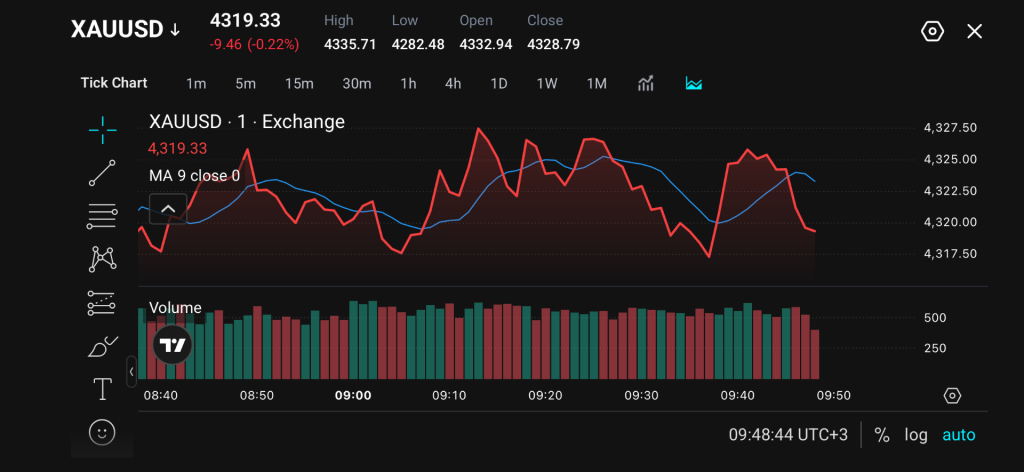
- XAU/USD is trading near the $4,319 area after recovering from the session low around $4,282.48
- Rising bond yields have increased the opportunity cost of holding gold, limiting demand for the non-yielding asset.
- Geopolitical tensions and higher oil prices continue to fuel inflation concerns, adding uncertainty to the Federal Reserve policy outlook.
- Traders are watching whether gold can stabilise above key support areas or extend its recent decline.
Market Move
Gold prices remained under pressure as investors weighed geopolitical risks against rising interest-rate expectations.
XAU/USD traded near the $4,319 area after moving between the session high of $4,335.71 and low of $4,282.48.
Although geopolitical tensions typically support demand for gold, the recent move has been dominated by higher Treasury yields and a stronger US dollar. Rising yields increase the opportunity cost of holding non-yielding assets, while a stronger dollar can reduce demand from overseas buyers.
The latest decline reflects a shift in market focus towards inflation risks, bond market movements and expectations for Federal Reserve policy.
Why Traders Are Watching
The recent rise in Treasury yields has created additional pressure on gold, as higher yields increase the attractiveness of income-generating assets.
At the same time, renewed geopolitical tensions and higher oil prices continue to create inflation concerns, which may influence expectations surrounding Federal Reserve policy.
The market is now watching whether inflation risks from energy prices will outweigh demand for gold.
Traders are also monitoring:
- US Treasury yields: Further increases could continue weighing on gold prices.
- US dollar strength: Continued dollar gains may create additional pressure on XAU/USD.
- Federal Reserve expectations: Upcoming economic data could influence the rate outlook.
- Geopolitical developments: Rising tensions may provide support for gold, but higher yields could offset safe-haven demand.
Key Trading Levels
| Price Level | What Traders Are Watching |
| 4,335.71 | Session high and immediate resistance area |
| 4,325.00 | Near-term recovery level after recent decline |
| 4,319.33 | Current trading area and near-term reference |
| 4,300.00 | Psychological support level |
| 4,282.48 | Session low and immediate downside support |
Gold is trading around the 4,319.33 area after recovering from the session low near 4,282.48 while remaining below the recent recovery zone.
A move above 4,325.00 could indicate improving short-term momentum, with a break above 4,335.71 suggesting stronger buying interest.
On the downside, a break below 4,300.00 could increase selling pressure and expose the 4,282.48 support area.
Bullish and Bearish Setups
| Setup | Trigger | Potential Market Reaction |
| Recovery Attempt | Hold above 4,300 | Gold may retest 4,325–4,335 resistance zone |
| Bullish Breakout | Break above 4,335.71 | Momentum could strengthen towards higher levels |
| Range Consolidation | Hold between 4,300 and 4,335.71 | Gold may consolidate |
| Bearish Breakdown | Fall below 4,300 | Selling pressure could increase towards 4,282 and lower support |
The bullish scenario relies on gold maintaining support above 4,300 and recovering towards the 4,325–4,335 resistance zone. A sustained break above 4,335.71 could indicate improving short-term momentum.
The bearish scenario becomes more crucial if gold falls below 4,300, which could signal a continued decline and increase the risk of further downside towards 4,282.48.
Disclaimer
The price levels and market scenarios above reflect the author’s assessment at the time of writing. They do not represent financial advice or an official recommendation from VT Markets. Traders should conduct their own analysis and manage risk carefully.
Trade Gold with VT Markets
Gold remains one of the most closely watched commodities, with price movements influenced by inflation expectations, interest-rate outlooks, currency movements and global market developments.
With VT Markets, traders can access gold markets alongside forex, indices, shares, commodities and other financial instruments through one platform.
Trade gold with VT Markets to monitor market movements, analyse price trends and respond to changing market conditions.
Start trading gold with VT Markets.
Why Trade Gold with VT Markets?
Gold trading provides exposure to one of the world’s most actively followed precious metals, allowing traders to respond to shifts in inflation, interest rates, currency strength and geopolitical developments.
With VT Markets, traders can access advanced charting tools, market insights and flexible trading platforms to analyse gold price movements and identify potential market opportunities.
Whether monitoring short-term volatility or longer-term market trends, traders can use VT Markets’ tools and resources to stay connected to analyse opportunities across global markets.
What to Watch Next
Gold’s next move will depend on how markets balance higher yields, dollar strength and ongoing demand for defensive assets.
Key factors include:
- US economic data: Upcoming employment and inflation rates may affect Federal Reserve policy expectations.
- Treasury yields: Further increases in bond yields could continue weighing on gold prices.
- US dollar movement: Continued dollar strength could create additional headwinds for XAU/USD.
- Geopolitical risks: Escalating tensions may support gold demand, although higher yields remain a key counterforce.
From a technical perspective, traders are looking at whether XAU/USD can reclaim the 4,325–4,335 resistance zone, while 4,300 remains the key short-term support level.
FAQ
Why is gold falling despite ongoing geopolitical tensions?
Gold has faced pressure because rising Treasury yields and a stronger US dollar have reduced demand for non-yielding assets. While geopolitical risks typically support gold, higher interest-rate expectations have become the dominant market driver.
How do Treasury yields affect gold prices?
Higher Treasury yields can weigh on gold because the metal does not generate interest income. When bond yields rise, investors may shift towards yield-generating assets, reducing demand for gold.
Could gold recover if the Federal Reserve becomes less aggressive?
A softer Federal Reserve outlook could support gold by lowering yield expectations and reducing pressure from the US dollar. Traders are watching upcoming economic data for signals on future policy direction.
Can gold be traded as a CFD?
Yes. Gold CFDs allow traders to speculate on gold price movements without owning physical gold. CFDs provide flexibility to take positions in both rising and falling markets, with appropriate risk management.
Start trading now — click here to create your real VT Markets account.








