





On 12 June 2026, SpaceX dominated financial news headlines on account of two records: the biggest-ever stock market debut in the global markets and the rise of the world’s first trillionaire. Elon Musk’s net worth, at a tune of $1.1 trillion, has landed him with a personal wealth that matches the entire economic output of most countries.
The crowning of Musk as the world’s richest man followed closely behind the listing of SpaceX stock on Nasdaq with a value of $2.2 trillion.
As we have seen time and time again, people get excited about any company that bears Musk’s footprint. After almost two decades since SpaceX’s founding, retail investors can get their first real shot at owning the company behind Falcon rockets, Starlink internet, and recently, a fast-growing AI business.
This guide offers everything you need to know about SpaceX: what SpaceX actually does, the people running the company, how the IPO played out, drivers of its valuation, SpaceX stock performance, and key figures from its first earnings report.
What Is SpaceX? A Look At Its Portfolios
Ask a random person from the general populace, and you’ll probably get the answer “a rocket company”. While it isn’t a wrong answer, it echoes SpaceX’s early spirit when Elon Musk founded the company in 2002. SpaceX’s Falcon 1 embodies this spirit as it is SpaceX’s first liquid fuel rocket to successfully reach orbit.
Since then, SpaceX has dreamed of more than reaching for the stars. The company’s portfolio can best be described in three segments:
1. Connectivity
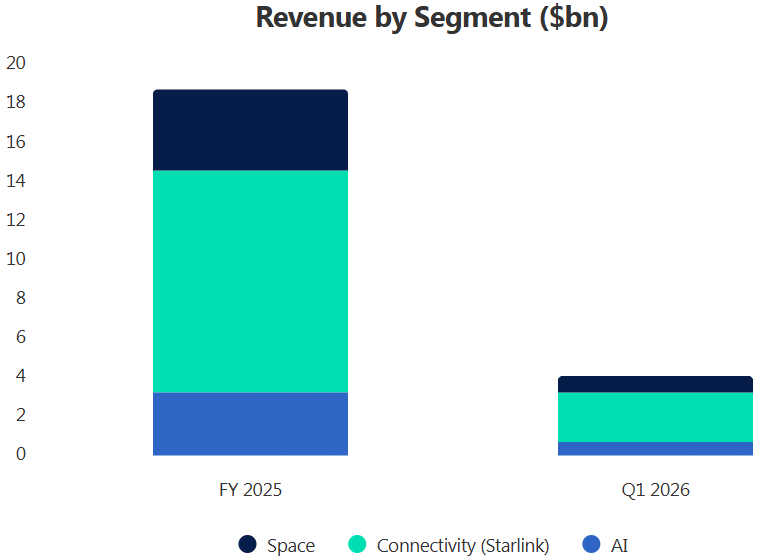
Starlink is a satellite internet network that beams broadband to homes, ships and remote regions. More than 9,500 satellites are orbiting the earth’s orbit to serve more than 9 million users globally. Starlink is the darling of the portfolio, contributing 61% to SpaceX’s revenue.
2. Artificial Intelligence
Starlink brings in profit, while the latest segment, AI, is a loss-making venture for SpaceX. Still, this area is a key propeller to guide SpaceX into the growing AI ecosystem. In February 2026, SpaceX acquired the AI company xAI along with the X platform. Integration was completed in May 2026, and Grok and X are now part of the SpaceXAI division.
3. Space Launch
Another SpaceX product that dominates the commercial launch niche is the Falcon. SpaceX has fundamentally transformed the cost of access to space with reusable launch rockets. There’s also Starship, SpaceX’s next-generation rocket system designed for deep-space missions, including future trips to the Moon and Mars. It’s not yet a meaningful revenue driver, but it’s central to the long-term growth story investors are pricing into the stock.
The People Behind SpaceX And Early Investors
Elon Musk, Founder And CEO
Musk remains the company’s largest shareholder and its controlling voice. Thanks to a dual-class share structure, he holds a minority of the economic stake in the company but a commanding majority of voting power. This structure gives him effective control over major decisions even as outside investors buy in.
Gwynne Shotwell, President And COO
Shotwell has run day-to-day operations at SpaceX for years and is widely credited with turning Musk’s ambitions into an operating business. She’s also one of the company’s largest individual shareholders, holding a meaningful stake in the higher-voting share class.
Initially hired to manage sales for SpaceX’s Falcon 1 rocket, Shotwell built a strong rapport with Musk. Over the years, this made her the public face of SpaceX. She steps in when Musk is busy with his other ventures.
Bret Johnsen, CFO
Johnsen’s financial leadership at SpaceX dates back to 2011. Before SpaceX, Johnsen served as VP at Broadcom and CFO at Mindspeed Technologies. Johnsen’s corporate finance experience caught Musk’s eye when he sought a tough lieutenant to lead SpaceX to its IPO.
Unlike Shotwell, Johnsen’s influence on SpaceX is confined behind the scenes, with fewer public appearances than Musk and Shotwell. Johnsen is a key figure in the space company’s merger with xAI and closing a landmark deal with Anthropic.
Antonio Gracias
Gracias is a former board member of Tesla and collaborated with Musk at DOGE. He’s the founder and CEO of Valor Equity Partners, which is one of the earliest institutional investors of SpaceX. Currently, Gracias and his VC firm are the second-largest SpaceX shareholder.
Apart from SpaceX and Tesla, Gracias serves on the boards of Neuralink and the Boring Co, further solidifying his reputation as one of Musk’s loyal allies.
Luke Nosek
Of all the members of the legendary “PayPal Mafia,” Nosek has remained closest to Musk. After co-founding Founders Fund with another PayPal Mafia member, Peter Thiel, Nosek wrote one of the earliest cheques for SpaceX when the firm was running privately.
Nosek left Founders Fund in 2017 to create his own venture fund, Gigafund, to back the “world’s most transformative companies.” The fund has since invested over $1 billion into SpaceX and several other Musk-founded companies like Neuralink and the Boring Company.
SpaceX’s Journey To Going Public
Why SpaceX Stayed Private For Over Two Decades
1. Long Horizons
A lot of what SpaceX was building demands conviction over a long-term timeframe. The idiom “it’s not like rocket science” stems from the challenging nature of aerospace engineering, especially when lower operating costs of rocket launches are a key selling point.
Rocket blows, you pick up the pieces, you try again, hoping the next launch won’t end up in flames. This is a brutal cycle that will make investors squirm if SpaceX were public from the beginning.
The same logic applies to Starship and to Starlink’s early years. Both demanded heavy, sustained R&D spending long before either generated meaningful revenue.
2. Boardroom Control
Then there’s the argument of governance. Without outside shareholders in the room, Musk kept a tight grip on decision-making and avoided the pressure that often pushes public companies toward safer, more incremental choices.
3. Inside Circle Funding
And finally, the funding. SpaceX fully depended on private sources to keep the business running.
VC firms like Gigafund and Valor shared Musk’s vision of affordable rocket launches and space exploration. They reflected this trust through large cheques well before an IPO was on the table. NASA contracts provided steady revenue. Starlink rose to become SpaceX’s cash cow in its own right.
Repeated launch failures, costly pivots, and long stretches with no clear payoff are easier to stomach when you’re not answerable to a market that punishes short-term stumbles.
At least that was the case until its ambitions outgrew its resources.
The Case For IPO
Here’s an important distinction: SpaceX didn’t need funding from the open market because it was on life support.
It went public because its next stage of growth required capital at scale following its acquisition of xAI in February 2026. The AI company is reportedly spending around $1 billion each month on computing infrastructure and model training.
That’s real bleeding pressure on SpaceX, and serious capital is needed to plug the wound.
The obvious solution? Listing on public markets.
Private capital carried SpaceX a long way. But funding Starship, expanding Starlink’s satellite constellation, and building out AI infrastructure all at once called for a drastic financial strategy. A public listing was the fastest, cleanest way to bring that much money in at once.
There was a liquidity angle too. Employees, early investors and long-time backers had a lot of paper wealth tied up in SpaceX shares with no easy way to cash any of it in. An IPO is the standard fix for that.
It creates an actual market where private shares can finally be bought and sold. That’s not a minor consideration for a company that had been private for over two decades, since a lot of early employees and investors had been waiting a very long time for some kind of exit.
SpaceX IPO: What Happened
IPO Pricing And Valuation At Listing
Stocks were priced at $135 each, raising roughly $75 billion and valuing SpaceX at about $1.77 trillion. It was the largest IPO ever completed, by a wide margin. The offering was underwritten by a syndicate of major banks, including Goldman Sachs, Morgan Stanley, BofA Securities, Citigroup and JPMorgan.
First-Day Trading And Market Reaction
Investor demand was intense right after Musk and Shotwell rang the opening bell from Texas and New York City. SpaceX stock jumped well past the IPO price the moment trading began on 12 June and closed its first session around $161.
Roughly 16 million stocks changed hands in post-market trading, adding to the 500-plus million stocks traded during the day. 12 June pushed SpaceX’s market cap past $2 trillion, briefly making it more valuable than Amazon and Microsoft combined.
It also made Musk, whose stake and voting control shot up in value overnight, the world’s first trillionaire, a milestone that stirred up about as much controversy as celebration.
What’s Driving SpaceX’s Valuation?
Investors aren’t paying for what SpaceX earns now. Instead, they’re paying for what it might become. Starlink’s growing subscriber base, SpaceX’s grip on commercial launches, and a fresh set of AI infrastructure contracts all feed the bullish story.
There’s also scarcity at play here. There are chances for investors to buy into a company this large and this early.
The Bull Case
The optimists point to Starlink as a genuinely profitable, fast-growing business in its own right, plus the strategic value of controlling both launch infrastructure and AI compute under one company. As space-based data centres and satellite broadband both scale, SpaceX is positioned to grow across several large markets at once instead of betting on just one.
The Bear Case
Despite billions in revenue, SpaceX was still operating at a loss the year before it was listed on Nasdaq. And just like any stocks that are recently listed, SPCX comes with early volatility and a thin trading history.
Then there’s the governance angle.
While traditional IPOs can gradually broaden corporate oversight, Musk will keep 85.1% of the combined voting power after the IPO. Besides Musk’s absolute control over the company’s direction, another interpretation of this framework is that Musk cannot be fired as the company’s CEO and chairman of the board.
That’s fairly standard for a founder-led tech IPOs, but it’s a real difference from companies where shareholders actually have proportional influence over big decisions.
SpaceX Stock Performance From IPO To Pre-First Earnings Report
– 12 June 2026, $160.95 close
Largest IPO in history. Priced at $135, opened at $150. Closed near $161 and gave SpaceX more than a $2 trillion market cap.
– 15 June 2026, $192.50 close, first full trading day
Stock kept climbing on the back of strong retail demand after a strong debut.
– 16 June 2026, $225.64, intraday all-time high
Reached all-time high three days after listing and briefly putting SpaceX above Amazon and Microsoft by market cap.
– 7 July 2026, $160.96, Nasdaq-100 inclusion
Index inclusion forced billions in passive buying against a thin public float as the stock sat 22% below its June peak.
– 17 July 2026, $131.11, first drop below IPO price
SPCX slipped under its IPO price for the first time.
– 28 July 2026, $107.80, all-time low
SPCX fell 20% below IPO price and shed more than $1.2 trillion in market value from the 16 June peak.
– 3 August 2026, $114.53 close
Last session before Q2 earnings, around 15% below its IPO price.
SpaceX’s First Earnings Report Takeaways
On 4 August 2026, SpaceX faced Wall Street for the first time as a public company, reporting second-quarter results that beat expectations.
Revenue came in at $7.81 billion against analysts’ forecast of $6.93 billion. The loss per share was 9 cents versus the expected 26 cents.
Revenue improved by 92% year-on-year from $4.1 billion, while the net loss narrowed sharply to $541 million from $1 billion a year ago.
Portfolio Performance
The revenues and losses across SpaceX’s three segments display a mix of strength and strain.
Space launch services generated $962 million, ahead of the $835 million expected, with an operating loss of $542 million.
Starlink delivered $4.29 billion in revenue against the expected $3.83 billion. It remains the only profitable segment out of the three with operating income of $1.66 billion for the quarter.
The AI segment posted $2.56 billion in revenue, beating the $2.18 billion forecast with a catch of $1.26 billion in operating loss.
When taken together, the results proved the underlying sentiment among investors: SpaceX’s growth is verified, and the promises are credible. But it comes with immense cost to fund SpaceX’s ambitions.
Trade SPCX With VT Markets
SPCX is likely to remain one of the most watched, hyper-volatile large-cap stocks for a long time.
The enthusiasm around the company is real: dominance in rocket launch services, a profitable satellite network and a slot in the AI race. Countering the hype is the risk of a company that still posted losses before its IPO.
Whether SPCX’s volatility looks like opportunity or risk really comes down to your time horizon, risk appetite, and a close watch on where SpaceX’s segments will go from here.
Trade SPCX as a CFD stock with VT Markets. Click here to open a live account.








