





Key Points
- Crude oil held above $82 per barrel after rising for three consecutive sessions as markets monitored developments around the Strait of Hormuz.
- Uncertainty over a potential US-Iran agreement to reopen the key shipping route continued supporting oil prices.
- Ongoing disagreements over the reopening conditions for the Strait of Hormuz kept traders cautious over the timing of any resolution.
- US Strategic Petroleum Reserve inventories fell below 300 million barrels, reaching their lowest level since 1983.
Crude oil held above the $82 per barrel area on Tuesday after rising for three consecutive sessions, as uncertainty surrounding the Strait of Hormuz kept supply concerns in focus.
Markets remained cautious over progress towards a potential US-Iran agreement to reopen the strategic waterway, which plays an important role in global energy shipments.
The lack of progress towards a resolution has kept attention on potential supply disruptions, supporting oil prices despite ongoing negotiations.
The uncertainty surrounding the reopening process has kept traders focused on geopolitical risks and the potential impact on global energy flows.
Why Traders Are Watching Crude Oil
The Strait of Hormuz remains the main focus for oil markets as traders assess the possibility of prolonged supply disruptions.
The waterway is a critical route for global energy shipments, meaning any restrictions or delays in reopening could influence oil supply expectations and broader market sentiment.
Beyond geopolitical developments, traders are also monitoring available supply buffers. US Strategic Petroleum Reserve inventories have fallen below 300 million barrels, reaching their lowest level since 1983 amid ongoing withdrawals linked to the conflict.
Lower emergency stockpile levels could become an additional consideration for markets if supply concerns continue.
Meanwhile, oil prices are also responding to broader negotiations between Washington and Tehran. A potential agreement could ease supply concerns, while further delays may keep risk premiums elevated.
Key Trading Levels
| Price Level | What Traders Are Watching |
| $85.00 | Key resistance area after the recent recovery |
| $83.00 | Immediate resistance following the latest move higher |
| $82.00 | Current trading area and near-term price reference |
| $80.00 | Psychological support level |
| $78.00 | Lower support if selling pressure increases |
| $75.00 | Wider support zone during a deeper pullback |
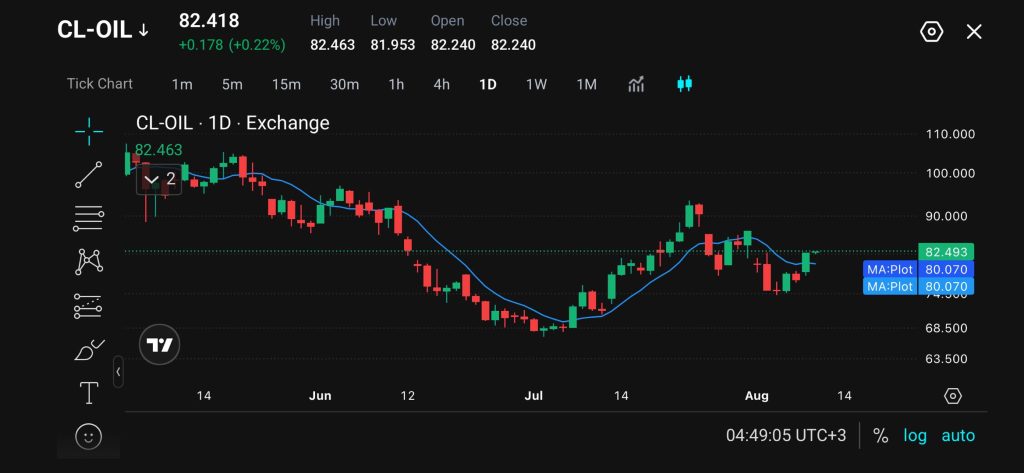
Crude oil is trading around the $82 area after recovering from its July lows near the $70 region, with traders monitoring whether the recent recovery can continue.
A move above $83 could strengthen short-term momentum and bring the $85 resistance area into focus.
On the downside, a break below $80 could signal weakening momentum, with further declines potentially exposing the $78 and $75 support zones.
Bullish and Bearish Setups
| Setup | Trigger | Potential Market Reaction |
| Recovery Continuation | Hold above $82 | Oil may attempt to retest the $83 resistance area |
| Bullish Breakout | Break above $85 | Momentum could strengthen towards higher levels |
| Range Consolidation | Hold between $80 and $83 | Oil may stabilise while markets assess geopolitical developments |
| Bearish Pullback | Break below $80 | Selling pressure could increase towards $78 |
| Deeper Correction | Fall below $78 | Oil may move towards the $75 support zone |
The bullish scenario depends on crude oil maintaining support above the $82 area and breaking through the $83 to $85 resistance zone. A sustained move above $85 could indicate stronger buying interest.
The bearish scenario becomes more relevant if oil falls below $80. A break of this level could increase downside pressure towards $78 and potentially $75.
Disclaimer
The price levels and market scenarios above reflect the author’s view at the time of writing and do not represent financial advice or an official recommendation from VT Markets. Traders should conduct their own analysis and manage risk carefully.
Trade Crude Oil CFDs With VT Markets
Crude oil remains closely watched as geopolitical developments, supply conditions and energy market expectations continue influencing price movements.
With VT Markets, traders can access crude oil CFDs alongside Brent crude, gold, forex, indices, shares, ETFs and other global CFD markets from one platform. This allows traders to follow oil price movements while monitoring broader market factors such as inflation expectations, the US dollar and global risk sentiment.
Use VT Markets’ charting tools to monitor support, resistance, price trends and market reactions as developments around energy supply and geopolitical risks unfold.
Learn more about trading Energies on VT Markets here.
Why Trade Crude Oil as a CFD?
Crude oil CFDs allow traders to take a view on rising or falling oil prices without owning physical barrels or entering into futures contracts.
This flexibility can be useful when oil markets react to factors such as Strait of Hormuz developments, supply disruptions, inventory changes and shifts in global demand expectations. If supply concerns increase, traders can monitor potential upside scenarios. If geopolitical risks ease, traders can assess possible downside movements.
With VT Markets, traders can follow crude oil price action in real time and compare it with other major CFD markets through one account.
What to Watch Next
Crude oil’s next direction will depend largely on developments around the Strait of Hormuz and broader supply expectations.
Key factors include:
- US-Iran Negotiations: Progress towards reopening the Strait of Hormuz and reducing supply concerns.
- Geopolitical Risk: Developments that could affect energy flows from the region.
- US Oil Inventories: Changes in commercial and emergency oil reserves.
- Global Demand Outlook: Expectations for economic growth and fuel consumption.
From a technical perspective, traders are watching whether crude oil can break above $83, while $80 remains the key short-term support level.
Frequently Asked Questions
Why is crude oil rising?
Crude oil has gained as uncertainty around the Strait of Hormuz and US-Iran negotiations increased concerns about potential supply disruptions.
Why is the Strait of Hormuz important for oil markets?
The Strait of Hormuz is a major energy transit route. Any disruption could affect global oil supply expectations and influence prices.
How do geopolitical tensions affect oil prices?
Geopolitical tensions can increase concerns over supply disruptions, creating higher risk premiums in oil markets.
What are the key crude oil levels to watch?
The main resistance levels are $83 and $85, while $80 is the key support level. Further downside could bring $78 and $75 into focus.
How does the US Strategic Petroleum Reserve affect oil prices?
The Strategic Petroleum Reserve provides an emergency supply buffer. Lower inventory levels can become a market consideration during periods of heightened supply uncertainty.
What could push crude oil prices lower?
Progress in US-Iran negotiations, reduced geopolitical risks, stronger supply availability or weaker demand expectations could weigh on crude oil prices.
Start trading now — click here to create your real VT Markets account.








