






Key Points
- The dollar index held above 101 on Wednesday after rising for four consecutive sessions.
- Higher oil prices and Middle East tensions increased inflation concerns and supported expectations for tighter Federal Reserve policy.
- US Treasury yields remained elevated, adding support to dollar demand.
- ADP data showed US private hiring growth slowed further in early July.
- Markets continued to price a higher probability of a Federal Reserve rate increase in September.
The dollar index held above 101 on Wednesday after advancing for a fourth consecutive session, supported by higher Treasury yields, rising oil prices and renewed geopolitical uncertainty.
The US carried out strikes on Iranian targets for an 11th consecutive night, keeping concerns over energy supply disruptions and regional instability elevated.
Oil prices moved higher as markets assessed the potential impact on global energy flows, while investors continued to monitor whether inflation pressures could affect the Federal Reserve’s policy outlook.
The dollar also received support from expectations that higher energy costs could reinforce inflation concerns and reduce the likelihood of near-term monetary policy easing.
Why Traders Are Watching the Dollar
The dollar remains influenced by three major factors: Middle East developments, Federal Reserve expectations and US economic data.
Higher oil prices have become a key market driver as traders assess whether supply risks could create renewed inflation pressure. A sustained increase in energy costs could make it more difficult for central banks to ease policy.
At the same time, higher Treasury yields have supported demand for the dollar by increasing the relative attractiveness of US assets compared with lower-yielding alternatives.
Markets are also monitoring Federal Reserve expectations. While policymakers are widely expected to leave interest rates unchanged at the upcoming meeting, pricing has shifted towards a higher probability of a rate increase later in the year.
Middle East Escalation Keeps Safe-Haven Demand Supported
The US Central Command said it completed 11 days of strikes on Iran, targeting military sites linked to threats against shipping activity in the Strait of Hormuz.
The continued military activity has increased concerns over potential disruptions to one of the world’s most important energy transit routes.
A prolonged conflict could keep oil prices elevated and support demand for defensive assets, including the US dollar.
However, any progress towards de-escalation could reduce some geopolitical risk premium and limit further dollar gains.
Red Sea Risks Add Further Energy Concerns
Energy markets are also monitoring developments beyond the Strait of Hormuz.
Iran-aligned Houthi militants have threatened further action against shipping routes in the Red Sea, raising concerns that disruption risks could spread across multiple trade channels.
Additional pressure on major shipping routes could increase concerns over energy supplies and keep inflation risks in focus.
For the dollar, the impact will depend on whether higher energy prices strengthen expectations for tighter Federal Reserve policy or whether geopolitical uncertainty begins to fade.
US Economic Data Shows Slower Hiring Momentum
US private hiring growth slowed further in early July, according to ADP data.
Private employers added an average of 16,500 jobs per week over the four weeks ending July 4, down from 19,250 in the previous four-week period.
The slowdown marked a fourth consecutive decline in the pace of hiring growth, highlighting signs that labour-market momentum may be moderating.
However, inflation risks linked to energy prices remain a major focus for markets as traders assess the Federal Reserve’s next policy direction.
Key Trading Levels
| Price Level | What Traders Are Watching |
| 101.8 | Wider resistance near recent recovery highs |
| 101.5 | Secondary resistance zone |
| 101.2 | Immediate resistance near latest session high |
| 101.07 | Current trading area |
| 100.8 | Immediate support near recent consolidation |
| 100.5 | Short-term support zone |
| 100 | Psychological support level |
| 99.8 | Wider downside reference |
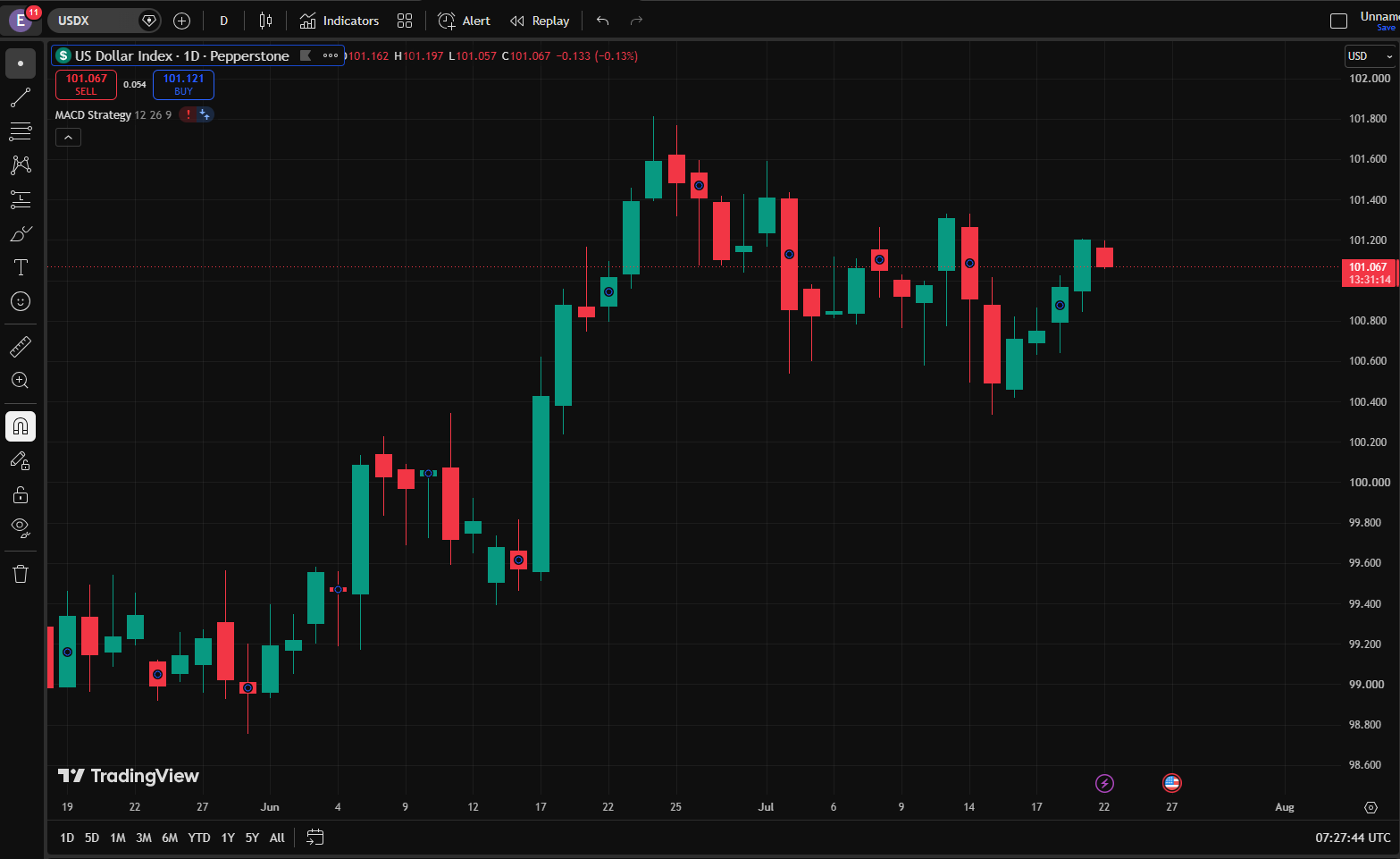
The US Dollar Index is trading near 101.07 after consolidating below the recent high around 101.20.
The index has recovered from its July pullback, but recent candles suggest momentum has slowed as price approaches resistance near 101.20.
A sustained move above 101.20 could bring 101.50 into focus, followed by the wider resistance area near 101.80.
On the downside, 100.80 is the first support level to monitor. A break below this area could expose 100.50, while a deeper decline may bring the psychological 100.00 level into focus.
Bullish and Bearish Setups
| Setup | Trigger | Potential Market Reaction |
| Bullish Continuation | Break above 101.20 | USDX may test 101.50 |
| Stronger Upside Move | Move above 101.50 | Attention may shift towards 101.80 |
| Range Consolidation | Remain between 100.80 and 101.20 | Traders may wait for clearer Fed or geopolitical signals |
| Bearish Pullback | Fall below 100.80 | USDX may retest 100.50 |
| Deeper Correction | Break below 100.50 | Index may decline towards 100.00 |
The bullish scenario depends on the dollar index breaking above 101.20 and maintaining momentum. A confirmed move could strengthen the recovery and bring 101.50 into focus.
The neutral scenario is continued consolidation between 100.80 and 101.20 as traders wait for clearer signals from oil prices, Federal Reserve expectations and geopolitical developments.
The bearish scenario strengthens if USDX falls below 100.80. A confirmed break could increase selling pressure towards 100.50, with further weakness exposing the psychological 100.00 level.
Disclaimer
The price levels and market scenarios above reflect the author’s view at the time of writing and do not represent financial advice or an official recommendation from VT Markets. Traders should conduct their own analysis and manage risk carefully.
Trade USDX CFDs With VT Markets
USDX remains active when Federal Reserve policy expectations, inflation risks, oil prices, geopolitical developments and global currency flows move together.
With VT Markets, traders can access USDX CFDs alongside major forex pairs, gold, oil, indices, shares, ETFs and other global CFD markets from one platform.
This allows traders to follow broader dollar movements while comparing developments across USDJPY, EURUSD, XAUUSD and energy markets.
Use VT Markets’ charting tools to monitor support, resistance, moving averages and breakout behaviour as the next USDX setup develops.
Start trading indices with VT Markets today.
Why Trade USDX as a CFD?
USDX CFDs allow traders to take a view on rising or falling US dollar index movements without owning the underlying currency basket.
This flexibility can be useful when the dollar reacts quickly to Federal Reserve expectations, inflation signals, oil-price movements, geopolitical developments and safe-haven demand.
If USDX breaks above resistance, traders can monitor potential bullish continuation. If momentum weakens, traders can assess possible downside scenarios.
With VT Markets, traders can follow USDX price action in real time and compare it with other major CFD markets through one account.
What to Watch Next
Middle East developments remain the main near-term focus for the dollar outlook. Further escalation or disruption around major energy routes could keep oil prices elevated and support demand for the US dollar.
Federal Reserve expectations will also remain important. A further rise in inflation concerns or rate-hike expectations could provide additional support for the dollar, while softer expectations may limit gains.
US economic data will also be monitored for signs of whether labour-market momentum continues to slow.
From a technical perspective, 101.20 is the immediate resistance level to watch. A sustained move above this area could bring 101.50 into focus, while a break below 100.80 may expose 100.50.
Frequently Asked Questions
Why is the dollar holding above 101?
The dollar is supported by higher Treasury yields, rising oil prices, geopolitical uncertainty and expectations that Federal Reserve policy may remain restrictive.
How do higher oil prices affect the dollar?
Higher oil prices can increase inflation expectations and reduce expectations for lower interest rates, which may support the dollar.
Why does the Strait of Hormuz matter for the dollar?
The Strait of Hormuz is a major energy transit route. Disruption risks can affect oil prices, inflation expectations and demand for safe-haven assets.
What is the market expecting from the Federal Reserve?
Markets expect the Federal Reserve to keep rates unchanged at the upcoming meeting while pricing in a higher probability of a rate increase in September.
What could push USDX higher?
Further geopolitical escalation, higher oil prices, stronger inflation concerns or rising expectations for tighter Federal Reserve policy could support USDX.
What could push USDX lower?
Reduced geopolitical tensions, lower energy prices, softer inflation expectations or weaker US economic data could pressure the dollar.
Start trading now — click here to create your real VT Markets account.








