





Key Takeaways:
- A CFD trading system is a complete, rule-based framework that tells you what to trade, when to enter and exit, and how much to risk.
- A system is broader than a single strategy. It bundles your entry rules, exit rules, position sizing and risk management into one repeatable process.
- Building a reliable system takes most traders four to twelve weeks of design, backtesting and demo testing before going live.
- Trading costs matter. Spreads, swaps and overnight financing can quietly erode an edge that looked profitable on paper.
- A demo account on MetaTrader 4 or MetaTrader 5 lets you test your system in live conditions before risking real capital.
Most traders jump straight into the market with a chart, a hunch and a hope. The result is rarely pretty. According to the European Securities and Markets Authority (ESMA), based on analyses by EU National Competent Authorities, between 74% and 89% of retail CFD accounts typically lose money.
The difference between the small group who succeed and the majority who do not usually comes down to one thing: a tested, repeatable process.
That is exactly what your own CFD trading system gives you. It replaces guesswork with rules. In this guide, we will walk you through how to design, test and refine a system from a blank page. You will find actionable steps, worked examples and a few pro tips about the markets.
What is Your Own CFD Trading System?

How do I create my own trading system is to keep it working. Before you build anything, it helps to be precise about what a system actually is. Many traders confuse it with a single setup or an indicator. In reality, a trading system is the full rulebook that governs every decision you make in the market.
What does it Mean to Build your own CFD Trading System?
To build one means to write down a fixed set of rules that you follow on every single trade. Nothing is left to mood or memory. The system answers four questions before you ever click buy or sell:
- What will I trade? The instruments and markets that suit your style and schedule.
- When do I enter? The exact conditions that trigger a position.
- When do I exit? Where you take profit and where you cut a loss.
- How much do I risk? The size of each position is relative to your account.
A contract for difference (CFD) lets you speculate on the price of an asset without owning it, in both rising and falling markets. Since CFDs are leveraged, a clear system is not a luxury. It is your shield against the very volatility that makes them attractive.
How is a Personal CFD System Different from a Trading Strategy?
People use the words interchangeably, but they are not the same. A trading strategy is a single method, for example, buying a breakout above resistance. A trading system wraps that strategy inside a complete operating framework that also handles risk, money management and review.
| Aspect | Trading strategy | Trading system |
| Scope | One specific setup or entry idea | The full process from entry to exit to review |
| Includes risk rules? | Not always | Always as sizing, stops and limits are built in |
| Repeatable? | Sometimes, if defined | Yes, by design and across many trades |
| Handles psychology? | Rarely | Yes, through fixed rules that remove emotion |
To make it simple, strategy is one tool. A trading system is the whole toolkit and the instructions for using it the same way every time.
What are the Core Components of a CFD Trading System?
Every robust system, however simple, is built from the same building blocks. Picture these as the non-negotiable parts:
- Market selection: Which instruments do you trade and why?
- Entry rules: The precise signal that opens a position.
- Exit rules: Stop-loss and take-profit logic.
- Position sizing: How much capital each trade uses.
- Risk management: Limits that protect your account.
- Record keeping: A journal that lets you review and improve.
If you leave out one of these, this means you have a strategy, not a system. The best version of your system is the one that covers all six and that you can actually stick to under pressure.
Is a CFD Trading System the Same as an Automated Trading Bot?
No. A system is a set of rules. A trading bot, known on MetaTrader as an Expert Advisor (EA), is software that executes those rules automatically. You can run a CFD system entirely by hand, semi-automated, or fully automated.
- Manual: You watch the charts and place every trade yourself.
- Semi-automated: Alerts flag setups, but you confirm and execute.
- Fully automated: An EA on MT4 or MT5 trades the rules for you, 24 hours a day.
Automation is simply a delivery method. The thinking still has to be yours. A bot built on a flawed system will lose money faster, not slower.
How Do You Build Your Own CFD Trading System?
With the theory clear, let us get practical. Building a CFD system follows a logical sequence. Take the steps in order and resist the urge to skip ahead to live trading.
What are the Steps to Create your Own CFD Trading System?
Here is a clean, repeatable build process you can follow from scratch:
- Define your goal and style: Scalping, day trading or swing trading, and your target return.
- Choose your markets: Forex, indices, commodities or shares.
- Pick your edge: Trend-following, mean reversion or breakout, for example.
- Write entry and exit rules: Specific and testable, with no grey areas.
- Set risk and sizing rules: The percentage you risk per trade.
- Backtest: On historical data to check the edge exists.
- Forward-test on demo: In live conditions with no real money.
- Go live small: Next, scale as confidence and consistency grow.
Pro tip: Write each rule as if you were handing it to a stranger. If they could trade it without asking you a single question, your rules are clear enough.
How do you Define Entry and Exit Rules for a CFD system?
Good rules are objective. “Buy when it looks strong” is useless. “Buy when the 50-period moving average crosses above the 200-period moving average” is a rule you can test and repeat.
A solid entry and exit framework usually specifies:
- Trigger condition: The indicator or price action that signals a trade.
- Confirmation: A second condition that filters out weak signals.
- Stop-loss level: This is where the idea is proven wrong.
- Take-profit level: It iswhere you bank the gain.
Worked example:
You go long EUR/USD when the price closes above the 20-day high (trigger) and the RSI is above 50 (confirmation). You place a stop 30 pips below entry and a target 60 pips above. That is a complete, testable rule set and a clean 1:2 risk-reward ratio.
How do you Set Position Sizing and Leverage Rules?
Position sizing decides how much you stand to lose if a trade goes wrong. The golden rule used by most professionals is simple: risk a small, fixed percentage of your account on each trade, usually 1% to 2%.
The position-size formula is:
Position size = (Account × Risk %) ÷ (Stop-loss in pips × Pip value)
Here is how that plays out on a $5,000 account risking 1% per trade:
| Account | Risk per trade | Stop-loss | Max loss |
| $5,000 | 1% | 30 pips | $50 |
| $5,000 | 2% | 30 pips | $100 |
| $5,000 | 1% | 50 pips | $50 |
Note: Notice the maximum loss stays constant when you fix the risk percentage, even as the stop distance changes. That is the point. On leverage, remember that CFDs amplify both gains and losses. Average leverage ranges from 30:1 in regulated regions up to 500:1 elsewhere, so set a personal cap well below the maximum your broker offers.
How do you Decide Which Instruments to Trade (Forex, Indices, Commodities, Shares)?
Choose instruments that match your available time, capital and temperament. Each asset class has its own rhythm:
| Asset class | Best for | Watch out for |
| Forex | 24/5 trading, deep liquidity, low spreads | Sensitive to economic news and rate decisions |
| Indices | Broad market exposure in one trade | Gaps at the open, overnight risk |
| Commodities | Gold and oil trends, inflation hedging | Volatile, supply-driven price swings |
| Shares | Company-specific moves and earnings plays | Wider spreads, single-stock risk |
Pro tip: Start with one or two instruments and master them. Deep knowledge of EUR/USD beats shallow knowledge of twenty markets every time.
How Long Does it Take to Build a Working CFD Trading System?
Honestly, plan for weeks, not days. A realistic timeline for a careful trader looks like this:
- Design and rule-writing: 3 to 7 days.
- Backtesting: 1 to 2 weeks.
- Demo forward-testing: 4 to 8 weeks.
- Live with small size: Ongoing, scaling gradually.
So most traders need four to twelve weeks before trading their system with real money. Rushing this stage is the single most common reason DIY systems fail.
What Rules Should Your Own CFD Trading System Include?
Rules are what separate a professional from a speculator. A complete CFD system puts risk first, because protecting capital is what keeps you in the game long enough to profit.
What Risk Management Rules Belong in a CFD Trading System?
At a minimum, your system should hard-code these protective rules:
- Risk no more than 1–2% of your account per trade.
- Place a stop-loss on every position, without exception.
- Cap your total open risk across all trades (for example, 6%).
- Set a daily or weekly loss limit, then stop trading once hit.
- Never add to a losing position to “average down”.
These rules feel restrictive when you are winning. They feel like a lifeline when you are not. The best own CFD trading system treats capital preservation as job number one.
How do you Set Stop-Loss and Take-Profit Rules?
Your stop-loss marks the point where your trade idea is wrong. Your take-profit marks where you bank the reward. Both should be decided before you enter, never in the heat of the moment.
Common, objective ways to place them include:
- Technical levels: Below a recent swing low or above resistance.
- Volatility-based: A multiple of the Average True Range (ATR).
- Fixed distance: A set number of pips that suits the instrument.
Whatever method you choose, apply it consistently. A stop you move further away to avoid being closed out is not a stop at all.
What Role does the Risk-Reward Ratio Play?
The risk-reward ratio compares what you risk to what you aim to win. It is arguably the most powerful lever in your whole system. This is because it lets you be profitable even with a low win rate.
This matters more than most beginners realise. For illustrative purposes, the table below shows why the ratio is decisive:
| Risk-reward | Win rate needed | Outcome at 50% wins | Verdict |
| 1:1 | Over 50% | Break-even (5 × +1 − 5 × −1 = 0) | Hard to profit |
| 1:2 | Over 33% | Net +5 units (5 × +2 − 5 × −1) | Strong edge |
| 1:3 | Over 25% | Net +10 units (5 × +3 − 5 × −1) | Excellent edge |
Worked example:
With a 1:2 ratio, you can lose six trades out of ten and still come out ahead. Four wins at +$100 each is +$400. Six losses at –$50 each is –$300. Net result: +$100, despite a losing record.
How do you Account for Spreads, Swaps, and Overnight Financing?
This is where many promising systems quietly vanish. Every CFD trade carries costs that nibble at your edge. Ignore them in testing and your live results will disappoint.
- Spread: The gap between buy and sell price, paid on entry.
- Commission: A per-trade fee on ECN-style accounts.
- Swap or overnight financing: A charge (or credit) for holding a position past the daily cut-off.
Worked example:
Suppose your system makes 8 pips of average profit per trade, but the spread is 1.2 pips and you hold overnight for a 0.8-pip swap. Your real edge is 8 − 1.2 − 0.8 = 6 pips, a 25% haircut. Across hundreds of trades, that gap decides whether you win or lose.
If you hold positions for days, a swap-free account can remove overnight financing from the equation entirely, which is worth modelling into your system.
How Do You Test Your Own CFD Trading System?
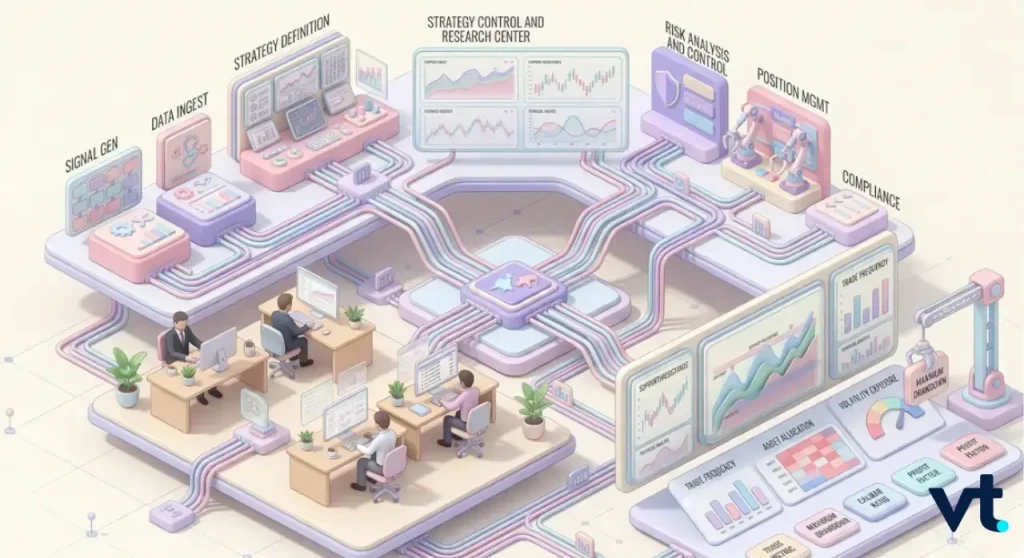
A system is only a theory until it is tested. Testing happens in two stages, including backtesting in the past, then forward-testing in the present, before a single real dollar is at stake.
How do you Backtest a CFD Trading System?
Backtesting runs your rules against historical price data to see how they would have performed. On MT4 and MT5 you can use the built-in Strategy Tester to automate this. A clean backtest follows a simple discipline:
- Apply your exact rules to past data, no tweaking mid-test.
- Include realistic spreads, commissions and swaps.
- Record every trade, win or lose.
- Review the headline metrics before drawing conclusions.
Pro tip: Test across different market conditions such as a trending year and a choppy one. A system that only works in one regime is not ready for the real world.
How do you Forward-Test on a Demo Account?
Backtesting shows what would have happened. Forward-testing shows what does happen, live, without risking capital. A free demo account lets you trade your system in real time with virtual funds, exposing problems a backtest hides like slippage, execution speed and your own discipline.
Run your demo forward-test for at least 30 to 50 trades, and treat it seriously:
- Trade the rules exactly, as if the money were real.
- Log every trade in your journal.
- Compare live results with your backtest expectations.
- Only go live once the two broadly agree.
What Metrics Show Whether a CFD System Works (Win Rate, Drawdown, Expectancy)?
Do not judge a system by profit alone. These three metrics tell the real story:
| Metric | What it measures | What good looks like |
| Win rate | Percentage of winning trades | Context-dependent; high R:R needs less |
| Drawdown (Max drawdown) | Largest peak-to-trough account drop | Lower is better; under 20% is comfortable |
| Expectancy | Average profit per trade over time | Must be positive after all costs |
Expectancy is the one to obsess over. The formula is:
- Expectancy = (Win % × Avg win) − (Loss % × Avg loss)
Worked example:
A 45% win rate, average win $120, average loss $50 gives (0.45 × $120) − (0.55 × $50) = $54 − $27.50 = +$26.50 expected per trade. A positive number means a genuine edge.
How much Historical Data do you Need to Test Reliably?
Enough to be statistically meaningful, and enough to cover varied conditions. As a rough guide:
- At least 100 trades in your sample as fewer and luck dominates.
- 12 months minimum of data for day-trading systems.
- 2 to 3 years for swing systems, to capture different market regimes.
More data is generally better, but only if it is clean and relevant. Testing a fast scalping system on decade-old data tells you little about today’s spreads and volatility.
What Are Common Mistakes When Building Your Own CFD Trading System?
Knowing the traps in advance is half the battle. Most DIY systems fail for the same handful of avoidable reasons.
Why do Most DIY CFD Trading Systems Fail?
The honest answer is that most fail before they begin, because the trader skips the boring parts. The recurring culprits are:
- Going live without proper testing.
- Vague rules that allow emotional override.
- Ignoring trading costs during testing.
- Risking too much per trade.
- Abandoning the system after a normal losing streak.
With many of retail accounts losing money, the market gives no prizes for effort. It rewards the process. Fixing these five mistakes puts you ahead of the majority immediately.
How does Overfitting Affect a CFD Trading System?
Overfitting is the silent destroyer of backtests. It happens when you tune a system so tightly to past data that it memorises history instead of finding a real edge. The result looks perfect on the chart and falls apart live.
You can spot the warning signs:
- Too many rules and filters bolted on to “fix” past losses.
- Oddly specific values, like a 37-period average chosen because it tested best.
- Flawless backtest results that collapse on new data.
Pro tip: Keep your system straightforward. Fewer rules and round numbers tend to survive contact with the live market far better than over-engineered ones.
Why is Ignoring Trading Costs a Problem?
This is due to costs turning winners into losers. A high-frequency system that looks profitable at a raw price can bleed out once spreads, commissions and swaps are included. We saw earlier how a 2-pip cost on an 8-pip edge wipes out a quarter of your profit.
Always test with the same costs you will pay live. If your strength only exists in a cost-free imagination, it does not exist at all.
How does Emotional Discipline Affect System Performance?
A perfect system in the hands of an undisciplined trader still loses. The data is blunt as many traders close winners too early out of fear and hold losers too long out of hope. This is the exact opposite of what their rules demand.
To keep emotion out of the cockpit:
- Trade only the setups your system defines.
- Pre-set stops and targets so decisions are automatic.
- Step away after hitting a daily loss limit.
- Judge yourself on following rules, not on any single result.
How Do You Improve and Maintain Your Own CFD Trading System?
A market is a moving target, so your system is never truly finished. The goal is steady refinement based on evidence, not constant tinkering driven by the last trade.
How do you Know When to Adjust your CFD trading system?
Adjust on data, never on emotion. A single losing trade, or even a losing week, is not a reason to rebuild. Look instead for sustained, structural signals:
- A drawdown that exceeds your backtested worst case.
- Win rate or expectancy drifting down over many trades.
- A clear, lasting shift in how your market behaves.
When you do change something, change one variable at a time and re-test. That way you know exactly what helped and what hurt.
How do you Keep a Trading Journal to Refine your System?
Your journal is the engine of improvement. It turns vague feelings into hard evidence about what works. For every trade, record:
- Date, instrument and direction.
- Entry, stop, target and exit prices.
- The reason the trade met your rules.
- Result, in both pips and percentage.
- A short note on your discipline and emotional state.
Review your journal weekly. Patterns emerge fast, perhaps your wins cluster in the London session, or your worst losses come from trades you took outside your rules. That is gold for refining the trading approach for your style.
How do Market Conditions Affect whether a System Keeps Working?
Every system has a favourite environment. A trend-following system thrives in directional markets and struggles in choppy ranges. A mean-reversion system does the reverse. No single approach wins in all conditions.
The practical responses are:
- Know which regime your system is built for.
- Reduce size or stand aside when conditions turn hostile.
- Consider a second, complementary system for the other regime.
Markets evolve, and estimated 35% of retail traders now use automated or algorithm-assisted strategies, raising the bar for everyone. Staying adaptable is what keeps a good system good.
Frequently Asked Questions (FAQs)
Q1: How do I create my own trading system as a complete beginner?
Start small and follow the sequence. Define your style, pick one market, write simple entry and exit rules, add a 1% risk rule, then backtest and demo-test before going live. Asking how do I create my own trading system is the right first step and the answer is a methodical process, not a secret indicator.
Q2: Do I need to know how to code to build a CFD trading system?
No. You can run your system manually on MT4 or MT5 by following your written rules. Coding is only needed if you want to automate it with an Expert Advisor. Many profitable traders never write a line of code.
Q3: How much money do I need to start trading my own CFD system?
Less than most people think, thanks to leverage and small account types. The priority is risk control, not capital size. A modest account traded with strict 1% risk teaches the same discipline as a large one and a cent account lets you start even smaller in live conditions.
Q4: How long before my CFD trading system becomes profitable?
Realistically, expect months of testing and refinement. Trading educators commonly suggest it takes somewhere between one and three years of dedicated practice (typically progressing from demo to small live accounts) before a trader develops steady positive expectancy, though estimates vary widely. Patience and process beat speed.
Build and Trade Your Own CFD Trading System with VT Markets
A profitable own CFD trading system is built, not bought. It comes from clear rules, honest testing and the discipline to follow your plan when the market tests your nerve. Get those three things right and you put yourself firmly among the minority who succeed.
The smartest place to test and trade your system is on a platform built for it. With VT Markets, you can backtest and forward-test on both MetaTrader 4 and MetaTrader 5. Access forex, indices, commodities and share CFDs from a single account, and trade with tight spreads and fast execution. VT Markets serves clients in over 160 countries, subject to jurisdictional eligibility.
Start risk-free on a VT Markets demo account, refine your own CFD trading system in live conditions, and step up to a live account when your numbers add up.








