





Key Takeaways
- Gold trading slippage is the gap between the price you expect and the price your order actually fills at on XAU/USD.
- It grows when the market moves fast, liquidity thins, or your order is large.
- Slippage can be positive, giving you a better price, or negative, giving you a worse one.
- Limit orders, slippage tolerance settings, and trading around news all help you keep it under control.
Gold is fast, liquid, and traded almost around the clock. It can move several dollars in seconds. That speed is exactly why gold trading slippage matters to every trader.
Slippage is the difference between the price you ask for and the price you actually get. On XAU/USD, where prices jump during news and quiet sessions alike, that small gap can shape your results.
This guide explains gold trading slippage in an easily digestible manner. You will learn why it happens, how much to expect, and simple ways to keep it in check. The examples use MetaTrader 4 and MetaTrader 5, the two platforms most CFD traders rely on.
What Gold Trading Slippage Means

Gold trading slippage happens when your order fills at a different price from the one you requested. It is not an error or a trick, but a normal part of how live markets work. In the split second between your click and the fill, the market can move. The price you see is a snapshot, not a promise.
How Gold Trading Slippage Works on XAU/USD
When you place a market order, you accept the best available price at the moment of execution. On XAU/USD, that price can shift between your click and the fill.
Let’s say gold is trading at $4,000.00. You click buy, expecting that price. By the time your order reaches the market, gold has ticked up to $4,000.50. Your order fills at $4,000.50. That $0.50 difference is your slippage.
- Requested price: $4,000.00
- Executed price: $4,000.50
- Slippage: $0.50 per ounce, or 50 pips
- Cost on one standard lot (100 ounces): $50
A quick note on units. One standard lot is 100 ounces, so each $0.01 move (one pip) is worth about $1 in pip value. A $0.50 slip is therefore 50 pips, or $50 on a standard lot.
Positive and Negative Slippage Explained
Slippage runs in both directions. Many traders only notice it when it costs them, but a fair execution model delivers both kinds over time.
- Negative slippage: your order fills at a worse price than expected. A buy fills higher, or a sell fills lower.
- Positive slippage: your order fills at a better price than expected. A buy fills lower, or a sell fills higher.
If you only ever see negative slippage, that is worth questioning. Genuine market movement should push prices in your favour sometimes too.
Slippage Compared With the Spread
Slippage and the spread are both costs of trading, but they are not the same thing. The bid-ask spread is the gap between the buy and sell price. You know it before you trade. Slippage is the movement between the price you request and the price you get. You only know it after the fill.
| Feature | Spread | Slippage |
| What it is | Gap between the bid and ask price | Gap between requested and filled price |
| When you know it | Before you place the trade | After the trade fills |
| Main cause | Broker and liquidity pricing | Price movement and thin liquidity during execution |
| When it bites | Every trade | Mostly market orders in fast markets |
Why Gold Is Prone to Slippage
Gold trading slippage shows up more often than on many currency pairs. Three forces explain most of it: volatility, thin liquidity, and the mechanics of execution.
1. Volatility and Thin Liquidity Windows
Gold is a high-volatility market. Over the past year, XAU/USD has traded within a 52-week range of roughly $3,268 to $5,595, a swing of more than $2,300 per ounce. It set an all-time high near $5,602 in January 2026. Big ranges mean bigger gaps between one price and the next.
Liquidity is the other half of the story. When fewer orders sit in the book, your fill can land further from the quoted price. Thin windows include the following.
- The gap between the New York close and the Asian open, when volume is light
- Public holidays in major financial centres
- The minutes just before and after major economic data
2. Execution Latency and Order Size
Execution latency is the delay between your click and the fill. In a fast gold market, even milliseconds matter. Order size matters too. A large position may fill across several price levels, so your average price drifts away from the first quote.
- Slow internet or platform lag adds delay, and delay invites slippage.
- Large orders can sweep through thin liquidity at worse prices.
- Liquidity providers quote tighter prices when volume is high and wider prices when it dries up.
3. Price Gaps at Session Open and Rollover
Sometimes the price simply jumps. Price gaps appear when the market reopens after a break, at the daily rollover, or after news breaks while your market was closed.
There are no trades in between, so your order fills at the next available price. This is why a stop-loss order can fill below your chosen level on a gap. The stop is a trigger, not a guarantee.
How Much Gold Trading Slippage to Expect
A fair question at this point is how much slippage is normal on gold. The honest answer is that it depends on conditions. Calm markets give tight fills, and volatile markets give wider ones. The ranges below are indicative and vary by broker and account type.
Typical Pip Ranges in Normal Conditions
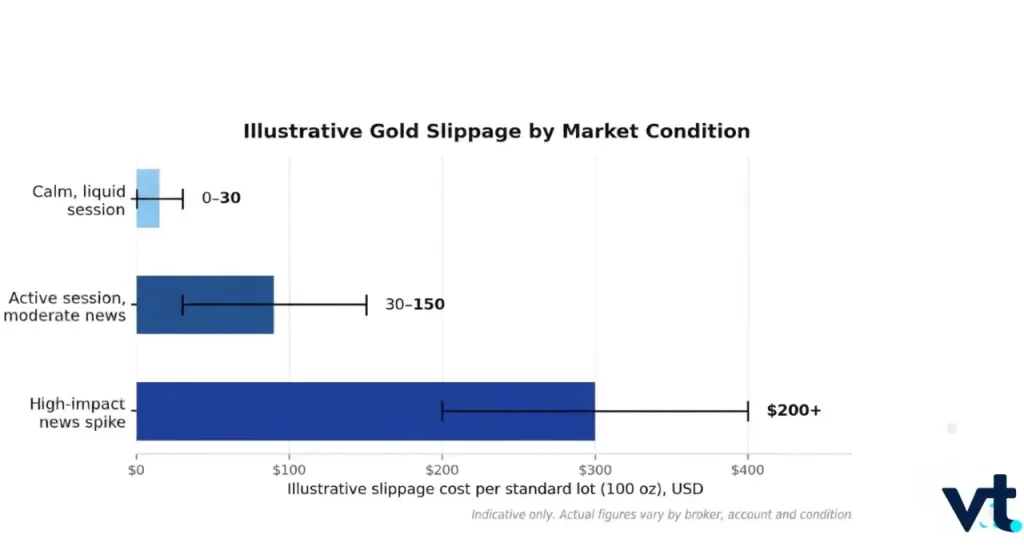
In a calm, liquid session with good execution, gold slippage is often small, sitting near zero and staying under a dollar an ounce. During a high-impact release it can widen to several dollars in an instant. The table and chart below show the pattern.
| Market condition | Typical slippage on XAU/USD | Cost per standard lot (100 oz) |
| Calm, liquid session | $0.00 to $0.30 (0 to 30 pips) | $0 to $30 |
| Active session, moderate news | $0.30 to $1.50 (30 to 150 pips) | $30 to $150 |
| High-impact news spike | $2.00 or more (200+ pips) | $200 or more |
Indicative only. Figures vary by broker, account and market conditions.
What Counts as Acceptable Versus Excessive
Acceptable gold trading slippage is small, roughly two-way over time, and tied to real market movement. Excessive slippage is large for the move seen, or almost always against you. That pattern can point to a weak execution model. A few pro-tips help you judge the difference.
- Track your fills. Compare the requested price with the executed price on your trade history.
- Expect both positive and negative slippage across many trades.
- Consistent one-way slippage against you is a red flag worth investigating.
- Judge slippage against the volatility at the time, not against a perfect fill.
When Gold Trading Slippage Is Most Likely
Gold trading slippage is not random. It clusters around a handful of predictable moments. Knowing them is half the battle.
1. High-Impact News Releases (NFP, CPI, FOMC)
Gold reacts sharply to United States data. In the seconds around a major release, spreads widen and slippage spikes. These are the high-impact news events to watch.
- Non-Farm Payrolls (NFP), released on the first Friday of each month
- United States Consumer Price Index (CPI) inflation data
- Federal Reserve interest rate decisions and FOMC statements, eight times a year
- Surprise geopolitical headlines and central bank comments
The move itself can be genuine and tradable. The risk sits in that first burst, where a market order placed at the wrong second can fill far from your intended price.
2. Market Open and Low-Liquidity Hours
Thin hours carry more slippage risk because fewer orders are available to fill yours. Treat these windows with extra care.
- The Sunday or Monday reopen, when weekend news can create a price gap
- The quiet stretch between the US close and the Asian session
- Rollover time, when spreads often widen briefly
How to Reduce Gold Trading Slippage
You cannot remove slippage from a fast market like gold. You can manage it. This section is the practical core of how to avoid slippage in trading, with steps you can apply today on MT4 and MT5.
1. Using Limit Orders and Slippage Tolerance Settings
Order type is your first lever. A limit order fills at your chosen price or better, never worse, though it may not fill at all if the price runs away. A market order prioritises speed over price. Both platforms also let you cap the slippage you accept.
- Use limit orders to set the exact price you are willing to accept.
- On MetaTrader 4 and 5, enable maximum deviation in the order window and set your allowed slippage in points. This is your slippage tolerance.
- Reserve market orders for moments when getting filled matters more than the exact price.
2. Trading Around Scheduled News
Most damaging slippage is avoidable because most big events are scheduled in advance. An economic calendar is a free and powerful tool.
- Check an economic calendar before every session, and note the red-flag events.
- Avoid market orders in the seconds around NFP, CPI and FOMC.
- If you want to trade the reaction, consider waiting for the first spike to settle.
3. Why Execution Model and Liquidity Depth Matter
Where your order is executed shapes how much you slip. A broker with deep liquidity depth and fast order execution speed fills you closer to the quoted price. In addition, a transparent execution model passes on positive slippage too.
VT Markets, for example, routes orders to deep liquidity on MT4 and MT5 with fast execution.
- Deep liquidity depth absorbs larger orders with less price impact.
- Faster order execution speed leaves less time for the price to move.
- A fair execution model shows both positive and negative slippage on your fills.
4. Whether Zero Slippage Is Realistic
No honest broker can promise zero slippage on gold in every condition. Some offer guaranteed stops or fixed spreads, usually at a cost. The healthiest mindset is to expect small, two-way slippage and to plan for it.
- Zero slippage in all conditions is not realistic on a market as fast as gold.
- Small, balanced slippage is normal and a sign of live pricing.
- Be cautious of anyone promising perfect fills every single time.
How to Calculate the Cost of Slippage
Putting a number on slippage is simpler than it sounds. Two short formulas cover almost every case, and they answer both how to calculate slippage in trading and what is slippage percentage in trading.
- Slippage per ounce = Executed price minus Requested price
- Slippage cost = Slippage per ounce multiplied by the number of ounces
- Slippage percentage = (Slippage per ounce divided by Requested price) multiplied by 100
The percentage view helps you compare slippage across assets of very different prices. A $0.50 slip on gold is a different share of price than the same slip on a cheaper instrument.
A Worked XAU/USD Example
Let’s say gold is trading at $4,000.00. You buy one standard lot, which is 100 ounces. Since the market is moving, your order fills at $4,000.80. Here is the full calculation.
- Slippage per ounce: $4,000.80 minus $4,000.00 = $0.80 (80 pips)
- Slippage cost: $0.80 multiplied by 100 ounces = $80
- Slippage percentage: ($0.80 divided by $4,000.00) multiplied by 100 = 0.02%
| Item | Value |
| Requested price | $4,000.00 |
| Executed price | $4,000.80 |
| Slippage per ounce | $0.80 (80 pips) |
| Position size | 1 standard lot (100 oz) |
| Slippage cost | $80 |
| Slippage percentage | 0.02% |
Two hundredths of one per cent sounds tiny, but in dollars it is still $80, and it repeats across every trade. That is why controlling slippage protects your bottom line over hundreds of trades, not just one.
Find out about how to calculate gold trade profits using an XAU/USD profit calculator.
Frequently Asked Questions (FAQs)
Q1: What is slippage in gold trading?
Slippage in gold trading is the difference between the price you request and the price your order fills at on XAU/USD. It happens when the market moves in the split second between your click and execution. Slippage can work for you or against you.
Q2: Is slippage the same as the spread?
No. The spread is the fixed gap between the buy and sell price, and you know it before you trade. Slippage is the movement between the price you request and the price you receive, and you only see it after the fill.
Q3: Why does gold experience more slippage than other pairs?
Gold is highly volatile and its liquidity can thin quickly. Large, fast price swings mean the next available price is often further from the last. Around major US data, both volatility and thin liquidity peak, so slippage on XAU/USD rises.
Q4: How much slippage is normal on XAU/USD?
In calm, liquid conditions, gold slippage is often small, from near zero to under a dollar an ounce. During high-impact news it can widen to several dollars in a single tick. Exact figures vary by broker, account type and the moment you trade.
Q5: How can I reduce slippage when trading gold?
Use limit orders to cap the price you accept, and set a maximum deviation on MT4 or MT5. Avoid market orders around scheduled news, trade in liquid sessions, and choose a broker with deep liquidity and fast execution.
Trade Gold With Confidence at VT Markets
Managing gold trading slippage is part of trading gold well. You now know why XAU/USD price moves cause it, how much to expect, and how to keep it under control with the right orders, timing and platform.
The next step is applying it into practice with a broker built for the job. VT Markets gives you deep liquidity, fast execution, and full maximum deviation controls on both MetaTrader 4 and MetaTrader 5, with live pricing and transparent fills.
Open your account with VT Markets today, and take control of every fill on XAU/USD.








