







Key Points
- Brent trades flat at $67.75 while WTI edges up 0.1% to $62.44
- Large geopolitical risk premium remains due to U.S.-Iran tensions
Oil prices were broadly unchanged in early European trade, with Brent crude at $67.75 and WTI rising 0.1% to $62.44. Despite limited price movement, a sizeable geopolitical risk premium remains embedded in the market.
Uncertainty surrounding U.S.-Iran relations continues to underpin prices. Recent comments from President Donald Trump suggesting that regime change would be the preferred outcome in Iran have heightened concerns over potential supply disruption.
These remarks reinforce fears that tensions could escalate, keeping traders cautious about aggressively selling crude.
At the same time, markets are monitoring diplomatic signals from Eastern Europe. Peace discussions between Ukraine and Russia have taken a more de-escalatory tone, which could gradually remove part of oil’s geopolitical premium if sustained.
Risk Premium Versus Fundamentals
Analysts highlight that a large geopolitical premium remains in prices due to Middle East uncertainty. If tensions ease meaningfully, the focus may shift back to underlying supply-demand dynamics.
Recent data points to softer fundamentals. Inventory builds and steady non-OPEC supply growth suggest that global supply remains comfortable. Should the geopolitical premium fade, these bearish elements could exert renewed downward pressure on crude.
At present, the market is balancing two competing narratives: potential disruption from Iran versus a stabilising global supply outlook. This tug-of-war has kept prices rangebound rather than trending decisively.
Technical Analysis
WTI crude oil (CL-OIL) is trading at $62.64, marginally lower on the session, as price continues to consolidate after failing to sustain momentum above the recent swing high at $66.47.
The daily chart shows a recovery structure from the $54.87 low, but upside pressure has clearly stalled near the mid-$60s region.
Price is now hovering just below the 5-day MA (63.41) and 10-day MA (63.64), while holding slightly under the 20-day MA (62.89).
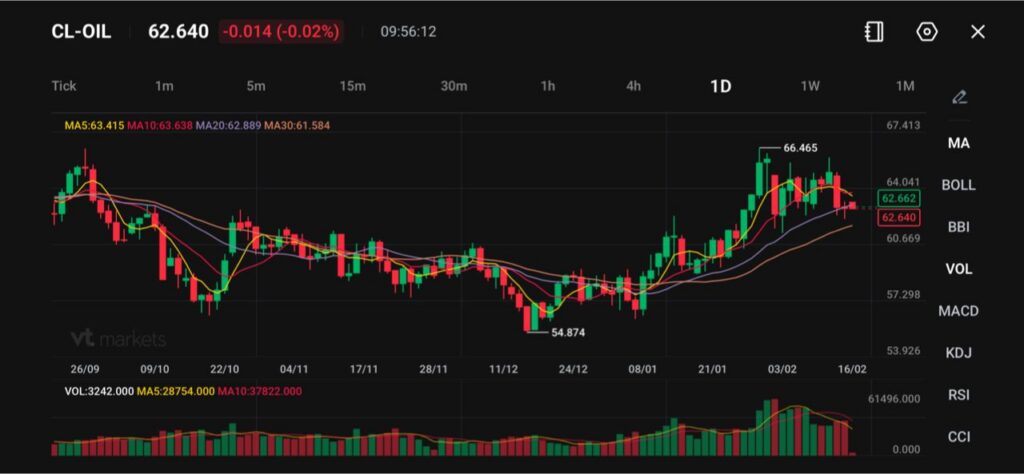
This clustering of short-term moving averages signals a loss of bullish momentum and suggests the market is entering a corrective phase rather than extending the prior rally.
The 30-day MA (61.58) remains upward sloping, offering dynamic support near the $61.50–$60.70 zone.
If crude holds above $60.70, the broader recovery bias from early January remains intact, with a potential retest of $64.00–$66.00 on renewed buying interest.
However, a decisive break below $60.50 would likely shift momentum back in favour of sellers, exposing the $57.30 region and potentially reopening the path toward the December lows.
Cautious Outlook
In the short term, oil may continue to trade sideways as traders assess geopolitical headlines. If rhetoric around Iran intensifies or diplomatic efforts stall, the risk premium could widen and lift Brent back toward the $68–$70 range and WTI toward $64–$66.
Conversely, sustained progress in Ukraine-Russia talks combined with calmer messaging around Iran could allow supply fundamentals to dominate.
In that scenario, WTI may drift toward $60–$61, particularly if inventory data reinforces surplus conditions.
For now, price action suggests consolidation, with geopolitical headlines likely to dictate the next directional move.









