






Key Points
- Front-month WTI crude fell 1.2% to $64.34 per barrel, while Brent dropped 1.3% to $68.58.
- US Iran agreement to hold nuclear talks in Oman trimmed immediate geopolitical risk pricing.
Oil prices slipped in the Asian morning session as confirmation of upcoming nuclear talks between the United States and Iran reduced immediate geopolitical anxiety.
Both the White House and Iran’s foreign ministry confirmed that negotiations will take place in Oman on Friday, prompting traders to scale back the short-term risk premium that had built into crude prices.
Front-month WTI crude futures traded down 1.2% at $64.34 per barrel, while Brent crude futures declined 1.3% to $68.58 per barrel. The pullback followed a sharp rally earlier in the week that had been driven by fears of supply disruption linked to escalating Middle East tensions.
A cautious forecast suggests oil may remain sensitive to headlines in the near term, with diplomacy offering temporary relief but not removing structural risks.
Risk Premium Softens, but Upside Concerns Persist
Our research desk notes that upside risks remain, particularly around US policy actions toward Iran and India’s continued purchases of Russian oil, both of which could tighten effective supply if sanctions enforcement intensifies.
These lingering uncertainties mean that while prices have dipped, traders remain reluctant to aggressively sell crude. The market continues to balance hopes for de-escalation against the reality that negotiations may take time and outcomes remain uncertain.
If talks falter or rhetoric hardens, risk pricing could return quickly.
Broader Supply Backdrop Remains Tight
Beyond geopolitics, the broader oil market remains constrained by disciplined supply management and uneven production growth. OPEC+ output restraint, coupled with limited spare capacity in several producing nations, has left prices highly responsive to geopolitical developments.
Demand signals have also stabilised, with consumption holding up better than expected in parts of Asia, even as global growth remains uneven. This has limited the downside follow-through after the initial selloff.
A cautious view points to continued volatility rather than a sustained decline unless diplomatic progress becomes more concrete.
Technical Analysis
Crude Oil (CL-OIL) is trading at $64.275, slightly down 0.26% (-0.169) in the current session, after a volatile series of swings. Earlier, prices rebounded sharply from a low of $62.855, climbing to an intraday high of $65.515 before retreating on profit-taking.
The surge toward $65.515 was accompanied by a large volume spike and steep upward crossover in short-term moving averages, signalling aggressive buyer activity.
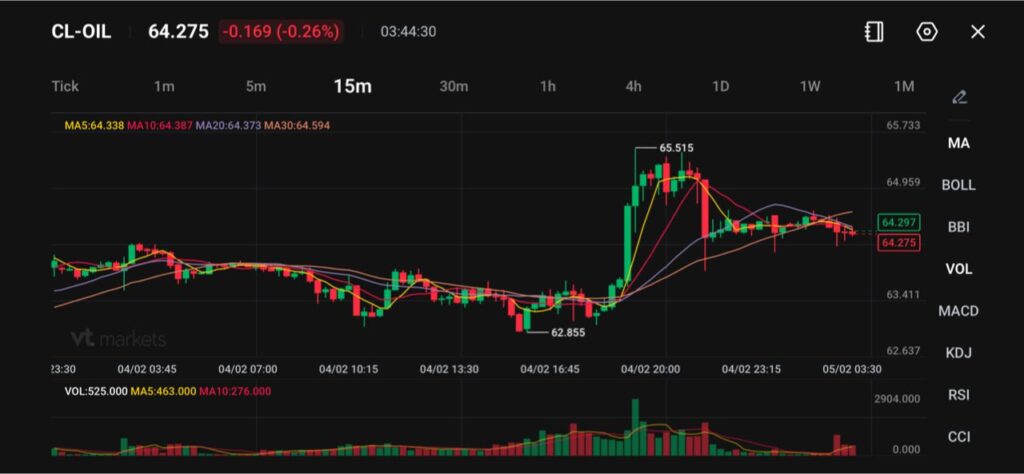
However, the rejection at the top and subsequent fade suggest a temporary exhaustion of upward momentum.
Currently, price action has consolidated back toward the short-term moving averages (MA5: 64.338 and MA10: 64.387), with the market showing signs of hesitation.
Price remains sandwiched between dynamic support and resistance, hovering near the $64.29 zone.
If bulls defend the $64.20–64.30 area, another test of $65+ could be in play.
A breakdown below $64.00 would expose the market to deeper pullbacks toward $63.40 and possibly $62.60, where prior support was last seen. Momentum is cooling for now, with volume easing off the earlier peak.









