






Key Points
- Nvidia closes at $176.17, down 3.28%, after touching lows near $176.00.
- Retail traders added $212M in net inflows, the highest among US tech names on Tuesday.
Tech shares faced pressure on Tuesday, with questions swirling over whether the pullback marked routine profit-taking or the start of a deeper correction. Nvidia fell 3.28% to $176.17, joining Tesla and Palantir in the red. Yet retail traders saw opportunity in the weakness.
Data from our research desk showed Nvidia, Tesla, and Palantir ranked as the most purchased stocks by retail traders on the day, attracting net inflows of $212M, $61M, and $59M respectively. The renewed buying appetite suggests confidence in the tech trade remains intact, even as institutional traders recalibrate after a strong multi-month run.
The backdrop highlights an ongoing tug-of-war in sentiment: profit-taking from fund managers after a stellar year-to-date rally, countered by steady retail inflows that have historically supported recoveries in big-cap tech.
Technical Analysis
Nvidia (NVDA) has staged an impressive rally since bottoming near 86.59 in April, climbing to recent highs around 183 before easing back to 176. The price action remains above its short- and medium-term moving averages, showing that the broader uptrend is still intact.
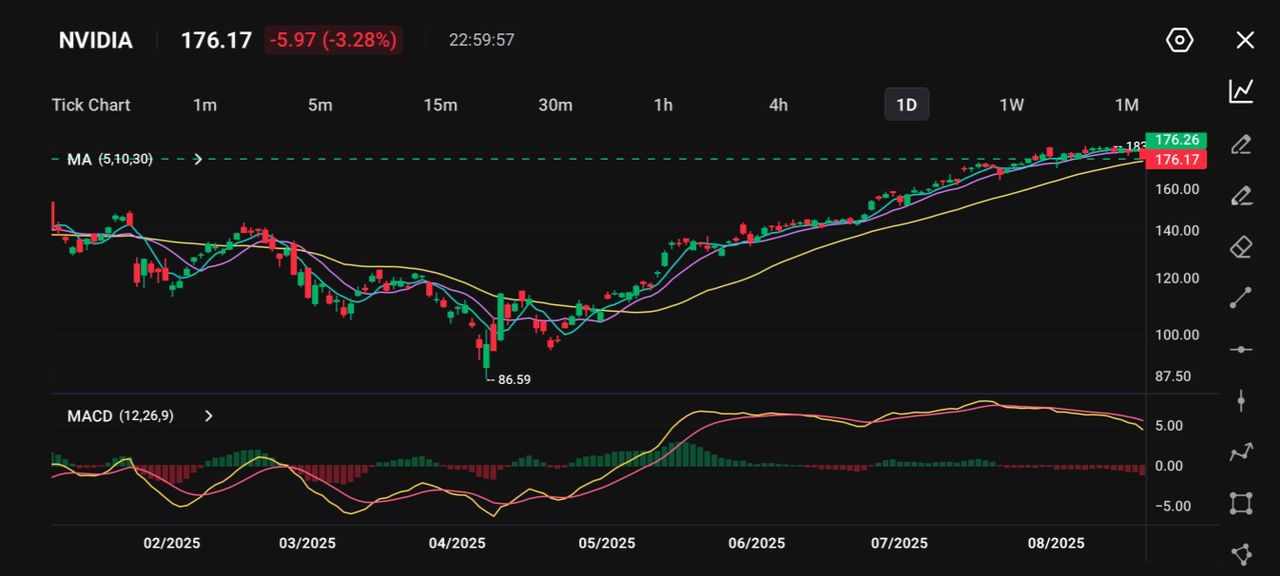
However, the latest dip and red candle suggest some profit-taking, with the MACD line flattening and momentum starting to cool.
In the near term, the key support to watch is the 170–172 region, which aligns with the rising moving averages. A bounce from here could keep the uptrend intact and invite another push back toward the 180–185 resistance zone. If support fails, the next downside area sits around 160.
While the longer-term trend remains bullish, short-term traders should watch for consolidation or a corrective pullback before the next leg higher.
Cautious Forecast
If dip-buying persists, Nvidia could stabilise above $175 and retest the $183 level. However, failure to hold support risks a deeper slide toward $165, particularly if broader risk sentiment weakens or profit-taking accelerates across tech.










