






Key Points
- Nikkei drops 1% as regional risk sentiment weakens
- Dollar up 1.6% against yen this week, pressuring Japanese equities
Japan’s Nikkei 225 fell 1% on Friday as risk appetite deteriorated across Asian markets. The pullback comes amid rising geopolitical tension in the Middle East, stress in US private equity stocks, and a stronger US dollar.
The retreat follows renewed trader caution after President Donald Trump set a 10 to 15-day deadline for Iran to reach a nuclear agreement, pushing oil prices higher and injecting volatility into global markets.
At the same time, concerns over liquidity in US private equity funds have rippled across equities.
While the Nikkei had previously benefited from strong US tech performance, the broader risk-off tone prompted traders to lock in gains.
Dollar Strength and Yields Weigh on Sentiment
The US dollar is heading for its largest weekly gain in four months. It is up about 1% against the euro, pushing EURUSD to $1.1753, and up 1.6% against the yen.
US Treasury yields remain elevated, with the 10-year yield at 4.07% and the two-year yield up five basis points this week to 3.46%. Federal Reserve minutes showed division over the pace of future rate cuts, reinforcing the view that policy easing is not imminent.
Stronger US data, including the biggest rise in industrial production in January and solid business equipment orders in December, has underpinned the dollar and dampened risk appetite globally.
Technical Analysis
The Nikkei 225 is trading near 56,836, down around 0.4% on the session, as the index pauses after recently printing a fresh high at 58,587.
The broader trend remains firmly upward, but short-term momentum is beginning to cool following the strong January advance.
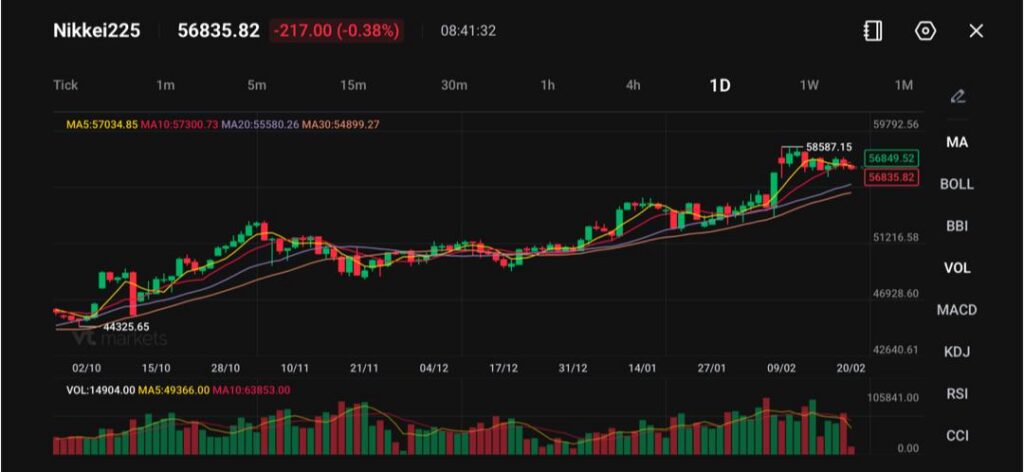
Price is currently hovering around the 5-day (57,034) and 10-day (57,301) moving averages, with both starting to flatten. The 20-day (55,580) and 30-day (54,899) averages remain well below current price, reflecting the strength of the underlying trend.
As long as the index holds above the 20-day average, the medium-term structure remains constructive.
Immediate support sits in the 56,000–56,500 zone, followed by stronger support near 55,500, which aligns with the 20-day moving average and previous breakout levels.
A sustained move below that region would suggest a deeper corrective phase. On the upside, a break back above 58,000 would reassert bullish momentum and reopen the path toward the psychological 60,000 level.
Market Implications
The Nikkei’s 1% drop signals that global macro risks are beginning to overshadow local drivers. If geopolitical tensions escalate within the 10–15-day window referenced by US officials, risk aversion may deepen and push the index lower.
Conversely, any easing in Middle East tensions or stabilisation in US private equity markets could restore confidence and support a rebound.
A sustained hold above recent consolidation zones would suggest the pullback is corrective rather than the start of a broader downturn.
For now, the Nikkei remains sensitive to dollar strength, oil prices, and global liquidity conditions. Traders will watch whether external risks intensify or stabilise in the coming sessions.
Learn more about trading Indices on VT Markets today.









