






Key Points
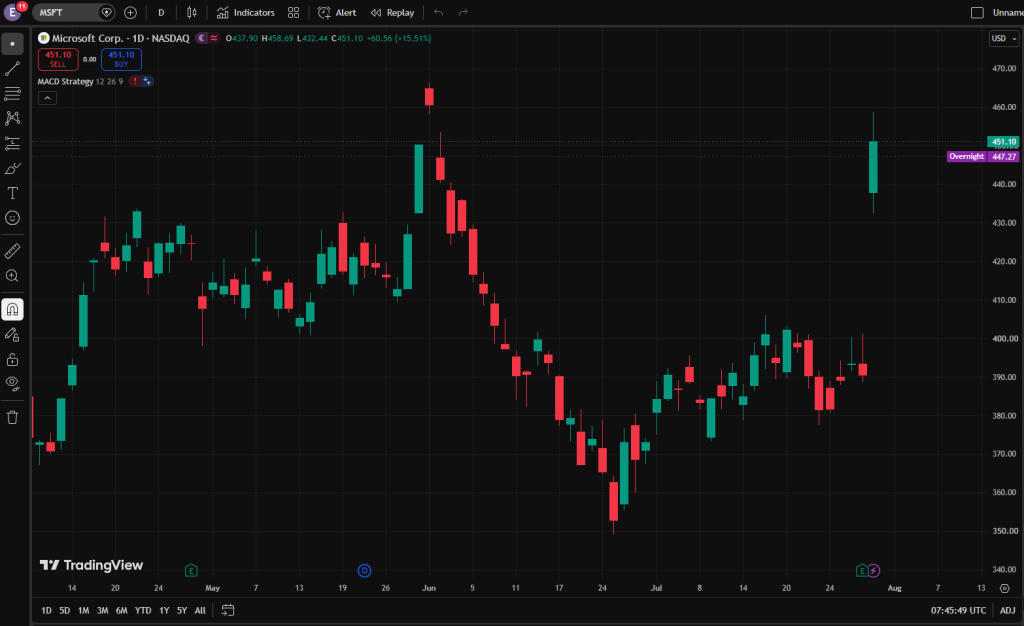
- Microsoft shares jumped around 15% after stronger-than-expected fourth-quarter earnings, as investors gained confidence in the company’s AI and cloud growth strategy.
- Revenue reached approximately $90 billion, while earnings per share came in at $4.74, beating analyst expectations.
- Azure revenue surpassed the $100 billion milestone for the first time, highlighting strong demand for cloud computing and AI-related services.
- Investors are reassessing whether Microsoft’s large AI investments can continue supporting sustainable revenue growth.
- Traders are watching Azure momentum, AI adoption, Copilot expansion and future capital expenditure plans.
Microsoft shares surged around 15% after the company delivered stronger-than-expected fourth-quarter results, easing concerns over whether its large artificial intelligence investments could translate into meaningful revenue growth.
The company reported quarterly revenue of approximately $90 billion, exceeding analyst expectations of around $87.7 billion. Earnings per share reached $4.74, above market forecasts of $4.25.
The strongest performance came from Microsoft’s cloud business. Its Intelligent Cloud segment generated approximately $39.3 billion in revenue, ahead of expectations, while Azure revenue surpassed the $100 billion milestone for the first time.
The results highlighted continued demand for cloud infrastructure, enterprise software and AI-related services as businesses expand their adoption of artificial intelligence technologies.
Why Traders Are Watching Microsoft
Microsoft remains one of the most closely watched companies in the AI ecosystem due to its strong position in cloud computing, enterprise software and artificial intelligence services.
The latest earnings report shifted market focus from concerns over rising AI investment costs towards whether Microsoft can successfully convert these investments into sustainable revenue growth.
Investors are closely watching AI monetisation through products such as Azure AI services and Copilot, with markets assessing whether wider adoption can translate into stronger commercial returns.
Azure growth remains another key factor, with strong cloud demand suggesting businesses continue investing in AI infrastructure, cloud computing and digital transformation.
Microsoft’s results also reinforced expectations that demand for AI infrastructure remains strong, as the company continues expanding data centre capacity and cloud resources to support AI services.
Investors will continue monitoring whether Microsoft can maintain strong growth while managing the costs associated with expanding AI infrastructure.
Key Trading Levels
| Price Level | What Traders Are Watching |
| $460 | Next resistance area after the earnings-driven breakout |
| $450 | Current trading area and key psychological level |
| $440 | Short-term support after the rally |
| $420 | Previous consolidation support |
| $400 | Major support zone |
Microsoft shares are trading around the $450 area after the sharp earnings-driven rally.
The immediate focus is whether buyers can maintain momentum above the $450 level. A sustained move higher could bring the $460 resistance area into focus.
However, after a significant one-day gain, some profit-taking may occur. A move below $440 could indicate weakening momentum and shift attention towards the $420 support zone.
Bullish and Bearish Setups
| Setup | Trigger | Potential Market Reaction |
| Bullish Breakout | Move above $460 | MSFT may extend gains as buying momentum continues |
| Bullish Continuation | Hold above $450 | Buyers may remain in control after earnings |
| Range Consolidation | Stay between $440 and $460 | Price may consolidate after the sharp move higher |
| Bearish Pullback | Break below $440 | Shares may retest the $420 support area |
| Deeper Correction | Fall below $420 | Selling pressure may increase towards $400 |
Microsoft shares remain supported by strong earnings momentum, but traders are assessing whether the latest rally can continue after the sharp move higher.
The bullish scenario requires buyers to maintain support above the $450 area and break above $460. A sustained breakout could support further upside.
The bearish scenario strengthens if MSFT falls below $440, which could signal profit-taking and a deeper correction.
Disclaimer
The price levels and market scenarios above reflect the author’s view at the time of writing and do not represent financial advice or an official recommendation from VT Markets. Traders should conduct their own analysis and manage risk carefully.
Trade Microsoft CFDs With VT Markets
Microsoft remains closely watched as investors assess developments across artificial intelligence, cloud computing, enterprise software and technology sector growth.
With VT Markets, traders can access Microsoft CFDs alongside other shares, indices, forex, gold, oil, ETFs and global CFD markets from one platform.
This allows traders to monitor Microsoft price movements while comparing developments across AI-related companies, technology stocks and broader market trends.
Use VT Markets’ charting tools to monitor Microsoft price movements, technical levels and market reactions following earnings reports and major company developments.
Start trading share CFDs with VT Markets.
Why Trade Microsoft CFDs With VT Markets?
Microsoft CFDs allow traders to take a view on the company’s share price movements without owning the underlying shares.
This flexibility can be useful when Microsoft reacts to earnings results, AI developments, cloud growth, capital expenditure plans and changes in investor expectations.
If Microsoft continues its AI-driven growth momentum, traders can monitor potential bullish scenarios. If market sentiment weakens, traders can assess possible downside risks.
CFDs are leveraged derivative products, meaning relatively small market movements can magnify both gains and losses compared with the margin deposited.
What to Watch Next
The next focus for Microsoft will be whether strong AI and cloud momentum can continue supporting future earnings growth.
Traders will monitor:
- Azure growth: Whether cloud revenue continues expanding as AI demand increases.
- AI adoption: Whether Copilot and AI-powered services gain wider enterprise usage.
- Capital expenditure: Whether Microsoft can maintain AI investment while protecting profitability.
- Enterprise demand: Whether businesses continue increasing spending on cloud and productivity solutions.
- Technology sector sentiment: Broader AI and semiconductor trends may influence Microsoft’s valuation.
Microsoft’s latest results improved confidence in its AI strategy, but investors will continue watching whether revenue growth can keep pace with the scale of investment required to build AI infrastructure.
Frequently Asked Questions
Why did Microsoft stock rise?
Microsoft shares rose after the company reported stronger-than-expected fourth-quarter earnings, supported by Azure growth, cloud demand and improving confidence in its AI strategy.
How did Azure contribute to Microsoft’s earnings?
Azure revenue surpassed the $100 billion milestone for the first time, reflecting strong demand for cloud computing and AI-related infrastructure from enterprise customers.
Is Microsoft benefiting from AI?
Microsoft is benefiting from AI through Azure, AI services and products such as Copilot. Investors are watching whether these investments can generate sustainable long-term revenue growth.
What are the key Microsoft stock levels to watch?
The main resistance level is around $460, while support levels are located near $440, $420 and $400.
What could affect Microsoft stock next?
Microsoft shares may be influenced by Azure growth, AI adoption, future capital expenditure plans, earnings performance and broader technology market conditions.
Start trading now — click here to create your real VT Markets account.








