







Key Points
- USDX falls as much as 0.3% to 98.841, its lowest since January 12.
- Renewed US tariff threats revive a broad “Sell America” trade across markets.
The US dollar retreated for a second consecutive session in Asian trading on Tuesday, extending its losses as investor confidence in US assets waned.
The dollar index (USDX) slipped as much as 0.3% to 98.841, marking its weakest level since January 12, as markets reacted to renewed tariff threats from the White House directed at European allies.
The move came after President Donald Trump warned of further tariffs linked to US efforts to secure control over Greenland, reigniting concerns over trade disruption, diplomatic strain, and policy unpredictability.
The reaction echoed the sharp market selloff seen after last year’s Liberation Day tariff announcement in April, when US stocks, Treasuries, and the dollar fell in tandem.
“Sell America” Narrative Gains Traction
Market participants responded by trimming exposure to US assets ahead of the reopening of Wall Street following the Martin Luther King Jr. Day holiday.
According to IG analyst Tony Sycamore, traders are rotating away from the dollar amid fears of prolonged uncertainty, strained alliances, retaliation risks, and accelerating de-dollarisation trends.
While hopes remain that tariff threats could be softened or delayed, the market is increasingly pricing in political risk as a structural factor rather than a temporary shock.
The persistence of the Greenland issue as a national security objective has kept pressure on the greenback.
Technical Analysis
The US Dollar Index (USDX) is under renewed pressure, with price falling to 98.536, down 0.30% on the session.
The chart shows a clear downtrend across the 15-minute timeframe, with price consistently trading below the short-term moving averages (MA5, MA10, MA20, MA30), all of which are flattening and descending—a sign of sustained bearish control.
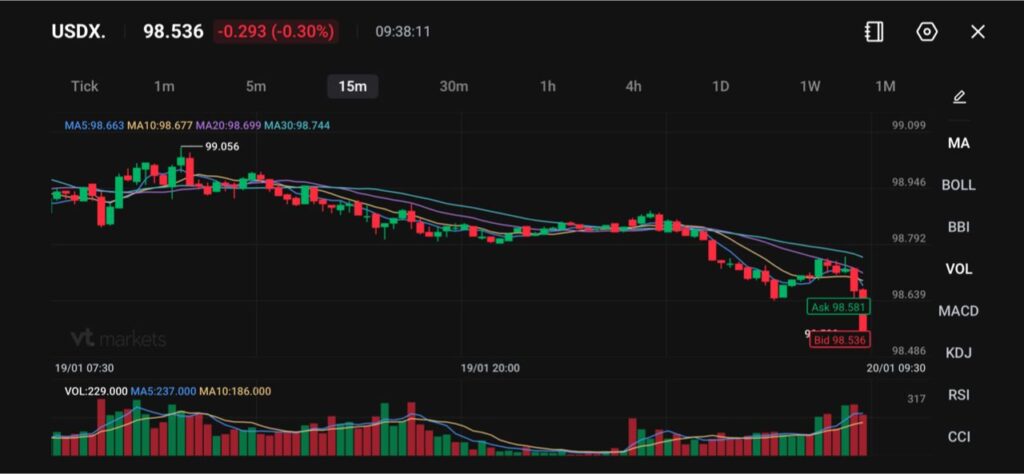
The intraday high of 99.056 now serves as a key resistance level, while near-term support may emerge around 98.48, the current session’s lower bound.
Volume has increased during the latest selling wave, lending some weight to the downward momentum. Unless buyers step in decisively above the 98.70–98.75 band to reclaim short-term moving averages, the path of least resistance remains to the downside.
The MACD appears poised for further divergence, suggesting continued bearish momentum in the near term.
Near-Term Outlook for USDX
Technically, the slide toward the 98.80–98.60 zone places the dollar at risk of deeper consolidation if political uncertainty persists. Any rebound would likely require a clear de-escalation in tariff rhetoric or renewed support from US economic data.
In the near term, the dollar’s path remains vulnerable to headline risk, with markets increasingly sensitive to policy credibility and geopolitical alignment rather than rate expectations alone.
Learn more about trading Indices on VT Markets today.









