


 Insights
  VT
VT 






Key Points
- The dollar index held around 98.3 and was set to fall about 1% for the week
- USD weakness was most pronounced against the euro and antipodean currencies
The US dollar index hovered around 98.3 on Friday, struggling to stabilise after a sharp decline that leaves it down roughly 1% for the week.
Price action reflected a tense and unsettled market mood, as traders reacted to rapid shifts in US foreign policy rhetoric and growing concerns around capital flows.
The selloff followed a volatile sequence of events earlier in the week, when President Donald Trump threatened to impose tariffs on several European countries opposing his plan to take control of Greenland.
That threat rattled risk sentiment and triggered broad selling across US assets. Trump later reversed course, stating that he had secured a framework agreement with NATO for a potential future deal, which eased immediate concerns but failed to fully restore confidence.
The lack of detail around the agreement has kept markets uneasy. Traders have speculated that any deal could involve mineral rights or the installation of missile systems, adding a strategic layer of uncertainty rather than removing it.
This has left the dollar exposed, particularly as political risk premia began to creep back into pricing.
A cautious view remains warranted. The dollar has avoided panic selling, but confidence has clearly weakened, and stabilisation near 98 does not yet signal a durable base.
Asset Reallocation Fears Add to Dollar Pressure
Beyond tariffs, markets have grown wary of Europe’s potential leverage over US financial markets. Attention turned to Europe’s large holdings of US assets, after a Danish pension fund announced plans to exit its US Treasury positions.
While this represents a single decision rather than a coordinated move, it has amplified concerns around capital reallocation risk at a sensitive moment.
This backdrop has left the dollar vulnerable to speculative selling, especially as traders reassess long-held assumptions about US assets being insulated from political disputes.
The result has been persistent pressure on the dollar index, even as risk sentiment stabilised elsewhere.
If similar announcements emerge from other institutional holders, the dollar could face further headwinds. In contrast, a period of silence or reassurance around asset flows could allow the index to consolidate rather than extend losses.
Policy Expectations Offer Limited Support
On the monetary policy front, the Federal Reserve is widely expected to keep interest rates unchanged at its meeting next week.
That expectation has provided little support for the dollar, as it is already fully priced into markets and lacks surprise value.
With rates seen on hold, the dollar has been left to trade primarily on political risk, capital flow speculation, and relative performance against peers. This dynamic has weighed most heavily on the index against the euro and commodity-linked currencies, where sentiment has improved modestly as US-specific risks took centre stage.
A cautious outlook suggests that unless the Fed delivers a clearer signal on future policy direction, interest rate expectations alone are unlikely to lift the dollar in the near term.
Technical Analysis
The US Dollar Index (USDX) is trading slightly higher at 98.139, up 0.07% after bouncing off a session low of 98.059. The index had spent most of the previous session grinding lower from its recent high at 98.651, with the price slipping below all key short-term moving averages.
However, early signs of recovery are emerging, with the latest candles edging back above the 5- and 10-period MAs on the 15-minute chart.
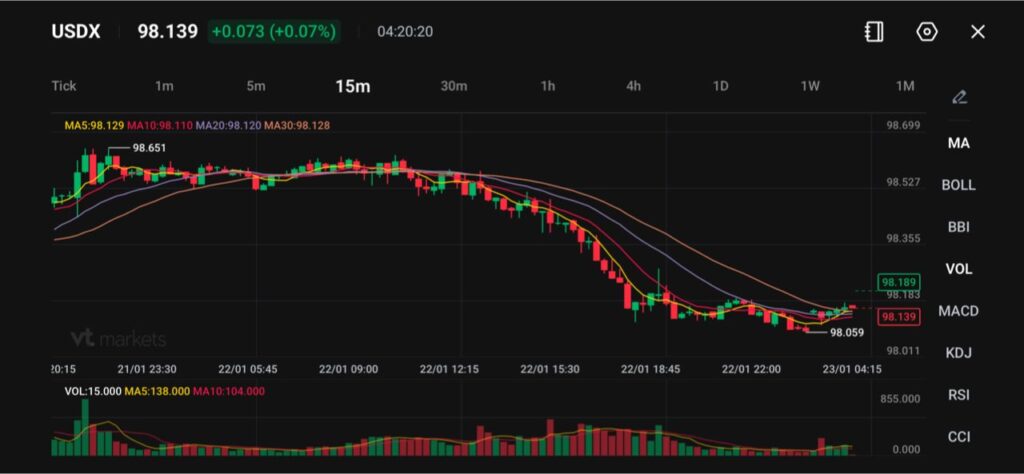
Momentum appears to be stabilising, and if the price can hold above the 98.10–98.18 zone, we may see a modest attempt to retest higher levels.
That said, overall sentiment remains cautious, and a sustained move back above 98.35 would be needed to negate the recent bearish pressure.
Short-Term Outlook
The dollar index remains under pressure as markets digest political reversals, speculative asset flow risks, and a steady Fed outlook.
Losses have been contained for now, but sentiment remains fragile after a week defined by sharp swings rather than clear direction.
If geopolitical tensions continue to cool and asset flow fears subside, the dollar may stabilise around current levels.
However, any renewed escalation in rhetoric or further signs of institutional diversification away from US assets could reopen downside risks, keeping the index in deep water as the week draws to a close.
Learn more about trading Indices on VT Markets today.









