






Key Points
- AUD/USD fell below 0.6950 and reached its weakest level in around two weeks after Australia’s June inflation figures undershot market expectations.
- Australia’s monthly CPI slowed to 3.8% year-on-year in June from 4.0% in May, while prices declined 0.1% month-on-month.
- Quarterly trimmed mean inflation rose 0.8% and reached 3.6% annually, below market expectations and the RBA’s previous forecast.
- Markets reduced the probability of an August RBA rate increase to around 4% from 21% before the data, while the estimated chance of another increase before year-end fell to approximately 50%.
The Australian Dollar fell after softer inflation reduced expectations of an RBA rate increase in August. AUD/USD dropped around 0.3% to 0.6953, near a two-week low, while a firm US Dollar added pressure.
Monthly inflation slowed to 3.8% in June, while quarterly CPI eased to 4.0%. Core inflation reached 3.6%, below market and RBA forecasts.
Although inflation remains above the RBA’s 2%–3% target, the softer data reduced the immediate need for another rate increase.
Why Traders Are Watching the Aussie Dollar
Softer inflation sharply reduced expectations for another RBA rate increase. The chance of an August hike fell from 21% to 4%. Meanwhile, the probability of a move by year-end dropped to around 50%. Australian three-year bond yields also fell by about 10 basis points, reducing the Aussie Dollar’s yield appeal.
However, further tightening remains possible. RBA Governor Michele Bullock said underlying inflation was still too high and that the Bank was prepared to raise rates again if needed.
AUD/USD will also depend on the Federal Reserve. A hawkish decision could strengthen the US Dollar and pressure the pair, while cautious guidance may support stabilisation.
Key AUD/USD Trading Levels
| Price Level | What Traders Are Watching |
| 0.702 | Immediate resistance zone after the recent recovery attempt. A break above this area could strengthen bullish momentum. |
| 0.7 | Key psychological resistance level. Sustained trading above this level may signal renewed upside interest. |
| 0.6947 | Current trading area as AUD/USD consolidates after the recent rebound. |
| 0.692 | Near-term support level. A break below this area could increase downside pressure. |
| 0.688 | Recent swing low and major support zone. A move below this level could expose further weakness. |
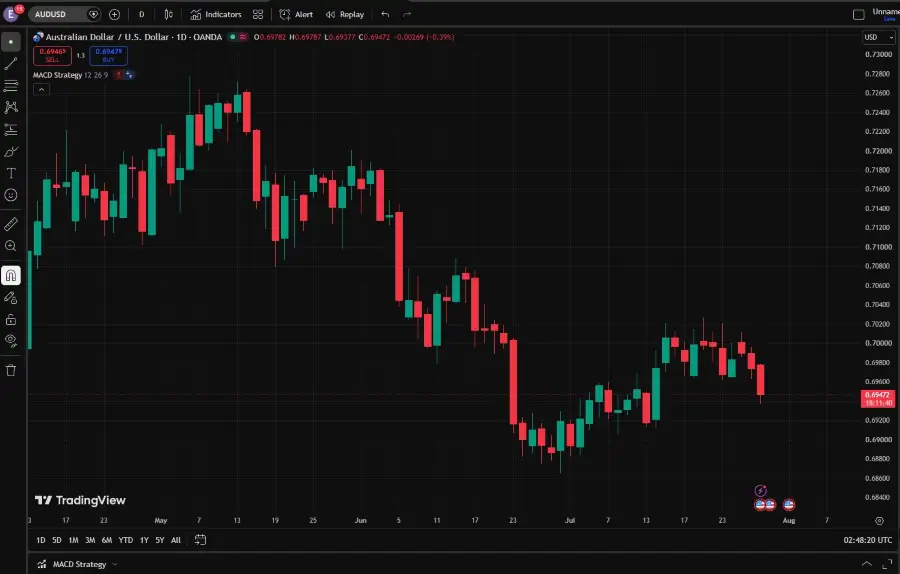
AUD/USD is trading around the 0.6950 area after recovering from recent lows near 0.6880.
The pair has struggled to break above the 0.7000 resistance zone, suggesting buyers are facing pressure near higher levels. A sustained move above this area could improve the short-term outlook, while a break below 0.6920 may shift focus back towards the recent lows.
Bullish and Bearish Setups
| Setup | Trigger | Potential Market Reaction |
| Recovery Attempt | Hold above 0.6920 | Buyers may attempt another move towards 0.7000. |
| Bullish Breakout | Break above 0.7020 | Momentum could improve and push AUD/USD towards higher resistance areas. |
| Range Consolidation | Hold between 0.6920 and 0.7000 | The pair may continue moving sideways while traders await new catalysts. |
| Bearish Breakdown | Fall below 0.6920 | Selling pressure could increase towards 0.6880. |
| Deeper Decline | Break below 0.6880 | The pair may enter a broader correction phase. |
AUD/USD remains at a technical crossroads as traders assess US dollar movements, Australian economic expectations and broader risk sentiment.
The bullish scenario would require buyers to regain control above the 0.7000 resistance area. A sustained move above 0.7020 could strengthen recovery momentum and open the path towards higher levels.
The bearish scenario strengthens if AUD/USD falls below the 0.6920 support level. A continued decline could increase selling pressure towards the 0.6880 support zone, with a break below this area potentially exposing further downside.
Disclaimer
The price levels and market scenarios above reflect the author’s view at the time of writing and do not represent financial advice or an official recommendation from VT Markets. Traders should conduct their own analysis and manage risk carefully.
Trade AUD/USD With VT Markets
The Australian Dollar remains sensitive to inflation data, RBA policy expectations, commodity-market developments and changes in global risk sentiment.
With VT Markets, traders can access AUD/USD and other forex CFDs through MetaTrader 4, MetaTrader 5 and the VT Markets App. Traders can also monitor forex alongside indices, precious metals, energies, shares and other CFD markets.
Charting tools can be used to follow price trends, economic releases and key support and resistance levels as the next Australian Dollar setup develops.
Start trading forex CFDs with VT Markets.
Why Trade the Aussie Dollar With VT Markets?
Australian Dollar CFDs allow traders to take a view on movements in AUD/USD and other AUD pairs without directly owning or exchanging the underlying currencies.
This provides flexibility when markets react to Australian inflation, employment figures, RBA decisions, Federal Reserve announcements and changes in global market sentiment.
AUD/USD offers direct exposure to the relative outlooks for Australia and the United States. AUD crosses such as AUD/JPY and AUD/NZD can provide a different perspective by removing the US Dollar and focusing on other central-bank or regional developments.
What to Watch Next
The immediate focus for AUD/USD is the Federal Reserve’s policy decision and its guidance on the future path of US interest rates. A firmer US Dollar could maintain pressure on the pair, while a less hawkish message may help the Australian Dollar recover some of its CPI-driven decline.
Traders will also monitor:
- RBA meeting on 11 August: Policymakers will assess whether the earlier rate increases and moderating domestic demand are sufficient to bring inflation back towards target.
- RBA Statement on Monetary Policy: Updated economic and inflation forecasts are scheduled for 11 August and may provide further guidance on the rate outlook.
- Australian labour and activity data: Signs of a weaker labour market or softer consumer demand could further reduce tightening expectations.
- US Dollar and Treasury yields: Changes in Federal Reserve expectations may influence the interest-rate differential between Australia and the United States.
- Oil prices and geopolitical developments: Energy costs remain relevant to both inflation expectations and broader risk sentiment.
- Chinese economic indicators: Australia’s trade exposure means changes in Chinese growth and commodity demand can influence Australian Dollar sentiment.
- Next Australian CPI release: The ABS is scheduled to publish July inflation data on 26 August 2026.
From a technical perspective, 0.6950 is the first recovery level to watch. A sustained return above 0.7000 could improve momentum, while a break below 0.6900 may expose AUD/USD to a deeper correction.
Frequently Asked Questions
Why did the Australian Dollar fall?
The Australian Dollar declined because June inflation was softer than expected. The figures reduced the perceived need for the RBA to increase interest rates again in August, weakening the rate support previously available to the currency.
Does softer inflation mean the RBA will reduce interest rates?
Not necessarily. Inflation remains above the RBA’s 2% to 3% target range, and Governor Michele Bullock has said that another increase remains possible if inflation does not return sustainably to target. The latest data mainly reduced expectations for an immediate increase rather than establishing a clear path towards lower rates.
What are the main AUD/USD levels to watch?
The immediate levels are 0.6950 and 0.6900 on the downside. Resistance can be found near 0.7000, followed by 0.7030, 0.7070 and 0.7100.
What could help AUDUSD recover?
A recovery could be supported by a weaker US Dollar, less hawkish Federal Reserve guidance, stronger Australian economic data or renewed expectations that the RBA may need to maintain restrictive policy. Technically, the pair would first need to recover above 0.6950 and then challenge the 0.7000 to 0.7030 resistance area.
Start trading now — click here to create your real VT Markets account.








