



Key points
- ASML shares closed at $1,815.27 on Wednesday, 15 July 2026, gaining approximately 2.2% after the company reported stronger-than-expected second-quarter results.
- Second-quarter sales reached €9.33 billion, exceeding analyst expectations of around €8.80 billion, while net income also beat forecasts.
- ASML raised its 2026 sales outlook to €43 billion–€45 billion, supported by strong demand for advanced semiconductor manufacturing equipment.
- The company plans to expand EUV and DUV production capacity as customers increase investment in AI-related chips.
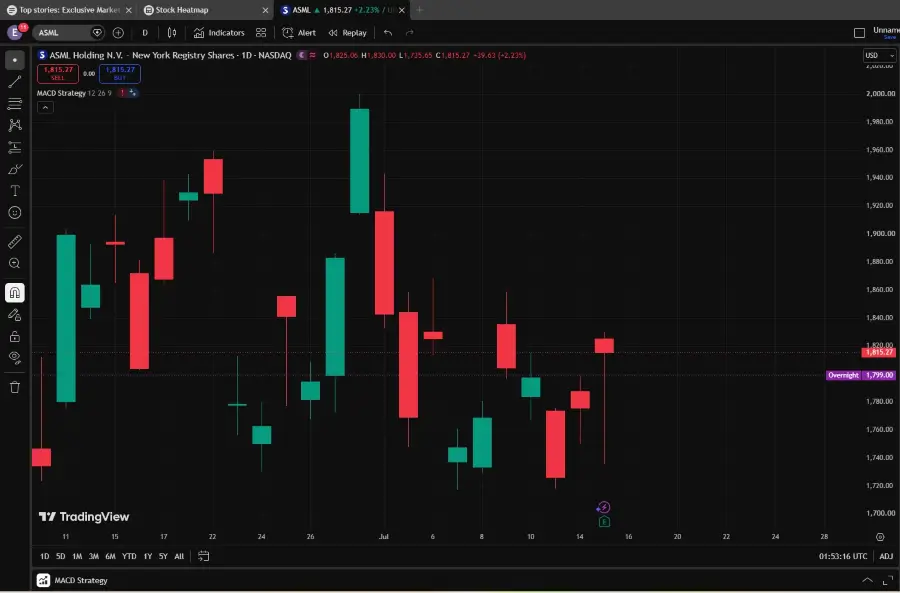
- The ASML daily chart shows immediate resistance near $1,830, while the $1,799–$1,800 area is the first support zone to monitor.
ASML Holding shares advanced on Wednesday after the semiconductor equipment manufacturer reported stronger-than-expected second-quarter results and raised its 2026 sales outlook.
The Nasdaq-listed shares closed at $1,815.27, up approximately 2.2% from the previous close of $1,776.11. The session was volatile, with ASML trading between $1,735.65 and $1,830.00 as investors assessed the earnings results, upgraded guidance and semiconductor demand outlook.
ASML reported second-quarter net sales of €9.33 billion, above analyst expectations of approximately €8.80 billion. Net income reached €2.92 billion, also exceeding market forecasts.
The company also raised its full-year 2026 net sales outlook to €43 billion–€45 billion, compared with its previous forecast range of €36 billion – €40 billion.
The stronger outlook reinforced expectations that demand for advanced chipmaking equipment remains supported by AI infrastructure investment.
Why Traders Are Watching ASML
ASML remains one of the most important companies in the global semiconductor supply chain because its lithography systems are required to produce many advanced chips.
The company’s extreme ultraviolet (EUV) technology enables semiconductor manufacturers to produce advanced logic chips and high-performance semiconductors used in artificial intelligence, data centres and high-performance computing.
Major semiconductor manufacturers, including TSMC, Samsung Electronics, SK Hynix, Micron and Intel, rely on ASML equipment as they expand production capacity.
For traders, ASML’s results provide insight into the health of semiconductor capital spending. Strong orders and higher production plans may indicate that chip manufacturers expect AI-related demand to remain firm, while weaker spending trends could signal a slowdown in the broader semiconductor cycle.
AI Demand Supports Capacity Expansion
AI-related investment has increased demand for advanced logic chips, memory products and semiconductor manufacturing equipment.
ASML said demand from customers remained strong, supporting plans to expand production capacity. The company expects to increase low-NA EUV capacity by around 30% in 2027, with further expansion under consideration for 2028.
The company also plans to increase DUV immersion capacity as customers continue investing in semiconductor manufacturing.
Most of the additional EUV capacity planned through 2027 has already been allocated, highlighting strong customer demand for advanced lithography systems.
Semiconductor Industry Outlook Remains in Focus
ASML’s strong results came during a period of mixed sentiment across semiconductor stocks.
ASML’s earnings supported confidence in AI-related semiconductor demand, but investors remain selective after a strong rally in chip-related shares.
The market is closely watching whether semiconductor companies can continue delivering earnings growth that justifies current valuations.
Future developments in AI chip demand, semiconductor capital expenditure plans and customer expansion strategies will remain important drivers for ASML’s share price.
Risks That Could Limit ASML’s Upside
Despite the stronger outlook, several risks remain.
One key factor is semiconductor capital spending. If customers slow expansion plans or delay new projects, demand for ASML equipment could weaken.
The adoption of next-generation High-NA EUV technology is another area traders are monitoring. While the technology offers improved chip manufacturing capabilities, the equipment is expensive and complex to implement.
Export restrictions also remain a factor. Chinese customers are an important part of ASML’s sales mix, although the company faces limitations on selling its most advanced systems to China.
Any changes in semiconductor regulations or customer investment plans could affect future revenue growth.
ASML Key Trading Levels
| Price Level | What Traders Are Watching |
| $1,880 | Wider resistance zone from the recent recovery area |
| $1,840 | Short-term breakout level after earnings reaction |
| $1,830 | Immediate resistance and latest trading range ceiling |
| $1,815.27 | Current closing area |
| $1,799–$1,800 | First support zone and psychological price area |
| $1,735.65 | Latest session low and major downside support |
ASML is currently trading below the immediate resistance area near $1,830. A move above this level could indicate renewed buying interest and bring $1,840 into focus.
A stronger recovery above $1,840 could shift attention towards the $1,880 resistance area.
On the downside, the $1,799–$1,800 zone is the first support area to monitor. A break below this level could weaken the short-term recovery and expose the latest session low near $1,735.65.
Bullish and Bearish Scenarios
| Setup | Trigger | Potential Market Reaction |
| Bullish Recovery | Move above $1,830 | ASML may retest $1,840 |
| Bullish Extension | Break above $1,840 | Buyers may target $1,880 |
| Range Consolidation | Hold between $1,799 and $1,830 | Shares may continue consolidating after earnings volatility |
| Bearish Breakdown | Break below $1,799 | ASML may retest $1,735.65 |
The bullish scenario depends on ASML reclaiming the $1,830 resistance level. A confirmed move above this area could suggest that buyers are regaining control after the earnings-driven volatility.
A break above $1,840 would strengthen the recovery setup and bring the $1,880 area into focus.
The neutral scenario is consolidation between $1,799 and $1,830, suggesting that traders are waiting for clearer signals from semiconductor demand, AI investment trends and broader technology sentiment.
The bearish scenario strengthens if ASML falls below $1,799. A confirmed break could increase downside pressure and bring the latest session low near $1,735.65 back into focus.
Trade ASML CFDs With VT Markets
ASML remains an important market for traders following artificial intelligence, semiconductor demand, technology earnings and global equity sentiment.
With VT Markets, traders can access ASML share CFDs alongside forex, gold, oil, indices, ETFs and other global CFD markets from one platform. This allows traders to monitor ASML price movements while tracking broader semiconductor trends and technology market conditions.
Use VT Markets’ charting tools to monitor support, resistance, moving averages and breakout behaviour as the next ASML setup develops.
Learn more about trading Shares CFDs on VT Markets here.
Why Trade ASML as a CFD?
ASML CFDs allow traders to take a view on rising or falling price movements without owning the underlying shares.
This flexibility can be useful when ASML reacts to earnings results, semiconductor demand changes, AI investment trends and broader technology market movements.
If ASML breaks above resistance, traders can monitor potential upside momentum. If price falls below support, traders can track possible downside continuation.
What to Watch Next
The next ASML move will depend on both company-specific developments and broader semiconductor trends.
Key factors to monitor include:
- Semiconductor capital expenditure plans from TSMC, Samsung, Intel, Micron and SK Hynix
- Demand for AI accelerators and advanced memory chips
- Expansion progress for EUV and DUV production capacity
- Adoption of High-NA EUV technology
- Semiconductor export-control developments
- Whether ASML can maintain support above the $1,799–$1,800 area
ASML’s upgraded outlook suggests strong demand remains in place. However, the earnings-day volatility shows that investors remain focused on whether AI-related semiconductor growth can continue to justify current expectations.
Frequently Asked Questions
Why did ASML shares rise?
ASML shares rose after the company reported stronger-than-expected second-quarter results and raised its 2026 sales outlook. The improved guidance reflected continued demand for advanced semiconductor manufacturing equipment linked to AI and high-performance computing.
How much did ASML shares move?
ASML’s Nasdaq-listed shares closed at $1,815.27 on 15 July 2026, gaining approximately 2.2%. The stock traded between $1,735.65 and $1,877.00 during the session.
Why is ASML important for AI chip production?
ASML produces advanced lithography systems, including EUV technology, which are used by semiconductor manufacturers to produce leading-edge logic and memory chips used in AI applications, data centres and high-performance computing.
What was ASML’s 2026 outlook?
ASML raised its 2026 net sales outlook to €43 billion–€45 billion, up from its previous forecast range of €36 billion–€40 billion, supported by strong demand for semiconductor manufacturing equipment.
What are the main ASML support and resistance levels?
The immediate resistance level is near $1,830, followed by $1,840 and $1,880. The first support zone is around $1,799–$1,800, while the latest session low near $1,735.65 represents a wider downside reference.
What risks could affect ASML shares?
Key risks include slower semiconductor capital expenditure, delays in AI-related chip demand growth, slower adoption of advanced EUV technology and changes to semiconductor export regulations.
Could ASML shares continue rising?
ASML’s outlook remains supported by semiconductor demand and AI infrastructure investment. However, future price movement will depend on earnings delivery, customer spending plans, valuation concerns and broader technology market sentiment.








