






Key Points
- AMD shares reversed lower after its Q2 2026 earnings report, rising 7% during regular trading hours to close at $518.58 before falling nearly 9% after-hours as investors reassessed the company’s AI growth outlook.
- AMD reported record quarterly revenue of $11.54 billion, supported by strong demand for AI and data centre products, with data centre revenue reaching $6.7 billion.
- Despite strong results and positive guidance, investors focused on whether AMD’s future AI growth can exceed already elevated market expectations.
- Competition in AI hardware remained a key market focus, with Nvidia maintaining a strong position following developments involving major AI infrastructure projects, including SpaceX’s Nvidia partnership.
- Traders are monitoring AMD’s data centre expansion, AI accelerator strategy and ability to gain market share in an increasingly competitive semiconductor sector.
Advanced Micro Devices Inc (AMD) shares reversed lower after its Q2 2026 earnings report, despite delivering record financial results and a stronger-than-expected outlook.
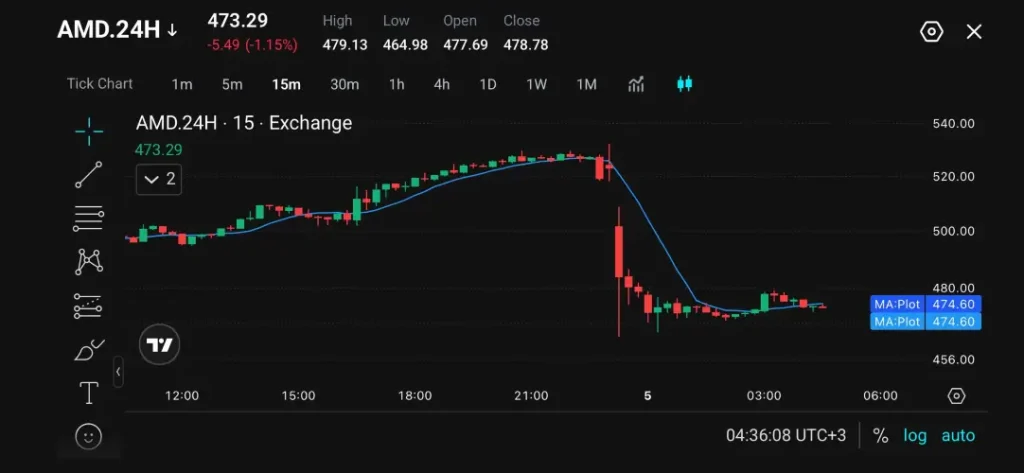
AMD shares climbed 7% during Tuesday’s regular trading session, closing at $518.58, as investors reacted positively to strong AI and data centre demand. However, the stock fell nearly 9% in after-hours trading toward the $472-$474 area after the earnings release as markets reassessed whether the results were strong enough to justify already elevated expectations.
AMD reported quarterly revenue of $11.54 billion, beating expectations, while data centre revenue reached $6.7 billion, driven by continued demand for AI computing infrastructure.
Despite the strong results, the market reaction showed that investors were looking beyond headline earnings and focusing on whether AMD can continue delivering growth at a pace that matches expectations.
Why Traders Are Watching AMD
AMD remains a key company in the AI semiconductor race as investors assess its ability to capture a larger share of the expanding AI infrastructure market.
The company has been strengthening its position through data centre processors, AI accelerators and broader AI solutions. Growth in its data centre business highlights continued demand, but traders are watching whether AMD can close the gap with Nvidia in a highly competitive market.
Nvidia remains the dominant force in AI hardware, and developments involving major technology companies continue shaping expectations across the sector.
SpaceX’s decision to build exclusively on Nvidia’s AI architecture has reinforced attention on Nvidia’s ecosystem strength, highlighting the competitive challenge AMD faces as it attempts to gain further AI market share.
The key question for investors is whether AMD’s AI growth can continue accelerating enough to support its valuation, or whether expectations have already moved too far ahead of fundamentals.
Key Trading Levels
| Price Level | What Markets Are Watching |
| $480.00 | Immediate resistance after the earnings-driven decline |
| $490.00 | Recovery level if buyers regain momentum |
| $473.29 | Current price area and short-term reference |
| $465.00 | Immediate support near recent after-hours lows |
| $460.00 | Key downside support if selling pressure continues |
| $450.00 | Deeper support zone if bearish momentum accelerates |
AMD is trading around the $473 area after reversing sharply following its earnings release, with investors reassessing whether strong AI demand can justify elevated growth expectations.
The stock is currently attempting to stabilise below the $480 resistance level, with a move above this area potentially opening the way toward $490.
On the downside, $465 remains an important short-term support level, while a break below this zone could expose the $460 and $450 areas.
Bullish and Bearish Setups
| Setup | Trigger | Potential Market Reaction |
| Recovery Attempt | Break above $480.00 | AMD may retest the $490.00 resistance area as buyers attempt to recover after the earnings sell-off |
| Bullish Continuation | Move above $490.00 | Buyers may target higher levels around $500.00 if confidence in AMD’s AI growth outlook improves |
| Range Consolidation | Hold between $465.00 and $480.00 | Price may continue stabilising as markets reassess AI expectations and semiconductor valuations |
| Bearish Pullback | Break below $465.00 | Selling pressure may increase towards the $460.00 support area |
| Deeper Correction | Fall below $460.00 | AMD may move towards the $450.00 psychological support level |
AMD remains at a critical technical point after its earnings-driven reversal. The bullish scenario depends on whether buyers can reclaim the $480-$490 resistance zone, which could indicate that investors are looking beyond short-term disappointment and focusing on long-term AI growth.
The bearish scenario becomes more likely if AMD fails to hold above $465, potentially bringing the $460 and $450 support areas into focus as investors continue evaluating AI growth expectations and competitive pressure from Nvidia.
Disclaimer
The price levels and market scenarios above reflect the author’s view at the time of writing and do not represent financial advice or an official recommendation from VT Markets. Traders should conduct their own analysis and manage risk carefully.
Trade AMD CFDs with VT Markets
AMD remains one of the most closely watched semiconductor stocks, with price movements influenced by AI investment trends, earnings results, data centre demand and industry competition.
With VT Markets, traders can access AMD CFDs alongside global shares, indices, forex, commodities and other CFD markets through MT4, MT5 and the VT Markets App.
Start trading share CFDs with VT Markets.
Why Trade AMD CFDs With VT Markets?
AMD CFDs allow traders to gain exposure to movements in AMD’s share price without owning the underlying stock.
The share price can react to earnings results, semiconductor demand, AI developments and broader technology market sentiment.
CFD trading involves risk, and leverage can magnify both potential gains and losses.
What to Watch Next
AMD’s next direction will depend on how markets assess the company’s AI growth trajectory, competitive position and ability to convert strong demand into sustainable returns.
Key factors include:
- AI growth execution: Investors will watch whether AMD can continue expanding its AI business and demonstrate that its investments in AI accelerators and data centre products can generate long-term growth.
- Data centre momentum: Continued growth in AMD’s data centre segment will remain a key valuation driver as demand for AI computing infrastructure expands.
- Nvidia competition: Developments across the AI semiconductor industry will influence expectations around AMD’s ability to gain market share against Nvidia and other chip providers.
- Customer adoption: New partnerships, large-scale deployments and demand from cloud providers will provide further signals on AMD’s position within the AI infrastructure market.
- Broader semiconductor sentiment: Changes in investor expectations toward AI spending and technology valuations could continue affecting AMD’s share price volatility.
From a technical perspective, markets are watching whether AMD can hold support around $465-$460, while a move above $480-$490 could signal renewed recovery momentum.
Frequently Asked Questions
Why did AMD stock fall after beating earnings expectations?
AMD shares declined after earnings despite strong results because investors focused on whether future AI growth could exceed already elevated expectations. The market was looking for stronger signs of accelerating returns from AI infrastructure investments.
Why is AMD stock volatile?
AMD stock volatility is driven by changing expectations around AI demand, competition within the semiconductor industry, valuation concerns and investor reactions to earnings guidance.
What is driving AMD’s growth?
AMD’s growth is supported by rising demand for AI computing, data centre expansion, AI accelerators and its broader semiconductor product portfolio.
How does AMD compete with Nvidia?
AMD competes with Nvidia through its AI accelerators, data centre processors and integrated AI solutions. Investors are watching whether AMD can capture a larger share of the expanding AI infrastructure market
Why is Nvidia important for AMD investors?
Nvidia remains the leading company in AI hardware, and developments affecting Nvidia’s ecosystem can influence expectations for the wider AI semiconductor sector, including AMD.
What levels are traders watching for AMD?
Traders are watching $480-$490 as the key resistance zone, while $465 and $460 remain important support levels after the recent earnings-driven decline.
Start trading now — click here to create your real VT Markets account.








