






A sudden headline, a weekend gap or a thin market can move prices further in a few seconds than they normally move in an hour. For new traders, these moments are often where the biggest losses happen. The order you attach to a position decides how much of that move you have to take. This guide looks at the main types of stop-loss order: the trailing stop-loss, the standard stop-loss and the stop-limit, plus the guaranteed stop-loss that some brokers offer.
Choosing between a trailing stop loss, a stop loss and a stop limit comes down to what happens after your price is reached. Trailing stop loss follows the price, stop loss closes at whatever price is available, and a stop limit may not close at all. The differences will show up most clearly when markets move fast.
If you trade contracts for difference (CFDs), these differences matter even more. With a CFD, you trade the price movement of an index, currency pair, commodity or share without owning it. Because CFDs use leverage, every point the market moves past your stop is multiplied by your position size.
Key definitions
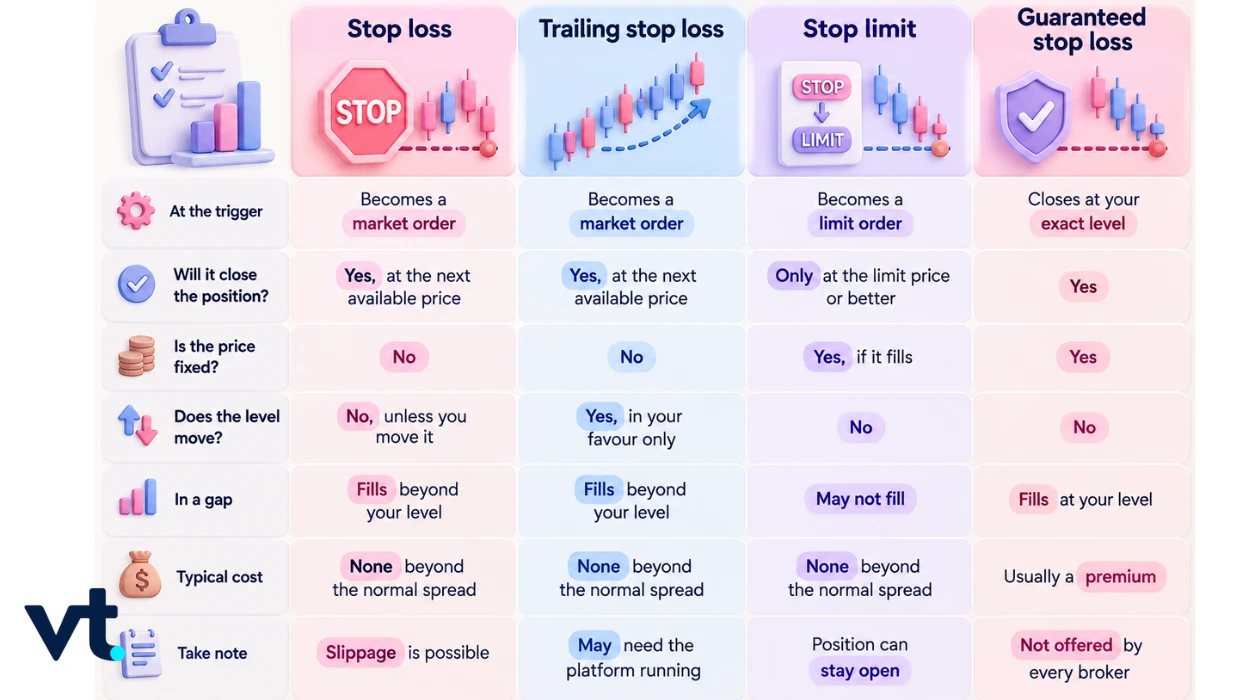
- Stop loss: closes your position at the next available price once your stop level is reached.
- Trailing stop loss: a stop that moves with the price when it goes in your favour and stays put when it does not.
- Stop limit: triggers at a stop price, then fills only at your limit price or better.
- Guaranteed stop loss: closes at your exact level whatever the market does, usually for a fee. Not every broker offers one.
- Gap: the price jumps from one level to another with no trading in between, often after weekends, at the open or after major news.
- Slippage: the difference between the price you asked for and the price you got.
What happens to orders when markets move fast
In a fast market, prices change faster than orders can be matched at each level. An order can then be filled far from the price you set, or not filled at all. Gaps and slippage become more likely when volatility rises and liquidity thins. Two well-documented events show how far this can go.
- 6 May 2010, US shares. During the “flash crash”, the joint SEC and CFTC report found that more than 20,000 trades in over 300 securities were executed at prices 60% or more away from their levels minutes earlier. Some traded as low as one penny. The report notes that many retail stop-loss orders were triggered as prices fell. Those trades were later cancelled.
- 15 January 2015, Swiss franc. The Swiss National Bank removed its minimum exchange rate of CHF 1.20 per euro without warning. A BIS working paper records that the franc rose by 40% against the euro within minutes. With few or no prices between levels, stops were filled far from where they had been set.
These are extreme cases, but the same mechanics apply on a smaller scale around any news release or weekend open. Traders cannot control market gaps. What they can control is the instructions they leave in place before it happens.
Why traders use stop orders to manage risk
Every trade is placed through an order, which tells your broker when and at what price to open or close a position. A market order fills straight away at the best available price. A limit order fills only at your price or better. A stop order waits until a set level is reached. For a full overview, see order types in CFD trading and order types on the VT Markets app.
The stop loss is the most commonly used stop order for managing risk. It closes a position once the market reaches a price you choose. It sets your exit before emotion can influence the decision and stays active even when you’re not monitoring the market. In a long position it sits below the current price, and in a short position it sits above.
To place one, follow how to set a stop loss and take profit on the VT Markets app.
For fixed-pip, percentage, ATR and support-based approaches, read effective stop loss strategies. For trading technicalities, see how to calculate stop loss and take profit.
The risk of stop losses: slippage during price gap
A stop loss sets an exit trigger, but not a guaranteed exit price. Once the stop level is reached, the order is triggered and executes at the next available price. In a gap, that price can be well beyond the level you set.
The SEC’s investor bulletin on stop orders says, “The stop price is not the guaranteed execution price for a stop order.” VT Markets’ makes the same distinction: during high volatility, price gaps or low liquidity, the final execution price may differ from the stop level.
Example: How slippage affects a stop loss
- You buy an index CFD at 5,000 and set a stop loss at 4,950. Your planned loss is 50 points.
- News comes out while the market is closed, and it reopens at 4,920.
- Your stop is triggered because the price is below 4,950. With the first available price around 4,920, the position closes there.
- Your loss is 80 points, not 50. The extra 30 points is slippage. At $10 a point, that amounts to $300.
A widening spread can also cause a stop to trigger. On many CFD platforms, long positions close at the bid price and short positions close at the ask. If the spread widens, the relevant bid or ask price may reach your stop even when the chart price you are watching does not. Spreads can widen during periods of volatility or lower liquidity. Brokers may also differ in the price they use to trigger stop orders.
Trailing stop loss and how it works
A trailing stop loss moves with the market by a set distance when the price goes your way and stays where it is when the price moves against you. Once it is triggered, it behaves like a standard stop loss. For the full definition, see what is a trailing stop loss.
Example: A trailing stop loss on a long position
- You buy an index CFD at 5,000 with a trailing distance of 50 points behind the price. Your stop starts at 4,950.
- The price rises to 5,120, and your stop follows it up to 5,070.
- The price dips to 5,090. Your stop does not move and stays at 5,070.
- The price falls to 5,070. The stop is triggered and the position closes at the next available price.
In a short position, this works in reverse: the stop trails above the price and moves down as the market falls.
How far behind should a trailing stop sit?
There is no single correct distance. One reference point is how far the market typically moves. If an index usually swings 60 points in a session, a 20-point trail is likely to be hit by ordinary movement. A 150-point trail may give back most of a move before it closes. Many traders read that normal range from the Average True Range (ATR) and set the trail as a multiple of it.
Where trailing stops falls short
Trailing stops are often better suited to trending markets because they allow a position to continue while moving the exit level behind it. Keep three limits in mind:
- It is still a stop. Once triggered, it becomes a market order and can slip in a gap, just like a standard stop loss.
- It may need your platform running. On MetaTrader, the trailing stop runs on the trading platform rather than the server. If the platform is switched off, the trailing mechanism stops updating; Only the last stop level it placed remains active.
- It may not start immediately. On MT4, the trail only begins once the position is profitable by the trailing distance. Until then, there is no stop unless you set one yourself.
Why do some traders choose a stop limit instead?
Both orders above share the same trade-off: a stop loss and a trailing stop will get you out, but they cannot promise the price you get. In a thin or jumpy market, such as share trading after trading hours or currency pairs moments after a data release, some traders would rather risk the order not being filled than accept a price far from their level. What they want is certainty of price, and that is what a stop limit order is designed to give.
How do stop limit orders work on CFD platforms?
On CFD platforms, a stop limit is mostly a pending order used to open a trade, not to close one. MetaTrader 5 offers Buy Stop Limit and Sell Stop Limit orders, and the VT Markets app also supports stop limit orders. In practice, a stop limit controls the price you enter at, while a stop loss or trailing stop loss manages your exit. For a wider overview, see types of orders in forex trading.
Difference between a stop loss and a stop limit
A stop loss turns into a market order when it is triggered, so it closes your position but not at a fixed price. A stop limit turns into a limit order, so it fills only at your chosen price or better. In a fast move, it may not fill at all. Put simply, choosing between a stop loss and a stop limit means choosing between a certain exit and a certain price. A standard order cannot give you both.
A stop limit has two prices:
- Stop price: the level that activates the order.
- Limit price: the worst price you are willing to accept.
How each stop order handles the same price gap
Here is the same example as before: an index CFD bought at 5,000, a position worth $10 a point, and a market that reopens at 4,920. The figures are illustrative.
| Order in place | What happens | Result |
| Stop loss at 4,950 | Triggered, closes at about 4,920 | Loss of 80 points, or $800 |
| Trailing stop of 50 points, still at 4,950 | Triggered, closes at about 4,920 | Loss of 80 points, or $800 |
| Stop limit: stop 4,950, limit 4,945 | Activated but not filled | Position still open, 80 points down and exposed to further moves |
If the price recovers to 4,945, the stop limit can fill. If it keeps falling to 4,850, the loss keeps growing. The SEC bulletin lists this as the main risk: a stop-limit order may not be executed if the price moves away from the limit.
What is a guaranteed stop loss?
A guaranteed stop loss closes your position at exactly the level you set, even if the market gaps through it. The broker absorbs the slippage and usually charges a fee for this. In the example above, a guaranteed stop at 4,950 would close at 4,950, a loss of 50 points ($500) plus any premium.
Where it is offered, a guaranteed stop usually comes with conditions:
- A premium, charged either when the stop is placed or only when it is triggered.
- A minimum distance from the current price.
- Limited coverage, for example only on certain markets or at certain times.
A reminder: guaranteed stops are a feature of specific brokers and products, not of the market itself, and many brokers do not offer them. Check the order ticket and product pages for your own account before you rely on one. On the VT Markets app, a stop loss is a standard stop, and the help page states that it does not fix the exact exit price in all market conditions. A guaranteed stop is also separate from negative balance protection, which deals with an account falling below zero, not with the price of a single exit.
Which stop order should you use?
Each of the four orders answers a different question. Do you need to be out of the trade no matter what? Do you want to lock in gains as the market moves your way? Is the price you get more important than whether you get filled? Or are you willing to pay so that both are covered?
As a rough guide:
- A stop loss suits most traders as a basic safety net in every position, as long as you accept that the exit price can slip in a gap.
- A trailing stop loss suits trending trades where you want to protect profits without closing early.
- A stop limit suits entering a trade at a controlled price, but it is a weak tool for protecting a position that is already open.
- A guaranteed stop loss suits positions held through high-risk events such as weekends or major data releases, where your broker offers one and the premium is worth paying.
A practical checklist to set stops order in CFD trading
Setting a stop-loss order comes down to five things: the level, the distance, the size, the timing and the platform. These steps use indicators you can find on most charts.
- Start with the chart. Many traders place a stop beyond a recent swing, low or high, or past a support or resistance level, so normal movement is less likely to reach it. A moving average can help show the trend.
- Measure current volatility. ATR shows how far a market typically moves in a period. A stop or trail set well inside one ATR is more likely to be hit by ordinary swings.
- Leave room for the spread. It can widen around news and rollover and reach a stop that looked safe on the chart.
- Size the position to the stop. Work out the loss of money if the stop is hit, include some allowance for slippage, and compare that with your account. With leverage, slippage is multiplied by your position size. Our guides to the risk reward ratio and what a pip is explain the arithmetic.
- Look at the calendar. Gaps and slippage are most common around releases, such as non-farm payrolls and central bank decisions. See trading forex on news releases.
- Know your market’s hours. Markets that close overnight or at weekends can reopen at a different price. See forex and gold market hours.
- Check how your platform handles the order. Find out whether a trailing stop runs on the server or on your device, and which price triggers your stop.
Common mistakes to avoid
- Moving a stop further away during a losing trade. This turns a planned loss into an unplanned one.
- Expecting a stop limit to protect an open position. In a gap it may not fill, leaving the position fully exposed.
- Confusing a stop loss with a stop-out. A stop loss is your own instruction on one position. A stop-out happens when the broker closes positions automatically because account equity has fallen below the required margin. See our guide to margin calls, and check VT Markets’ product pages for the levels that apply to your account.
Try it yourself: open a demo account and place the same trade three ways: with a stop loss, with a trailing stop and with a stop limit entry. Watch how each one reacts around a scheduled news release. You can also add ATR to a chart on Web Trading or view your stop as a price line on the VT Markets app.
Markets where order choice matters most
Each market gaps and moves in its own way, so orders behave differently from one to the next.
- Share CFDs follow exchange hours, so results released after the close often cause a gap at the next open. See the guide to trading CFD shares.
- Crypto trades around the clock and has a history of very large percentage drops in short periods. Start with how to trade crypto for beginners.
- The Volatility Index (VIX) tends to jump when share markets fall quickly. See our volatility index explainer.
- Indices and gold react sharply to economic data and central bank decisions. See what indices are and our beginner’s guide to gold trading.
Which orders hold up in fast markets?
No order type holds up perfectly in every fast market, and each one gives something up. The table shows how they have tended to behave in four common situations.
| Situation | Stop loss | Trailing stop loss | Stop limit |
| News release spike | Closes, often with slippage | Closes, often with slippage; a tight trail is hit early | May be skipped if the price jumps past the limit |
| Weekend or opening gap | Closes at the opening price | Closes at the opening price | Stays unfilled if the open is beyond the limit |
| Sharp dip and quick rebound | Closes near the low, before the rebound | Closes near the low, before the rebound | May stay open through the dip, with no protection if it continues |
| Steady trend | Holds its level | Follows the trend and moves the exit | Holds its level |
Two patterns stand out. Orders that become market orders are reliable on the exit but not on the price. Orders that become limit orders are reliable on the price but not on the exit. The 2010 flash crash showed the first trade-off at its most extreme. The 2015 Swiss franc move showed why the second matters, because any position left open stayed exposed as the price kept moving.
Start online CFD trading with VT Markets today
In fast markets, the real question is not which order is best but which trade-off you are choosing. For CFD traders, that choice sits alongside position size, because leverage multiplies any slippage. Risk is part of every trade, and an order does not remove it. What an order does is let you decide in advance how much exposure you are willing to carry, which is the core of smart risk management.
If you’re ready to put trailing stop loss, stop loss and stop limit orders to work, VT Markets gives you access to the tools and platforms to get started.
Trade on MetaTrader 4 (MT4) and MetaTrader 5 (MT5), built for speed, reliability and advanced order features for when news lands and markets move fast.
New to trading? Practise with a VT Markets demo account before you commit to a live account. It is a useful way to see how each order type behaves around news releases across currency pairs, indices and commodities, without putting real money at risk.
Open your live account with VT Markets today and access secure, transparent and competitive CFD trading across some of the world’s most popular markets.
General Disclaimer: The content on this website is provided for general informational purposes only and does not take into account your specific investment objectives, financial circumstances, or particular needs.



