




Key Points
- Crude oil slipped towards $82 per barrel on Tuesday after reaching five-week highs.
- Hopes for renewed US-Iran ceasefire talks reduced some geopolitical risk premium.
- Oil prices remained elevated as military strikes and retaliation continued.
- Concerns over energy shipments remain due to Strait of Hormuz disruptions and Red Sea risks.
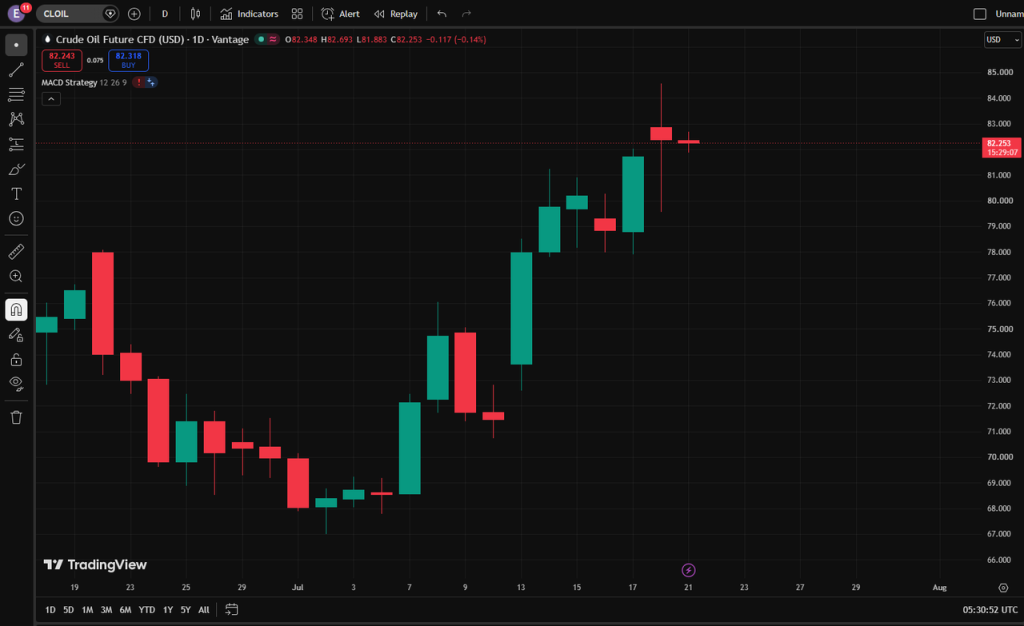
- The WTI crude oil chart shows immediate resistance near $82.70, while $81.80 is the first support level to monitor.
Crude oil prices slipped towards $82 per barrel on Tuesday, easing from five-week highs as expectations grew that renewed ceasefire discussions between the US and Iran could resume.
Mediators worked to encourage both sides to agree to a new ceasefire, with reports pointing to a possible 10-day truce. However, oil markets remained focused on whether diplomatic efforts could reduce ongoing risks to global energy supplies.
Oil prices stayed elevated after US attacks on Iran entered a tenth consecutive day, while Tehran maintained retaliatory strikes against neighbouring countries.
The conflict has kept inflation concerns in focus as traders assess whether higher energy prices could continue to influence global monetary policy expectations.
Why Traders Are Watching Oil
Oil prices remain caught between two opposing forces: easing geopolitical expectations and continued supply risks.
Signs of potential negotiations have reduced some of the immediate risk premium priced into crude markets. However, the conflict has already created concerns about disruptions to major energy routes, particularly around the Strait of Hormuz and the Red Sea.
Further escalation could keep supply concerns elevated and support prices, while progress towards a ceasefire may reduce pressure on energy markets.
For crude oil traders, the main focus is whether diplomatic developments can outweigh the supply risks created by ongoing military activity.
US-Iran Conflict Keeps Supply Risks Elevated
The US military said it completed its latest strikes on Iran, targeting sites it said supported Tehran’s ability to threaten shipping activity in the Strait of Hormuz.
The latest developments came after US attacks on Iran continued for a tenth consecutive night, while Tehran responded with retaliatory strikes against neighbouring countries.
President Donald Trump also warned that Iran would face further consequences following the deaths of three US service members.
The prolonged conflict has increased concerns that disruption around major energy routes could continue to affect global oil flows.
Red Sea Risks Add Another Supply Concern
Energy markets are also monitoring developments beyond the Strait of Hormuz.
Iran-backed Houthi militants announced a maritime blockade affecting Saudi shipping routes, raising concerns over potential risks to oil shipments through the Red Sea.
The development adds another layer of uncertainty for global energy markets, with traders assessing whether disruptions could spread across multiple shipping routes.
If supply concerns intensify, oil prices may remain supported despite temporary relief from ceasefire expectations.
Key Trading Levels
| Price Level | What Traders Are Watching |
| $85.00 | Wider resistance near recent conflict-driven highs |
| $83.00 | Psychological resistance and potential breakout level |
| $82.70 | Immediate resistance near the latest session high |
| $82.25 | Current chart area |
| $81.80 | Immediate support near the latest consolidation |
| $80.00 | Short-term support and key downside reference |
| $78.00 | Previous consolidation zone and deeper support area |
The WTI crude oil daily chart shows price trading near $82.25 after opening around $82.35. The latest session high stood near $82.69, while the low was approximately $81.88.
Oil has rebounded from the July lows, but recent price action suggests momentum has slowed as prices consolidate below the $83.00 resistance area.
Immediate resistance is located near $82.70. A sustained move above this level could bring the psychological $83.00 level into focus.
A confirmed break above $83.00 would strengthen the bullish structure and shift attention towards $85.00, which remains a wider resistance area near recent conflict-driven highs.
On the downside, $81.80 is the first support level to monitor. A break below this area could expose $80.00.
Bullish and Bearish Setups
| Setup | Trigger | Potential Market Reaction |
| Bullish Breakout | Move above $82.70 | WTI crude oil may test $83.00 |
| Bullish Extension | Sustained break above $83.00 | Attention may shift towards $85.00 |
| Stronger Upside Move | Break above $85.00 | Oil may extend the recovery from recent lows |
| Range Consolidation | Remain between $81.80 and $82.70 | Traders may wait for clearer US-Iran developments |
| Bearish Pullback | Fall below $81.80 | WTI crude oil may retest $80.00 |
| Deeper Correction | Break below $80.00 | Price may decline towards $78.00 |
The bullish scenario depends on WTI crude oil breaking above $82.70 and holding that level. This would suggest that supply concerns and geopolitical risks remain supportive of prices.
A confirmed move above $83.00 would strengthen the recovery setup and bring $85.00 into focus.
The neutral scenario is continued consolidation between $81.80 and $82.70. Range-bound movement may indicate that traders are waiting for clearer developments in US-Iran negotiations, energy supply risks or broader market sentiment.
The bearish scenario strengthens if oil falls below $81.80. A confirmed break could bring $80.00 into focus.
Disclaimer
The price levels and market scenarios above reflect the author’s view at the time of writing and do not represent financial advice or an official recommendation from VT Markets. Traders should conduct their own analysis and manage risk carefully.
Trade CL-OIL CFDs With VT Markets
CL-OIL remains active when geopolitical developments, energy supply risks, shipping routes and global demand expectations move together.
With VT Markets, traders can access CL-OIL CFDs alongside gold, silver, forex, indices, shares, ETFs and other global CFD markets from one platform. This helps traders track oil price movements while monitoring related developments across inflation expectations, energy markets and broader risk sentiment.
Use VT Markets’ charting tools to monitor support, resistance, moving averages and breakout behaviour as the next CL-OIL setup develops.
Learn more about trading Energies on VT Markets here.
Why Trade CL-OIL as a CFD?
CL-OIL CFDs allow traders to take a view on rising or falling WTI crude oil prices without owning physical oil or futures contracts.
This flexibility can be useful when oil reacts quickly to geopolitical developments, ceasefire negotiations, shipping disruptions, Strait of Hormuz risks and changes in global energy supply expectations.
If CL-OIL breaks higher, traders can monitor potential recovery setups. If geopolitical risks ease or supply concerns fade, traders can assess possible downside continuation.
With VT Markets, traders can follow CL-OIL price action in real time and compare it with other major CFD markets through one account.
What to Watch Next
Developments in the US-Iran conflict remain the main near-term focus for crude oil markets.
Further military escalation or disruption around major energy routes could increase supply concerns and support prices. At the same time, progress towards a ceasefire could reduce geopolitical risk premium and place downward pressure on oil.
Traders will also monitor developments around the Strait of Hormuz and the Red Sea. Any further disruption to shipping routes could increase concerns over global energy flows.
From a technical perspective, $82.70 is the immediate resistance level to watch. A sustained move above this area could bring $83.00 and $85.00 into focus, while a break below $81.80 may expose $80.00.
Frequently Asked Questions
Why are oil prices rising despite ceasefire hopes?
Oil prices remain supported by ongoing supply concerns linked to the US-Iran conflict, including risks around major shipping routes such as the Strait of Hormuz and the Red Sea.
Why does the Strait of Hormuz matter for oil prices?
The Strait of Hormuz is one of the world’s most important energy transit routes. Any disruption could affect global oil supply expectations and increase price volatility.
How do geopolitical tensions affect crude oil?
Geopolitical tensions can increase concerns about supply disruptions, causing traders to price in higher risk premiums. However, progress towards peace negotiations can reduce some of that pressure.
What are the main crude oil levels to watch?
Immediate resistance is near $82.70, followed by $83.00 and $85.00. Immediate support is near $81.80, followed by $80.00 and $78.00.
What could push crude oil higher?
Further conflict escalation, additional supply disruptions, risks to shipping routes or stronger demand expectations could support crude oil prices.
What could push crude oil lower?
A successful ceasefire agreement, reduced supply concerns, weaker demand expectations or a break below key technical support levels could pressure oil prices.










