




Key Points
- WTI crude extended its gains after the US revoked an authorisation covering Iranian oil sales.
- The original authorisation was due to remain in place until 21 August, but authorised transactions must now wind down by 17 July.
- Renewed attacks on commercial vessels and subsequent US strikes raised concerns about shipping through the Strait of Hormuz.
- WTI moved above $71 a barrel in early Wednesday trading.
- Rising OPEC+ output targets and recovering Gulf exports could limit the duration of the geopolitical risk premium.
Global crude oil prices climbed on Wednesday as renewed tension between the US and Iran brought Middle East supply risks back into focus.
The US West Texas Intermediate, commonly followed by traders as CL-Oil, moved to approximately $71.81. The benchmark gained close to 2% after rising by about 3% during Tuesday’s session.
Tuesday’s official settlement placed WTI at $70.44. Prices then extended their advance in post-settlement trading, reaching approximately $72.20 for WTI after the US announced the licensing change. The WTI benchmark were more than 5% above the previous session’s settlement levels at that point.
The move represented a sharp reversal from Monday, when WTI closed at $68.55 as improving supply conditions and higher production expectations weighed on the market.
Why Traders Are Watching This
The immediate catalyst was the US decision to revoke General License X. On 7 July, the Office of Foreign Assets Control replaced it with General License X1, shortening the wind-down period for authorised Iranian oil transactions from 21 August to 17 July. The change increased uncertainty over Iranian exports, although the effect will depend on enforcement and the availability of alternative sales channels.
Shipping risks added to the move after three commercial vessels were struck in or near the Strait of Hormuz, followed by US strikes on Iran. US officials attributed the attacks to Iran, which had not claimed responsibility, while Qatar separately blamed Iran for an attack on a Qatari LNG tanker.
The Strait of Hormuz remains central to the oil outlook because cargoes equal to roughly one-fifth of global oil and LNG supply passed through the waterway before the conflict. Even without full closure, delays, rerouting, higher insurance costs and reduced tanker traffic can increase the supply-risk premium in crude prices.
Key WTI Trading Levels
| Price Level | What Traders Are Watching |
| $72.20 | Post-settlement high. A sustained break above may signal a larger geopolitical risk premium. |
| $71.81 | Early Wednesday’s price and the nearest short-term momentum reference. |
| $70.44 | Tuesday’s settlement. Holding above may support the advance; falling below may indicate fading momentum. |
| $68.55 | Monday’s close and the level from which the latest rally accelerated. |
For WTI, the post-settlement move towards $72.20 provides the nearest event-driven high. A sustained move above that area would indicate that the market continues to add a geopolitical risk premium.
The early Wednesday price near $71.81 is the next immediate reference point. Tuesday’s settlement at $70.44 may help traders assess whether the advance is holding during regular market hours.
Below that, Monday’s close near $68.55 marks the level from which the latest geopolitical rally accelerated.
These are recent event levels rather than confirmed long-term support or resistance zones. Price action may remain sensitive to headlines, particularly outside the main settlement period.
Bullish & Bearish Scenarios
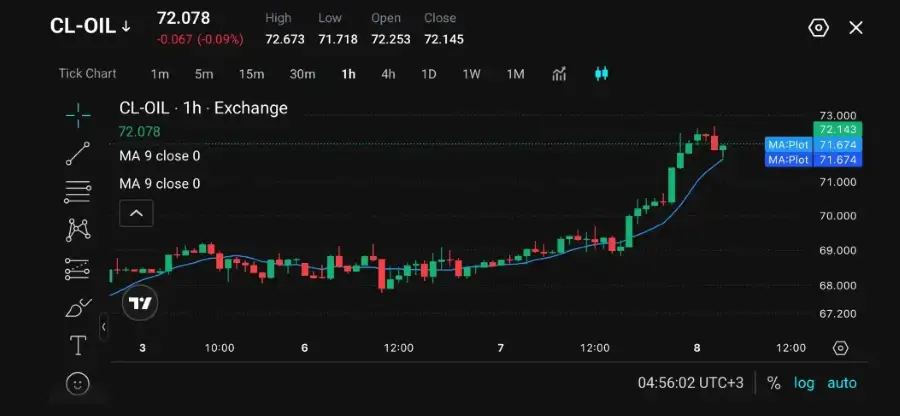
| Setup | Trigger | Potential Market Reaction |
| Recovery Attempt | Move above 72.25 | CL-Oil may retest 72.67. |
| Bullish Extension | Break above 72.67 | Attention may shift towards 73.00. |
| Range Consolidation | Remain between 71.67 and 72.67 | Price may consolidate after the recent rally. |
| Bearish Pullback | Break below 71.67 | CL-Oil may retreat towards 71.00. |
| Deeper Reversal | Fall below 71.00 | Price may revisit the 70.00 region. |
CL-Oil remains supported after its sharp advance, although the pullback from 72.67 suggests that short-term momentum is easing. Price is still trading above the nine-period moving average near 71.67, keeping the immediate structure constructive.
A move above 72.25 could bring 72.67 back into focus. A confirmed break above 72.67 may then open the way towards the 73.00 region. If price remains between 71.67 and 72.67, consolidation may continue as traders assess the sustainability of the recent rally.
On the downside, a break below 71.67 could shift attention towards 71.00. A further fall below 71.00 may expose the 70.00 region. These are short-term chart reference levels rather than confirmed long-term support or resistance zones.
The broader market remains sensitive to renewed US-Iran tensions and shipping risks around the Strait of Hormuz, which have added a geopolitical supply premium to crude oil prices.
Disclaimer
The price levels and market scenarios above reflect the author’s view at the time of writing and do not represent financial advice or an official recommendation from VT Markets. Traders should conduct their own analysis and manage risk carefully.
What Could Limit the Oil Rally?
The latest geopolitical developments are supportive of crude prices, but the wider supply picture remains mixed.
OPEC+ agreed to increase its production target by 188,000 barrels per day from August. The United Arab Emirates also raised output to near-record levels in June, while Saudi Arabia reduced its official selling price for Arab Light crude delivered to Asia.
Exports through the Strait of Hormuz had also been recovering before the latest vessel attacks. Greater availability of Middle East crude contributed to the decline that returned oil prices towards pre-conflict levels earlier in the week.
These supply factors could limit the move if the latest escalation does not cause a sustained disruption to physical oil flows.
Trade Crude Oil Future (USD) CFD With VT Markets
Crude oil can experience sharp price movements when OPEC+ production policy, geopolitical developments, shipping conditions and global demand expectations change.
With VT Markets, traders can access oil and other energy CFDs alongside forex, gold, silver, indices, share CFDs, ETF CFDs and other global markets through one platform.
VT Markets provides the tools to monitor price action, identify key levels and respond as market conditions evolve. Whether crude oil recovers above $72.20 or extends its decline below $68.55, traders can follow the setup using advanced charting tools, flexible account options and access to multiple asset classes.
Start trading crude oil CFDs with VT Markets today.
Why Trade CL-Oil as a CFD?
CFDs allow traders to take a view on both rising and falling oil prices without taking physical delivery of crude.
This can make CL-Oil useful during fast-moving market events, particularly when OPEC+ decisions, geopolitical risks, inventory data and demand expectations create short-term volatility.
With VT Markets, traders can access CL-Oil and other major global markets through one account, making it easier to monitor cross-market opportunities as they develop.
What to Watch Next
Traders will continue to monitor security developments around the Strait of Hormuz and any evidence that commercial vessels are delaying, cancelling or rerouting journeys.
The diplomatic response will also matter. A return to negotiations could reduce the risk premium, while additional strikes or retaliation could keep crude oil volatility elevated.
The 17 July wind-down deadline under the revised US licence will provide another reference point for Iranian export expectations. Traders may watch whether buyers reduce purchases before the deadline and how strictly the restrictions are enforced.
US inventory data will provide a separate fundamental signal. Market sources cited by Reuters indicated that American crude inventories fell during the latest reporting week, while the official US Energy Information Administration report is the next key release for domestic supply conditions.
Frequently Asked Questions (FAQs)
Why did global crude oil prices rise?
Oil prices rose after the US revoked an authorisation permitting Iranian oil sales and launched strikes against Iran following attacks on commercial vessels. The developments increased concern about Iranian exports and shipping through the Strait of Hormuz.
What does CL-Oil represent?
CL-Oil generally refers to West Texas Intermediate crude oil futures. WTI is the main US crude benchmark and is priced separately from Brent, which serves as the primary international benchmark.
Why is the Strait of Hormuz important to oil prices?
The Strait of Hormuz connects major Gulf oil producers with international markets. Before the conflict, cargoes equal to around one-fifth of global oil and LNG supply passed through the waterway. Disruptions can therefore affect shipping costs, delivery times and global supply expectations.
Will the revoked licence automatically reduce Iranian oil exports?
Not necessarily. The licence change increases legal and financial restrictions, but the actual effect depends on enforcement, buyer behaviour, shipping access and Iran’s ability to use alternative export channels.
What should crude oil traders monitor next?
The main factors include tanker traffic through the Strait of Hormuz, further US or Iranian military action, diplomatic negotiations, implementation of the 17 July wind-down deadline, US crude inventory data and changes in OPEC+ production.










