




Key Points
- The Nikkei 225 fell below 69,000 as semiconductor-related heavyweights declined.
- Samsung Electronics forecast second-quarter operating profit of 89.4 trillion won, nearly 19 times the 4.7 trillion won recorded a year earlier.
- Kioxia recorded a double-digit decline, while Tokyo Electron and Advantest also came under pressure.
- Banks, automakers and other value-oriented shares gained, helping the broader TOPIX outperform the Nikkei.
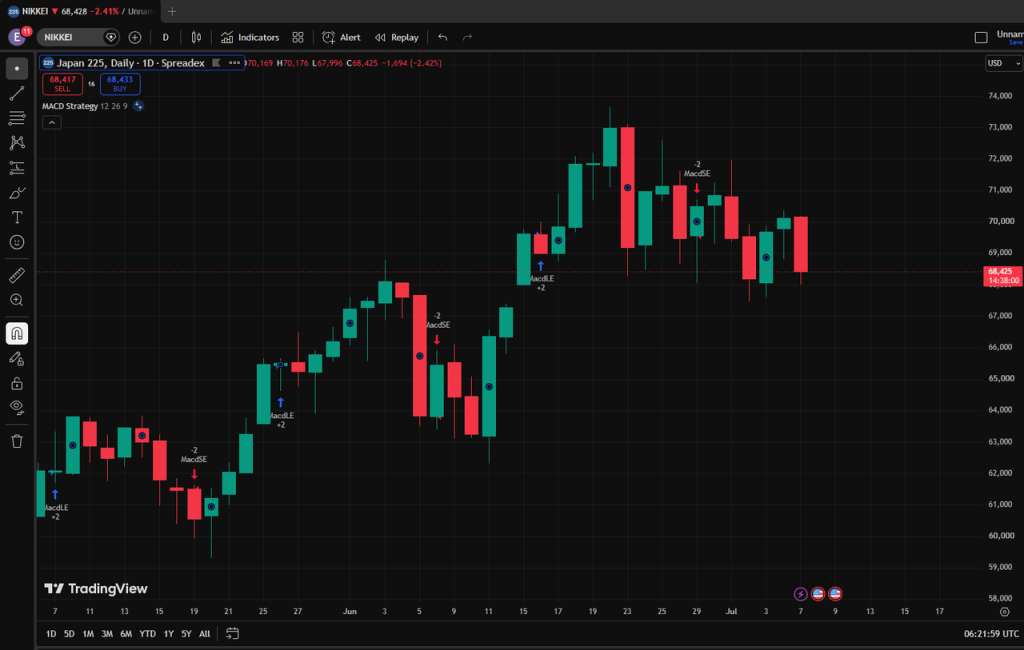
- The Nikkei225 daily chart places immediate support near 68,000, while 69,000 is the first recovery level to monitor.
Japan’s Nikkei 225 fell on Tuesday as a sharp decline in Samsung Electronics triggered broader selling across regional semiconductor shares.
The cash index fell below 69,000 later in the session as losses in technology heavyweights outweighed strength elsewhere in the Japanese market.
The benchmark had opened near 69,460 before falling towards 68,000.
Earlier in the session, memory-chip producer Kioxia fell 10.86%, while Advantest and Tokyo Electron declined 0.64% and 1.85%, respectively.
Samsung’s decline was particularly influential because the company is one of the world’s largest memory-chip producers. Its performance can affect sentiment towards Japanese companies exposed to memory demand, semiconductor testing and chip-production equipment.
Why Traders Are Watching the Nikkei
The Nikkei 225 is particularly sensitive to movements in high-priced technology and semiconductor shares.
Unlike a market-capitalisation-weighted index, the Nikkei is price-weighted. This means companies with higher individual share prices can exert a larger influence on the benchmark, even when most Japanese stocks are trading higher. The index contains 225 companies listed on the Tokyo Stock Exchange’s Prime Market.
This structure helps explain why the Nikkei fell sharply while the broader Japanese market remained comparatively resilient.
Samsung’s reaction also matters because its preliminary operating-profit forecast exceeded market expectations. When a company’s shares fall despite a stronger-than-expected profit forecast, it may indicate that optimistic expectations have already been reflected in valuations.
The move therefore raises questions about whether the recent AI and semiconductor rally is entering a period of consolidation or more sustained profit-taking.
Samsung Profit Forecast Fails to Support Chip Sentiment
Samsung Electronics estimated second-quarter consolidated sales of approximately 171 trillion won and operating profit of 89.4 trillion won.
The operating-profit estimate exceeded the 87.3 trillion won LSEG SmartEstimate and compared with 4.7 trillion won in the same period a year earlier. Revenue was expected to increase by approximately 129% year on year.
Despite the stronger forecast, Samsung shares fell sharply as traders questioned whether elevated memory prices and rapid AI infrastructure investment could continue supporting earnings at the same pace.
Analysts attributed the decline to elevated expectations, profit-taking following the earlier rally and concerns that spending on AI data centres could eventually slow.
The reaction affected semiconductor shares across the region because Japanese chipmakers and equipment suppliers are exposed to many of the same trends, including memory pricing, AI data-centre investment and expectations for future semiconductor demand.
South Korea’s KOSPI also fell sharply, reinforcing the weakness across regional technology markets.
Value Shares Limit the Broader Decline
The broader Japanese market performed better than the Nikkei as traders rotated away from semiconductor and growth stocks towards financial and value-oriented companies.
The TOPIX moved lower after reaching a record high earlier in the session, but its decline remained smaller than that of the Nikkei. Banking shares advanced, including Mitsubishi UFJ Financial Group, Mizuho Financial Group and Sumitomo Mitsui Financial Group. Toyota Motor also gained.
Around 66% of the shares trading on the Tokyo Stock Exchange’s Prime Market advanced, while 31% declined. This indicated that the selling was concentrated in semiconductor-related companies rather than spread evenly across the Japanese equity market.
The distinction between the two indices is important. The Nikkei is price-weighted, while TOPIX is a broader, free-float-adjusted market-capitalisation-weighted index.
Tuesday’s move therefore appeared to reflect sector rotation and profit-taking in technology stocks rather than a complete deterioration in Japanese equity-market sentiment.
Key Trading Levels
| Index Level | What Traders Are Watching |
| 73,000 | Wider resistance near the late-June peak |
| 72,000 | Secondary resistance if the recovery extends |
| 71,000 | Resistance from recent lower highs |
| 70,000 | Major psychological resistance |
| 69,000 | Immediate recovery level |
| 68,425 | Current chart area |
| 68,000 | Immediate support near the latest session low |
| 67,500 | Secondary support |
| 66,500 | Wider downside reference |
The Nikkei225 showed the index near 68,425 after opening around 70,169. The session high stood near 70,176, while the low was approximately 67,996.
The large bearish daily candle indicates strong selling pressure and shows that Nikkei225 moved below the previous 68,500 support area during the session.
The broader chart shows that Nikkei225 remains in a short-term correction after retreating from its late-June peak near 73,000. Recent price action has also produced a series of lower highs, suggesting that near-term momentum remains weak.
Immediate support is now located near 68,000, close to the latest session low. Holding above this area could allow the index to consolidate after the technology-led decline.
On the upside, a recovery above 69,000 could ease immediate selling pressure and bring 70,000 back into focus.
A sustained break above 70,000 would provide a stronger indication that buyers are returning. Further gains could shift attention towards 71,000, followed by the 72,000 to 73,000 resistance region.
A confirmed move below 68,000 could expose 67,500. If that level also fails, the correction may extend towards wider support near 66,500.
Bullish and Bearish Setups
| Setup | Trigger | Potential Market Reaction |
| Recovery Attempt | Move above 69,000 | Nikkei225 may retest 70,000 |
| Bullish Confirmation | Break above 70,000 | Attention may shift towards 71,000 |
| Wider Recovery | Break above 71,000 | The index may approach 72,000 to 73,000 |
| Range Consolidation | Remain between 68,000 and 69,000 | The index may stabilise near recent lows |
| Bearish Continuation | Break below 68,000 | Nikkei225 may decline towards 67,500 |
| Deeper Breakdown | Fall below 67,500 | The correction may extend towards 66,500 |
The bullish scenario depends on Nikkei225 recovering above 69,000 and holding that level. This would suggest that immediate selling pressure is easing and could bring 70,000 into focus.
A stronger recovery would require a confirmed break above 70,000. If buyers clear that psychological level, the index could extend towards 71,000.
A move above 71,000 would strengthen the recovery structure and shift attention towards the wider resistance region between 72,000 and 73,000.
The neutral scenario is consolidation between 68,000 and 69,000. Range-bound movement may indicate that traders are assessing whether the semiconductor decline represents temporary profit-taking or the beginning of a deeper correction.
The bearish scenario strengthens if Nikkei225 falls below 68,000. A confirmed break could bring 67,500 into focus.
Disclaimer
The index levels and market scenarios above reflect the author’s view at the time of writing and do not represent financial advice or an official recommendation from VT Markets. Traders should conduct their own analysis and manage risk carefully.
Trade Nikkei225 CFDs With VT Markets
Nikkei225 can experience sharp movements when semiconductor earnings, regional chip-sector sentiment and shifts between growth and value stocks affect Japan’s equity market.
With VT Markets, traders can access Nikkei225 CFDs alongside other global CFD markets through one platform. This allows traders to follow Japan’s benchmark while monitoring related movements across Asian equities and global technology markets.
Use VT Markets’ charting tools to track support and resistance levels, assess momentum and monitor potential breakout or breakdown setups as market conditions change.
Start trading indices with VT Markets today.
Why Trade Nikkei225 as a CFD?
Nikkei225 CFDs allow traders to take a view on rising or falling movements in Japan’s benchmark index without owning the individual shares that make up the index.
This flexibility can be useful when the Nikkei reacts quickly to semiconductor earnings, regional chip-sector sentiment and shifts between growth and value stocks. If technology shares stabilise and Nikkei225 recovers above key resistance, traders can monitor bullish continuation. If selling pressure persists across semiconductor-related companies, traders can assess downside setups.
With VT Markets, traders can follow Nikkei225 price action in real time, analyse key support and resistance levels and compare the index with other major CFD markets through one account.
What to Watch Next
Traders should monitor whether Samsung Electronics and other South Korean semiconductor shares begin to stabilise following the sharp decline.
The performance of Kioxia, Tokyo Electron and Advantest will also be important. Continued weakness in these companies could maintain pressure on the Nikkei because of the index’s sensitivity to high-priced technology shares.
The rotation into banks, automakers and other value companies should also be watched. Continued strength in these sectors may help limit the broader market decline even if semiconductor shares remain under pressure.
The relative performance of the Nikkei and TOPIX may provide another useful signal. Continued Nikkei underperformance would suggest that weakness remains concentrated in technology and growth shares rather than spreading across the entire Japanese market.
Samsung is scheduled to release its detailed second-quarter results on 30 July, including a breakdown of performance across its business divisions. The release may provide further information about memory demand, chip pricing and the outlook for AI-related infrastructure investment.
For now, 68,000 to 69,000 is the main short-term range for Nikkei225. A confirmed move above 69,000 could bring 70,000 into focus, while a break below 68,000 may expose 67,500.
Frequently Asked Questions
Why did the Nikkei 225 fall?
The Nikkei declined after a sharp fall in Samsung Electronics weighed on regional semiconductor sentiment. The weakness spread to Japanese chip-related companies, including Kioxia, Tokyo Electron and Advantest.
Why did Samsung shares fall despite a strong profit forecast?
Samsung’s preliminary operating-profit forecast exceeded market expectations. However, traders remained concerned about whether the AI-driven memory-chip boom and elevated infrastructure spending could continue at the same pace. The strong result may also have already been reflected in the company’s share price.
Why does Samsung affect the Nikkei?
Samsung is one of the world’s largest memory-chip producers. Changes in its outlook can influence sentiment towards Japanese memory manufacturers, chip-testing companies and semiconductor-equipment suppliers.
Why did TOPIX outperform the Nikkei?
The Nikkei is price-weighted and more sensitive to high-priced technology shares. TOPIX has broader market coverage and benefited from gains in banks, automakers and other value-oriented companies.
Was the decline broad across Japan’s stock market?
No. Around two-thirds of the shares on the Tokyo Stock Exchange’s Prime Market advanced. The decline was concentrated mainly in semiconductor and technology-related companies.
What are the main Nikkei225 levels to watch?
Immediate support is near 68,000, followed by 67,500 and 66,500. Immediate resistance is near 69,000, followed by 70,000 and 71,000.
Could the Nikkei recover?
The Nikkei could recover if semiconductor shares stabilise and Nikkei225 moves back above 69,000. A confirmed break above 70,000 would provide a stronger recovery signal.
What could push the Nikkei lower?
Continued weakness in Samsung and other regional chipmakers, concerns about AI-related valuations or further profit-taking in Japanese technology shares could place additional pressure on the index. A break below 68,000 would strengthen the bearish setup.










