







Key Points
- USD/JPY traded around 161.82, largely flat in early Asian trade.
- The pair remained close to Thursday’s 161.95 high, with 161.96 seen as a key multi-decade threshold.
- US PCE inflation rose 4.1% year-on-year in May, matching market expectations.
- Tokyo inflation accelerated in June, but the yen saw limited support from the data.
- The US-Japan rate gap continues to keep pressure on the yen.
- Intervention risk remains elevated as USD/JPY trades close to 162.00.
The Japanese yen remained under pressure on Friday, trading around 161.82 against the US dollar and holding close to its weakest level in nearly 40 years.
USD/JPY eased slightly from Thursday’s 161.95 level, but the pair stayed near the 161.96 threshold. A sustained move above this area would put the yen at its weakest level against the dollar.
The dollar paused after recent gains, but the yen struggled to recover as traders continued to weigh US rate expectations, Japan inflation data, and the risk of possible intervention by Japanese authorities.
Dollar Strength Keeps Pressure on the Yen
The yen’s weakness remains closely tied to the wider US-Japan rate differential.
Although the dollar index slipped after a three-day advance, the greenback stayed supported by expectations that US interest rates may remain elevated. US PCE inflation rose 4.1% year-on-year in May, in line with forecasts, keeping inflation pressure in focus for the Federal Reserve.
Fed officials also gave mixed signals. Some comments pointed to possible progress in services inflation, while others warned that price pressures remain too high. This leaves traders focused on whether the Fed will keep policy restrictive for longer.
Japan Inflation Adds Policy Pressure
Tokyo inflation data showed that price pressures in Japan continued to firm in June.
Headline Tokyo CPI rose to 1.7% year-on-year, while core CPI increased to 1.6%. A narrower core measure, excluding fresh food and energy, rose to 1.9%.
The data adds pressure on the Bank of Japan to remain alert to inflation risks. However, the yen’s reaction was limited because Japan’s policy rate remains low compared with the US.
For traders, the key question is whether stronger inflation data will translate into clearer BoJ policy signals. Without stronger policy signals, yen rallies may remain fragile.
BoJ Policy Signals Remain in Focus
The Bank of Japan remains a major driver for yen sentiment.
If the BoJ signals a more hawkish path, the yen could find support. A clearer rate-hike outlook may reduce the appeal of yen-funded carry trades.
However, if the BoJ stays cautious, the rate gap between Japan and the US may continue to weigh on the currency. This could keep USD/JPY supported even when the dollar pauses against other major currencies. JPY crosses such as EUR/JPY and GBP/JPY may also remain sensitive to this theme.
Intervention Risk Returns Near Key Levels
Intervention risk has returned as USD/JPY trades close to 162.00.
Markets often become more cautious when the yen approaches historically weak levels. A fast or one-sided move could increase the chance of verbal warnings or direct action from Japanese authorities.
This does not mean intervention is guaranteed. It means traders may need to account for sudden volatility, especially around thin liquidity periods, US data releases, and official comments from Japan.
Technical Analysis
USDJPY is currently trading near a key resistance level around 162.000. The three moving averages are trading very closely to each other, indicating that bullish momentum is starting to slow down.
The MACD indicator signal line is starting to head towards the 50 level, and a bearish histogram has started to form. To look for short opportunities, traders can wait for the signal line to cross below the 50 level.
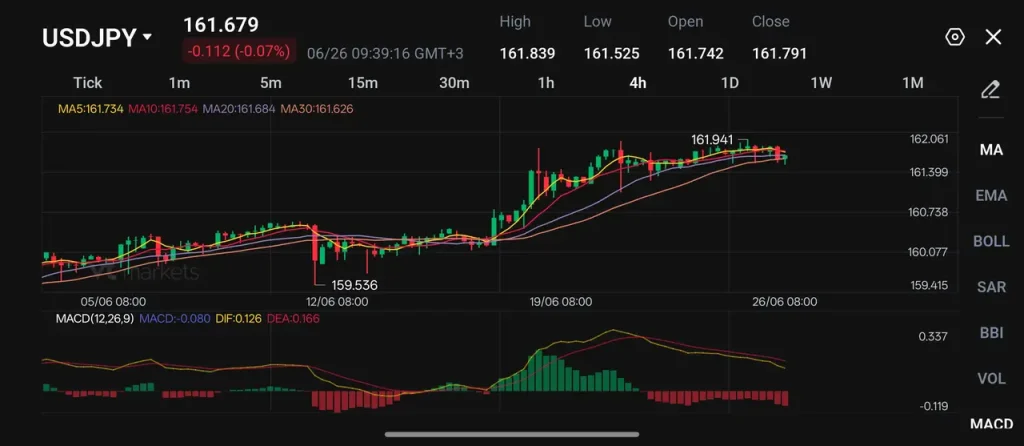
Key levels to watch:
- Major resistance: 162.000
- Support: 161.461
- Major support 160.000
Cautious Forecast
USD/JPY could remain supported if US yields rise, Fed officials maintain a restrictive tone, or the dollar benefits from safe-haven demand. A cautious BoJ stance may also keep the yen under pressure.
The yen could find support if Japanese officials increase intervention warnings, if the BoJ signals a stronger policy response, or if US data reduces expectations for higher rates.
Traders may watch 161.37, 161.58, 161.95, 162.00, 162.12, and 162.33 as near-term levels. Upcoming US inflation data, labour market releases, Fed commentary, BoJ signals, and Japanese inflation figures may shape the next move.
Learn more about trading Forex Pairs on VT Markets here.
Frequently Asked Questions
Why is the yen trading near a 40-year low?
The yen’s weakness is closely tied to the gap between US and Japanese interest rates. With US rates expected to stay elevated and Japan’s policy rate remaining low, the dollar has stayed more attractive relative to the yen. At the time of writing, USD/JPY was trading around 161.82.
What is significant about the 161.96 to 162.00 area?
A sustained move above roughly 161.96 would mark the yen’s weakest level against the dollar since 1986, making it a closely watched multi-decade threshold. The 161.95 to 162.00 zone is also where intervention risk tends to be built, as markets often grow more cautiously when the yen approaches historically weak levels.
Did Japan’s inflation data support the yen?
Tokyo inflation firmed in June, with headline CPI rising to 1.7% year-on-year and core CPI to 1.6%. Even so, the yen saw limited support from the data, largely because Japan’s policy rate remains low compared with the US. The market reaction suggests stronger inflation alone may not lift the yen without clearer policy signals from the Bank of Japan.
What does intervention risk mean for traders here?
Intervention risk refers to the possibility of verbal warnings or direct action from Japanese authorities when the yen weakens quickly or in a one-sided way. It is not guaranteed, but it can introduce sudden volatility, particularly around thin liquidity periods, US data releases, and official comments from Japan.
Which factors could shift the yen’s direction next?
The article points to several. USD/JPY could stay supported if the US yields rise, Fed officials keep a restrictive tone, or the dollar attracts safe-haven demand. The yen could find support if Japanese officials step up intervention warnings, the BoJ signals a stronger policy response, or US data reduces expectations for higher rates. Near-term levels flagged include 161.37, 161.58, 161.95, 162.00, 162.12, and 162.33.










