







Key Points
- Oil trades at $66.375, up 0.16%, near multi-month highs.
- UBS expects Brent to return to $60–$70 range if tensions ease.
- Iran-US nuclear talks remain key driver of risk premium.
Oil traded at $66.375 (+0.16%) on Tuesday, hovering near its strongest levels since early August. Brent futures also remained close to multi-month highs as geopolitical tensions in the Middle East continued to underpin prices.
Recent gains have largely been driven by the risk of supply disruptions, particularly linked to the possibility of US military action against Iran. The prospect of instability in a region critical to global oil flows has embedded a risk premium into crude markets.
Iran and the United States are scheduled to hold a third round of nuclear talks in Geneva on Thursday. While Washington has called for Iran to abandon its nuclear programme, Tehran has firmly rejected such demands and denied pursuing atomic weapons capability. Markets are closely monitoring developments for signs of escalation or de-escalation.
Risk Premium May Gradually Fade
UBS expects oil prices to decline modestly in the coming weeks, provided tensions do not intensify.
The bank said a gradual fading of the global risk premium, combined with easing supply disruptions, should bring Brent back into the $60 to $70 per barrel range. It also set an end-March 2027 Brent forecast of $67 per barrel and widened its assumed WTI-Brent discount to $4 per barrel, up from $3 previously.
This outlook suggests current pricing already reflects a degree of global uncertainty. Should talks progress or tensions cool, some of that premium could unwind.
Technical Analysis
Crude oil (CL) is trading near 66.38, up modestly on the session, as the market continues to extend its recovery from the January low at 54.87.
The daily structure has shifted decisively higher over the past few weeks, with a sequence of higher highs and higher lows signalling improving momentum.
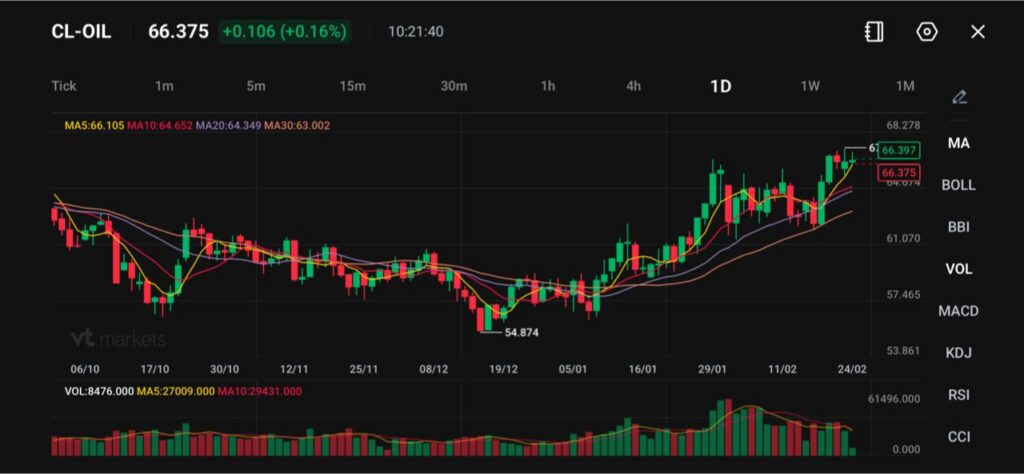
Price is holding above the short-term moving averages, with the 5-day (66.10) and 10-day (64.65) trending upward. The 20-day (64.35) and 30-day (63.00) remain well below current price and continue to slope higher, reinforcing the bullish bias in the medium term.
The recent push toward the 66.50–67.00 region suggests buyers are testing the upper boundary of the current upswing.
Immediate support lies around 64.50–65.00, aligning with the 10- and 20-day averages, followed by stronger support near 62.50–63.00. On the upside, a sustained break above 67.00 would likely open the path toward the 68.50–70.00 zone.
For now, oil remains in a constructive uptrend, with pullbacks appearing corrective rather than indicative of a broader reversal.
Cautious Outlook
Oil prices remain supported by geopolitical risk and tight positioning near recent highs. However, if Iran-US talks reduce the likelihood of supply disruptions, the embedded risk premium may begin to fade.
A sustained move above $68 could open the path toward $70 and beyond, especially if tensions escalate. Conversely, easing rhetoric or constructive diplomatic progress could pressure crude back into the mid-$60s and potentially toward the lower end of UBS’s projected range.
For now, the uptrend remains intact, but its durability hinges on developments in Geneva and the broader Middle East landscape.










