







Key Points
- NZD/USD rebounds from a 2-week low to trade near 0.602 despite the jobless rate hitting a decade high.
- Rate hike bets shift to late 2026, with traders now pricing in a 70% chance of a move by September.
The New Zealand dollar hovered at 0.60201 in early Asia trade, stabilising after last session’s recovery from a two-week low of 0.593. This follows a sharp rally that peaked at 0.60926 on 2 February, before paring gains.
The currency found support at its 5-day moving average of 0.60068 and now trades just above the 20-day moving average (0.59267), suggesting some bullish momentum remains.
Traders appear to be weighing mixed labour market data against sticky inflation and firmer economic growth. The fourth quarter unemployment rate unexpectedly rose to 4.4%, the highest level since 2014. However, employment itself grew by 0.4% q/q, beating forecasts of 0.2%.
This divergence has complicated the Reserve Bank of New Zealand’s outlook, as weak labour data argues against further tightening—yet inflation remains above the 1–3% target band, and growth is starting to show signs of recovery.
As a result, market expectations have pivoted cautiously. Swaps now imply a 70% chance of a rate hike by September, although the RBNZ’s own guidance still points to mid-2027 for the first increase.
This mismatch highlights the tension between forward guidance and market pricing.
Technical Analysis
The NZD/USD pair edged slightly higher to 0.60201, marking a modest gain of +0.06% on the day. The pair is stabilising after a sharp rebound from the recent pullback, which followed a rally that peaked at 0.60926 earlier this month.
Technically, the pair remains in an upward trend, with price action continuing to hold above the MA20 (0.59267) and MA30 (0.58750).
However, short-term momentum has slowed as the MA5 (0.60068) and MA10 (0.60237) begin to converge, indicating potential near-term consolidation.
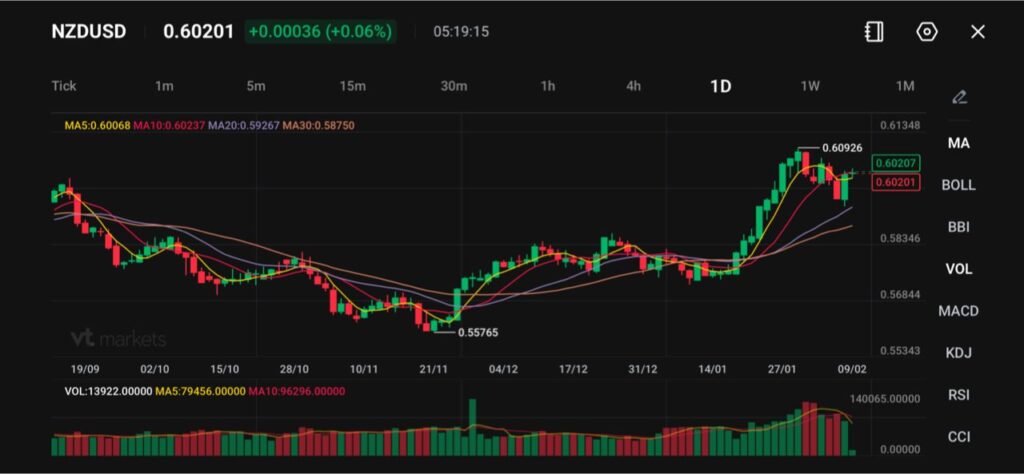
The recent dip to support around 0.592 was met with solid buying interest, highlighting the strength of the underlying bullish structure.
The RSI and MACD indicators (not shown directly in the image, but inferred from price action and volume) suggest that while upward momentum is intact, the rally may be pausing for breath. Volume has eased slightly, implying reduced conviction in the latest moves.
As long as NZD/USD remains above the 0.5950–0.6000 zone, the broader recovery remains valid. A break above 0.60926 could pave the way toward 0.613–0.615, while any fall below 0.592 would expose the pair to deeper correction risks.
Market Implications
In the short term, expect sideways consolidation between 0.597 and 0.609, with a bias to the upside if risk sentiment improves. October hike expectations are building, and rate-sensitive plays like NZD/JPY and NZD/CHF could benefit if global inflation remains sticky.
Traders should watch for key events this month, including US CPI updates and the upcoming RBNZ meeting, for cross-asset sentiment cues.
Learn more about trading Forex Pairs on VT Markets here.










