






Key Takeaways:
- A cent account is a live trading account where balances are displayed in cents (USC) instead of dollars.
- It allows traders to trade forex, gold, silver, and oil with very small capital.
- Cent accounts serve as a bridge between demo and standard accounts, ideal for beginners or strategy testing.
- At VT Markets, cent accounts offer similar spreads and execution speed to standard accounts, just with smaller trade sizes.
What Is a Trading Cent Account?
For many new traders, the hardest part of trading is not learning charts or indicators — it’s placing that first trade with real money.
A trading cent account is designed specifically for this stage. It lets you trade live markets with real prices and real execution, but with significantly reduced financial risk. Instead of showing your balance in dollars, a cent account displays it in cents, making position sizes and potential losses much smaller and easier to manage.
In simple terms, a cent account lets you experience real trading conditions without the psychological pressure that often comes with larger capital.
That’s why cent accounts are commonly used as the next step after a demo account. You are no longer trading with virtual funds, yet you are not exposing yourself to the same level of risk as a standard trading account.
At VT Markets, the cent account is built for traders who want to:
- Move beyond practice mode
- Build confidence in live trading
- Learn proper risk management
- Develop discipline, one trade at a time
How Does a Trading Cent Account Work?
At a glance, a cent account works just like a standard trading account. The key difference lies in how your balance and trade sizes are displayed.
For example, a $50 deposit will appear as 5,000 cents (USC) on your trading platform.
Aside from the account currency denomination, a cent account functions like any other live trading account. You can open and close trades, apply technical analysis, use stop-loss and take-profit orders, and trade in real market conditions.
The key advantage is that each price movement has a much smaller monetary impact, making mistakes less costly and learning more forgiving.
Cent Account vs Standard Account
| Cent Account | Standard Account | |
| What stays the same | – Live market prices – Real-time trade execution – Access to trading tools and indicators – The ability to use stop-loss and take-profit orders – Real profits and losses | |
| What’s different | – Deposit: $50 – Account balance display: USC – Lot size: 5,000 units – Pip value: $0.10 for major currencies | – Deposit: $50 – Account balance display: USD, EUR, JPY etc – Lot size: 5,000 units – Pip value: $10 for major currencies |
How Gold Trading Works on a Cent Account: A Practical Example
On a standard account, one lot of XAUUSD typically represents 100 ounces of gold.
On a cent account, one cent lot of XAUUSD represents just 0.01 of a standard lot.
This smaller contract size allows traders to open much smaller positions, which translates into lower margin requirements, reduced pip value, and significantly lower risk per trade.
To put this into perspective:
If a one-pip movement in gold is worth around $1 on a standard account, the same one-pip move on a cent account may be worth around $0.01, depending on the broker’s setup.
As balances and pip values are smaller on a cent account:
- Losses feel less overwhelming
- Traders are less likely to panic or overtrade
- Position sizing can be adjusted more precisely
- Beginners can focus on execution and discipline, not money stress
This is what makes cent accounts particularly suitable for beginners.
Who Should Open a Cent Account?
Beginner Traders Moving Beyond Demo
For traders taking their first step into live markets, cent accounts are often the most practical transition.
They allow beginners to test strategies, make mistakes, and learn risk control without the fear of large losses derailing confidence early on.
| Scenario | Standard Account Loss | Cent Account Loss | Psychological Impact |
| Poor trade management | -$500 (50% of $1,000) | -$5 (50% of $10) | Devastating vs. Manageable |
| Strategy testing failure | -$200 (20% of $1,000) | -$2 (20% of $10) | Discouraging vs. Educational |
| Single bad trade | -$100 (10% of $1,000) | -$1 (10% of $10) | Painful vs. Negligible |
In short, the key benefits for beginners are:
- Real market exposure without significant losses potential
- Time to develop trading skills in a forgiving environment
- Opportunity to understand how risk tolerance manifests with actual money
Strategy Testers
Cent accounts are also useful for experienced traders who want to validate ideas in live conditions before committing larger capital.
They are commonly used for:
- Testing algorithmic trading systems with real execution
- Validating backtested strategies in current market conditions
- Experimenting with different trading platforms
- Assessing broker execution quality without significant risk
Traders with Low Capital
Individuals unable to commit substantial funds to trading, whether due to financial constraints or competing investment priorities, find cent accounts perfectly suited to their circumstances.
With low capital requirements, they can participate in financial markets meaningfully without diverting resources from other financial goals.
How to Choose the Right Broker for Cent Accounts
Not all brokers offer cent accounts, and among those that do, conditions vary significantly. When choosing a cent account provider, focus on these core factors.
Essential Evaluation Criteria:
- 1) Availability of Different Account Types: Choose a broker that offers multiple account types such as STP, ECN and Swap-Free, so you can choose and scale up smoothly when ready.
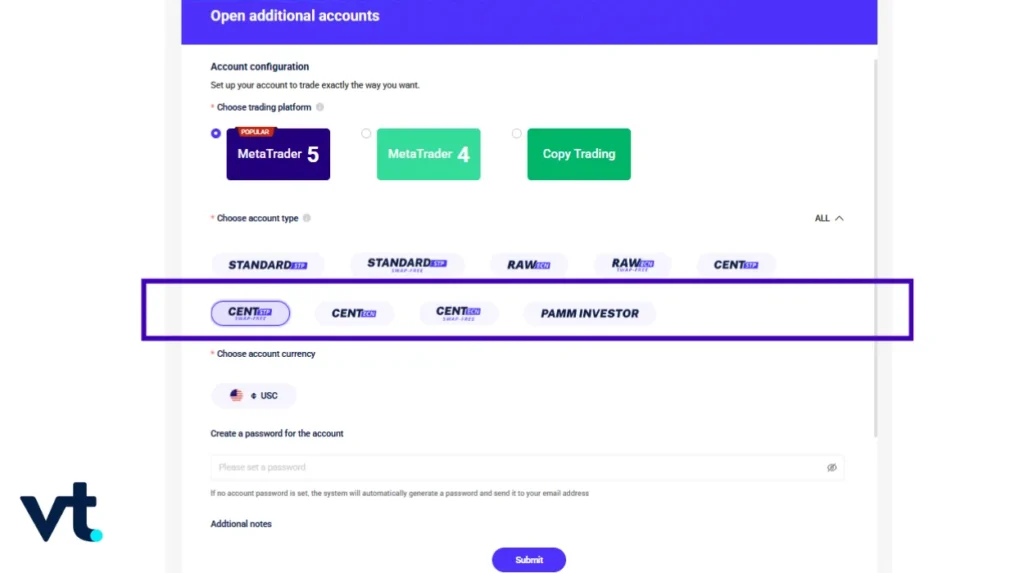
| Dimension | Cent STP | Cent STP Swap-Free | Cent ECN | Cent ECN Swap-Free |
| Execution | STP | STP | ECN | ECN |
| Spread model | Mark-up spread | Mark-up spread | Raw spread | Raw spread |
| Commission | No | No | Yes | Yes |
| Swap / Overnight fee | Yes | No | Yes | No |
| Best for | Beginners, testing | Swap-free beginners | Active traders | Swap-free active traders |
- 2) Trading Conditions: Compare spreads, execution speed, and leverage. At VT Markets, cent accounts offer leverage of up to 500:1, similar to standard accounts.
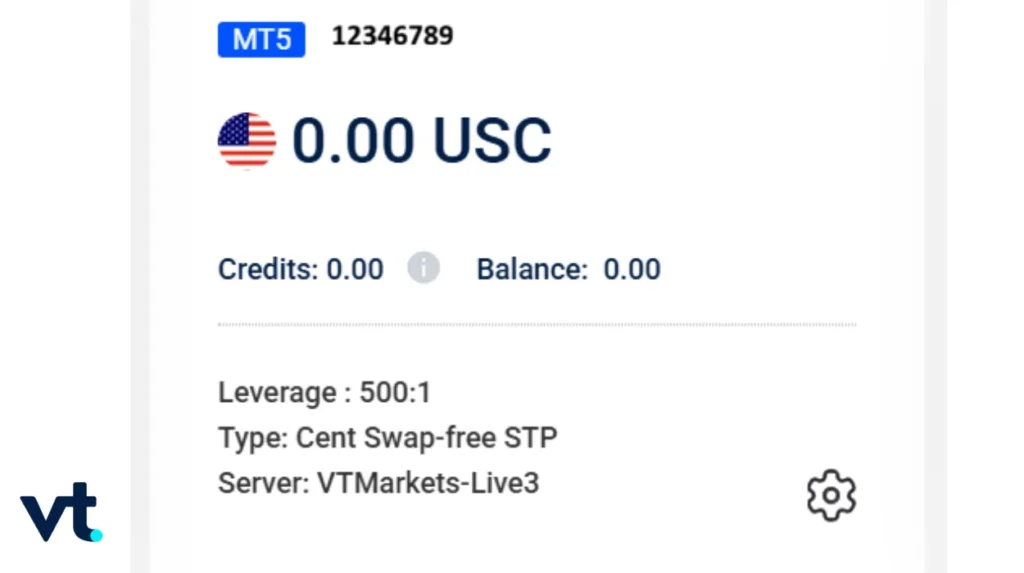
- 3) Platform Quality: Assess whether trading platforms offer full functionality for cent accounts. For example, VT Markets supports MetaTrader 5 (MT5) for cent accounts.
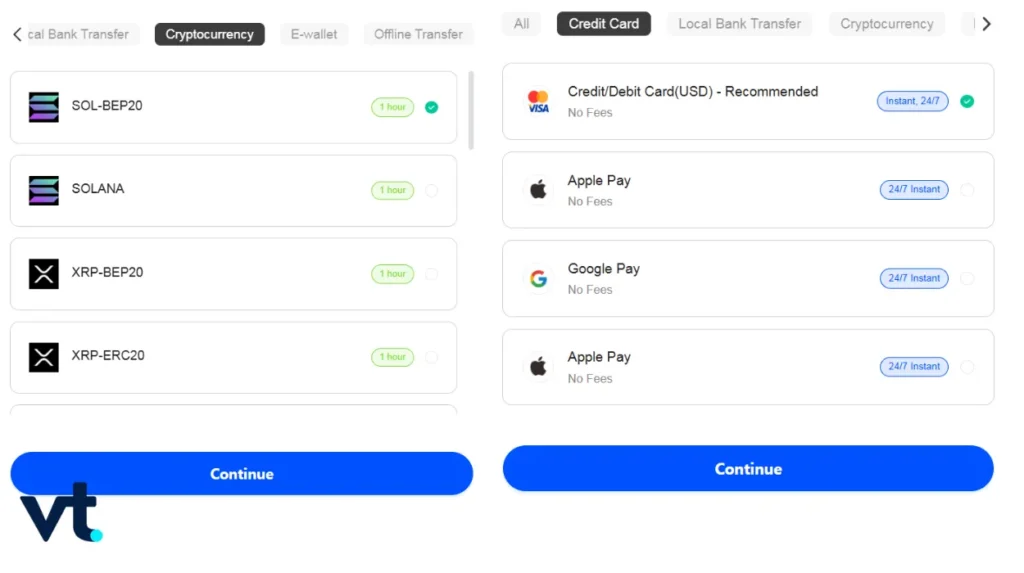
- 4) Deposit/Withdrawal Methods: Look for flexible, low-fee funding methods. VT Markets offers multiple funding options for cent accounts, including cryptocurrency, credit card, local bank transfer, e-wallet, or offline transfer.
Red Flags to Avoid
Be cautious if a broker shows warning signs. You should avoid red flags such as:
- Unusually high minimum or maximum deposit requirements for cent accounts
- Reports of withdrawal difficulties or account manipulation
- Significant differences in trading conditions between account types
- Aggressive marketing promising unrealistic returns
VT Markets and other reputable brokers often maintain consistent standards across all account types, with transparent terms and reliable execution.
Practical Strategies for Maximising Cent Account Benefits
Capital Management Principles for Small Balances
Effective capital management becomes even more crucial when working with limited capital. These principles help traders maximise learning while preserving their accounts:
Risk Management Framework:
- Risk no more than 2-3% per trade (on a $10 account, that’s $0.20-$0.30)
- Maintain stop-losses on every position without exception
- Never risk more capital to recover losses faster
- Track all transactions meticulously for performance analysis
- Set weekly/monthly loss limits regardless of account size
Developing Trading Strategies That Work Well with Cent Accounts
Certain trading strategies prove more suitable for cent account constraints than others:
Optimal Approaches:
- Scalping with Extreme Discipline: Small, frequent gains compound effectively
- Swing Trading Major Currencies: Lower transaction frequency reduces spread impact
- Risk-Reward Focus: Pursue setups offering minimum 1:2 risk-reward ratios
- Single Currency Pair Mastery: Deep expertise in one or two pairs rather than scattered attention
Approaches to Avoid:
- High-frequency strategies where spreads erode profits
- News trading requiring rapid execution and tight spreads
- Complex multi-leg positions difficult to manage with small balances
Setting Realistic Growth Expectations
Cent accounts are primarily learning tools. Understanding realistic growth rates can prevent disappointment and supports disciplined decision-making. For cent accounts in 2026:
- Exceptional Performance: 10-15% monthly (extremely rare and unsustainable)
- Strong Performance: 5-8% monthly
- Realistic Target: 2-5% monthly
- Learning Phase: -5% to +3% monthly while developing consistency
Remember that the primary goal isn’t spectacular returns but rather skill development, emotional mastery, and strategy validation.
Common Mistakes to Avoid with Cent Accounts
Treating Cent Accounts as “Play Money”
The most damaging mistake involves failing to treat cent accounts with the same seriousness as larger accounts. Because absolute monetary values seem insignificant, traders sometimes:
- Take excessive risks they’d never accept with larger balances
- Skip proper analysis and rely on impulses
- Ignore risk management protocols
- Fail to track and review performance systematically
This behaviour creates harmful habits that persist when graduating to standard accounts, often leading to significant losses when stakes increase.
Staying Too Long in the Cent Account Comfort Zone
While cent accounts serve as valuable transitional stages, remaining indefinitely prevents progress.
Traders who’ve achieved consistent profitability over 6+ months should consider advancing to accounts with higher ceilings. The psychological and practical limitations of cent accounts eventually constrain development beyond certain points.
Overleveraging Despite Smaller Position Sizes
Many brokers offering cent accounts provide leverage up to 1:500. This accessibility creates temptation to overleverage positions, which amplifies both gains and losses. Even with small absolute values, overleveraging might expose accounts to unnecessary significant risk.
Leverage Recommendations by Experience:
| Trader Experience | Recommended Maximum Leverage | Rationale |
| First 3 months | 1:50 | Focus on learning, not leverage |
| 3-12 months | 1:100 | Developing consistency |
| 12+ months | 1:200-1:500 | Demonstrated discipline |
The Future of Cent Accounts in Forex Trading
Industry trends suggest cent accounts will play an increasingly important role in trader development. As of 2026, several innovations are reshaping the cent account landscape:
Emerging Trends:
- Nano Accounts: Some brokers now offer nano account options with balances measured in fractions of cents enabling start trading.
- Gamification Integration: Educational features rewarding progression through structured learning paths.
- AI-Powered Coaching: Automated analysis providing personalised feedback on cent account performance.
- Social Trading Integration: Copy trading features specifically designed for cent account participants.
VT Markets continues monitoring these developments, evaluating which innovations genuinely benefit traders versus those serving primarily as marketing gimmicks. The firm’s assessment framework examines whether new features demonstrably improve trader education outcomes, support sustainable skill development, and maintain alignment with regulatory expectations and ethical trading practices.
This measured approach ensures that any cent account enhancements implemented genuinely serve trader development rather than simply creating differentiation for competitive positioning. As the cent account landscape evolves, distinguishing between meaningful innovation and superficial features becomes increasingly important for traders selecting development environments and for brokers committed to supporting genuine trader success rather than merely acquiring deposits.
How to Open a Cent Account
Opening a Cent Account is straightforward. Follow the steps below to create your account and start trading with smaller trade sizes.
Note: Before opening a cent account, please ensure that you have completed your identity verification. For a detailed guide on how to complete the account opening process, refer to our article How to Open a Live Trading Account with VT Markets.
Step 1: Open Trading Account
Once your identity verification is completed, you can proceed to open a trading account.
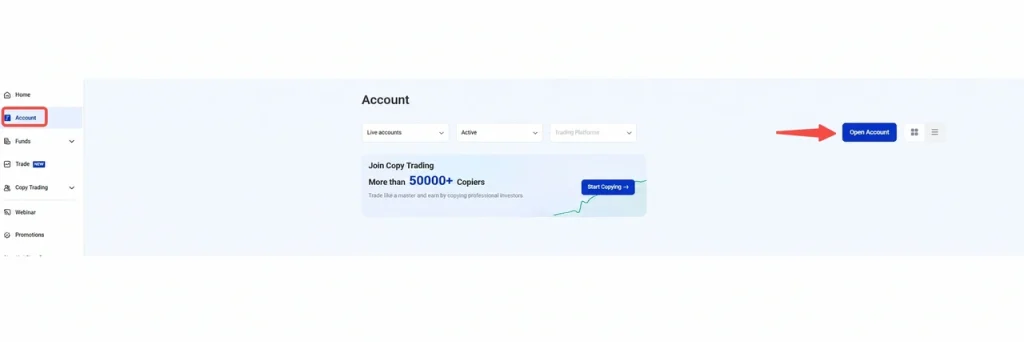
Go to the Account section from the left navigation bar, then click Open Account to create a new trading account.
Step 2: Select Your Trading Platform
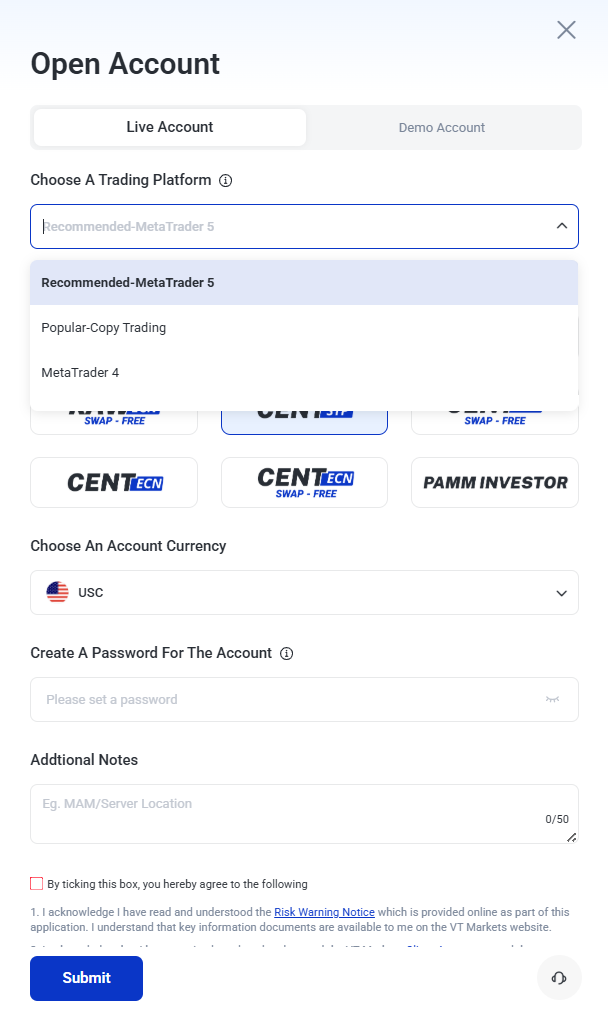
Choose the trading platform you would like to use.
Depending on availability, you may be able to select from options such as:
- MetaTrader 4 (MT4)
- MetaTrader 5 (MT5)
- Copy Trading
Select the platform that best suits your trading preferences.
Step 3: Choose Your Account Type
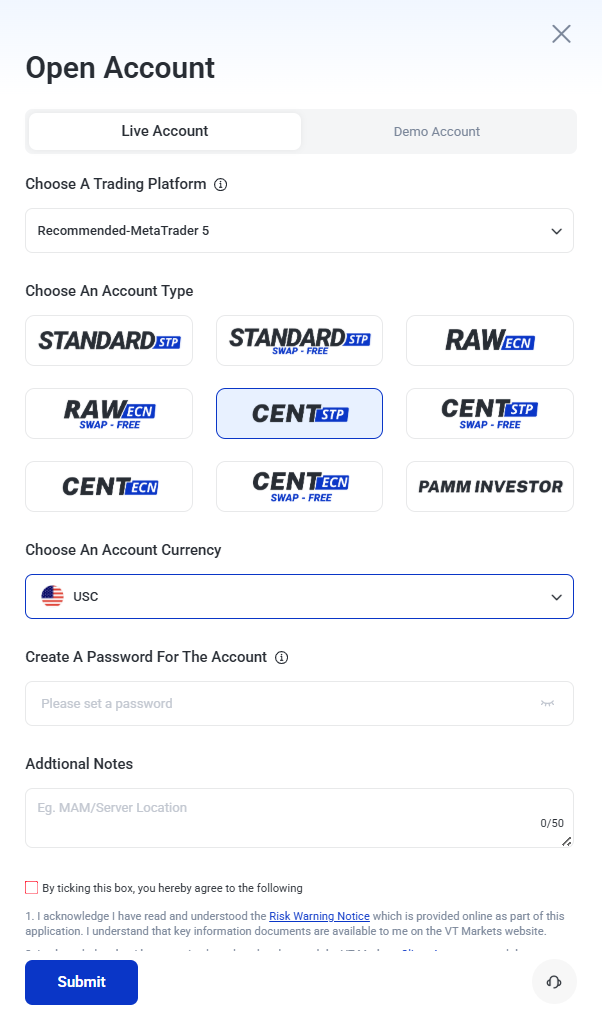
Select your preferred account type based on your trading needs, experience level, and trading style.
Review the available account options in the app before making your selection. You may also choose an account with the Swap-Free option if preferred.
For more information about account types, you may refer to the following guides:
- The Complete Guide to the VT Markets Raw ECN Account
- The Ultimate Guide to the VT Markets Standard STP Account
- What is a Swap-Free Account?
Step 4: Select Your Preferred Account Currency
The currency for a Cent Account is set to USC by default. No other currency options are available for this account type.
Step 5: Create Account Password
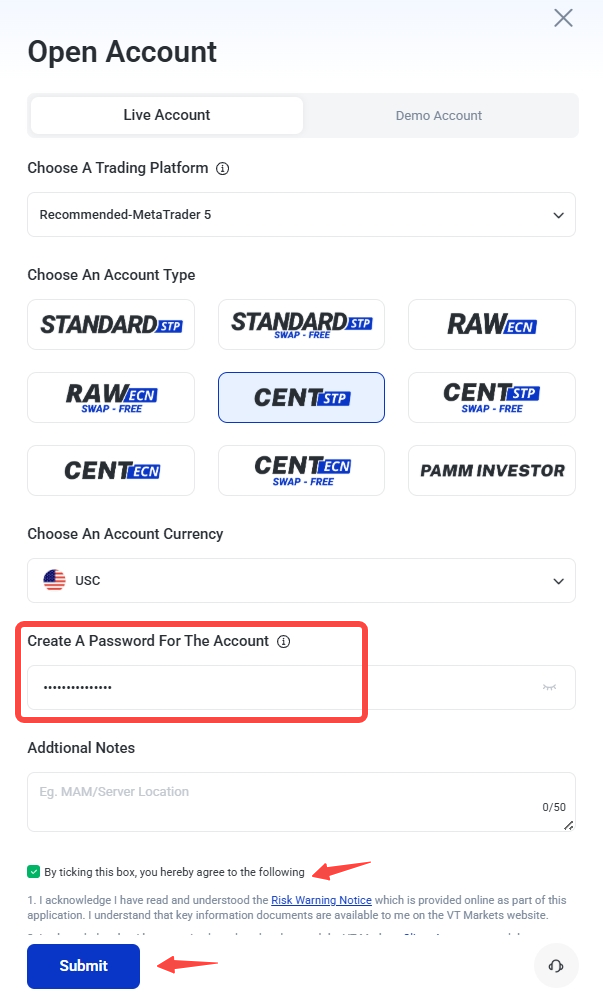
Set up your account password, tick the checkbox to agree to the Terms and Conditions, then click Submit to continue.
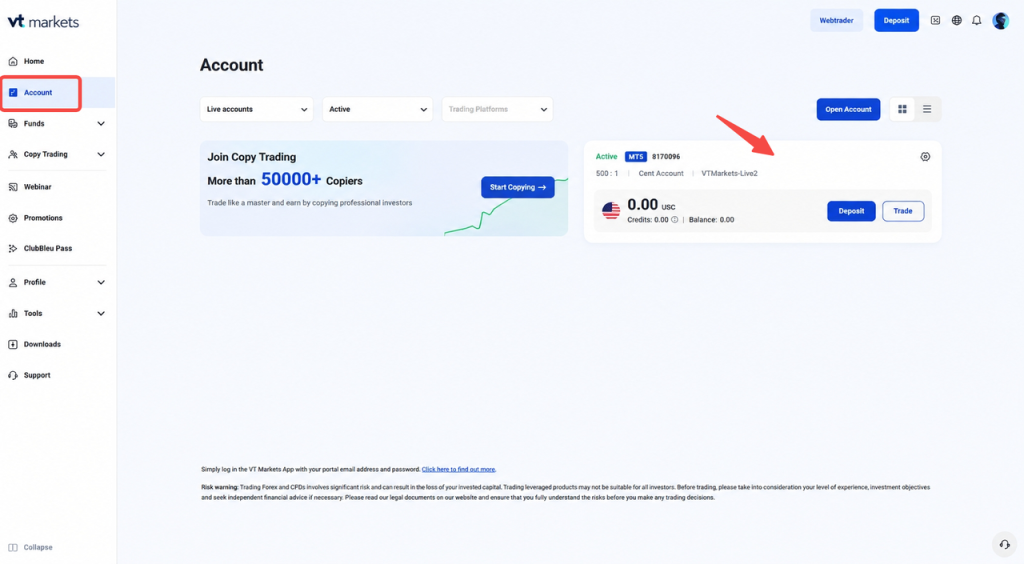
Once completed, your trading account will be created and you can view your account details under the Account section.
Step 6: Account Created
Once your account is created, you can view your account details under the Account section.
Frequently Asked Questions (FAQs)
Q1: Can I make real money with a cent account?
Yes, you can generate real profits with cent accounts. While the absolute dollar amounts are modest (e.g., earning $0.50 on a 5% return of a $10 deposit), the percentage growth is real and demonstrates skills that scale to larger accounts.
Q2: How long should I trade with a cent account before upgrading?
Most traders benefit from 6-12 months of cent account experience before transitioning to standard accounts. However, duration matters less than achievement of specific milestones: consistent profitability, emotional control, documented strategy effectiveness, and maximum account growth of 50-100%. Some traders reach these benchmarks in 4 months; others require 18+ months. Focus on developing competence rather than rushing the process.
Q3: What products or assets can I trade with cent accounts?
You can trade gold, silver, forex, and oil on the VT Markets cent account. It covers most major currencies (EUR/USD, GBP/USD, USD/JPY, USD/CHF, AUD/USD, USD/CAD, NZD/USD) on MetaTrader 5 (MT5).
Q4: What is the order limit on VT Markets’ cent account?
The VT Markets cent account supports up to 500 open and pending orders. If your total number of orders exceeds this limit, you will temporarily be unable to place new orders until it falls back within the allowable range. Alternatively, you can open new trades with other account types.
Your Cent Account Journey Starts Here with VT Markets
Whether you’re a complete beginner taking first steps beyond demo trading, an experienced trader testing new approaches, or someone with limited capital seeking gradual market exposure, cent accounts offer compelling advantages. They provide real environmental experiences with lower risk profiles, creating ideal conditions for gaining experience without the threat of significant losses.
The key to maximising cent account benefits lies in approaching them with the same professionalism you’d apply to managing substantial portfolios. Develop robust risk management protocols, maintain meticulous records, treat every trade seriously, and view the account as your training ground for future success rather than a shortcut to quick profits.
With VT Markets, you get cent accounts that mirror standard trading conditions, helping you build confidence and skills that scale with you.








