







Key Points
- Brent trades near $63.55 while WTI holds around $59.04 as geopolitical risk premiums unwind.
- Ample supply and balanced outlook from OPEC continue to cap upside momentum.
Oil prices edged lower in Asian trading on Friday, extending losses from the previous session as concerns over supply disruptions eased. Brent crude slipped 0.3% to $63.55 per barrel, while WTI fell 0.3% to $59.04 per barrel by 0418 GMT.
The pullback followed comments from US President Donald Trump suggesting that Iran’s crackdown on protesters was easing.
This reduced fears of imminent military action that could disrupt oil flows from the region. Earlier in the week, both Brent and WTI had climbed to multi-month highs after protests intensified in Iran and Trump signalled potential strikes.
Despite the latest dip, Brent remains higher than a week ago and is still on track for a fourth consecutive weekly gain. That reflects how sensitive prices remain to geopolitical headlines, even as immediate risks fade.
Fundamentals Keep a Lid on Sustained Rallies
While sentiment has driven recent price swings, the broader supply backdrop remains comfortable. Analysts continue to flag expectations of ample supply this year, limiting the scope for a sustained breakout higher.
OPEC said on Wednesday that global oil supply and demand are expected to remain balanced in 2026, with demand growth in 2027 rising at a pace similar to this year. That assessment reinforces the view that the market is not facing a structural shortage in the near term.
Market participants also point out that geopolitical spikes tend to fade quickly unless they translate into real disruptions in physical barrel flows.
Technical Analysis
WTI crude is struggling to extend its recovery after rebounding from the 54.867 support zone. Price has now pulled back just below the 59.00 mark, showing hesitation near a short-term resistance level.
The 5- and 10-day moving averages are beginning to converge, reflecting slowing upward momentum.
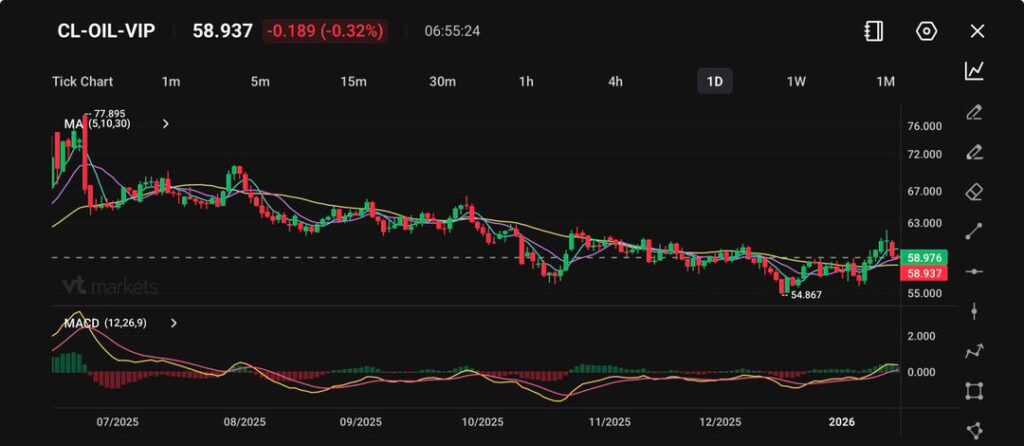
The MACD histogram is flattening, while the signal line threatens to roll over.
This suggests waning bullish strength, especially after failing to clear the 63.00–64.00 area in recent sessions. Still, the medium-term trend remains sideways, with volatility compressed.
Range-Bound Trading Likely to Persist
Shell added a longer-term supportive note by releasing its 2026 Energy Security Scenarios, estimating that primary energy demand by 2050 could be 25% higher than last year.
While this underpins the long-term outlook for oil demand, it offers limited support for near-term pricing.
In the short term, oil prices are likely to remain driven by headlines rather than fundamentals. Without a clear revival in Chinese demand or a meaningful supply bottleneck, crude appears set to stay range-bound.










