






- AI-driven tech stocks continue to lead structurally, but their market dominance is increasingly challenged by stretched valuations, infrastructure bottlenecks, and rising energy constraints.
- Market leadership is broadening as capital rotates out of overcrowded mega-cap tech and into undervalued sectors poised for earnings catch-up.
- 2026 is a trader’s market, characterised by rising dispersion and elevated volatility, creating opportunities on both long and short sides.
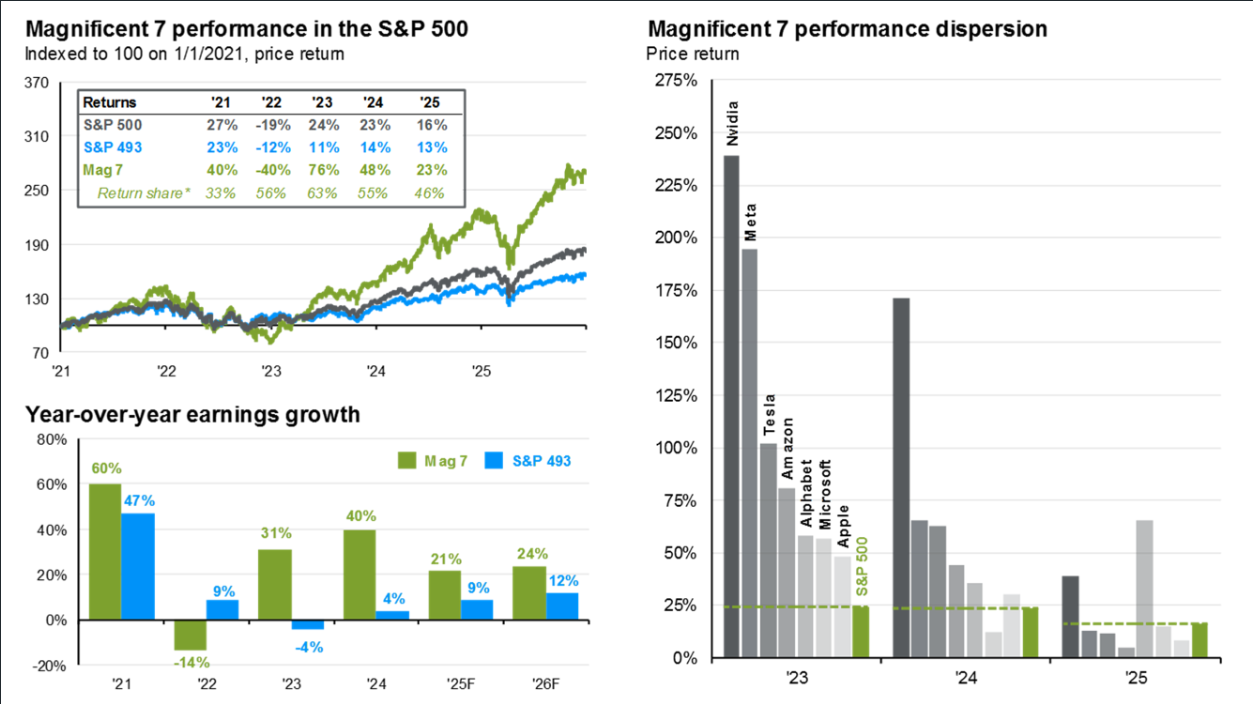
Technology stocks have dominated US equities since the onset of the AI boom. Over the past year alone, the S&P 500 surged sharply, driven disproportionately by a small group of mega-cap names.
As the market enters 2026, the era of a single express lane dominated by a handful of mega-cap technology stocks has officially transitioned into a complex landscape of detours, rerouting, and lane closures.
The Magnificent Seven dominance that defined previous years is facing increasing scrutiny, giving way to a Great Rotation where leadership is expected to diffuse into the other 493 companies of the S&P 500.
(Source: JP Morgan)
For traders, this environment offers a unique set of opportunities. The ability to go long on emerging sectors while simultaneously shorting overvalued tech names allows for sophisticated relative-value strategies.
However, success in 2026 requires more than just following the trend; it requires an understanding of how sweeping fiscal policy, a Federal Reserve leadership vacuum, and the physical constraints of AI infrastructure are reshaping market mechanics.
Macroeconomic Catalysts Reshaping 2026
The structural shift of 2026 is driven by two primary macro forces: the legislative impact of the One Big Beautiful Bill Act (OBBBA) and the uncertainty surrounding the Federal Reserve’s leadership transition.
The OBBBA Fiscal Thrust
Passed on July 4, 2025, the OBBBA has become the defining fiscal policy of the current cycle. By making the individual tax cuts of the Tax Cuts and Jobs Act permanent and introducing new incentives, business and consumer tax cuts combined will result in approximately $285 billion of fiscal stimulus in 2026.
Individual taxpayers are also expected to see an average federal tax cut of over $3,700 in 2026, a move that is reshaping consumer discretionary spending and providing a banner season for the financial sector.
For traders, the OBBBA is not just a tax story; it is an industrial pivot. The Act fundamentally reshapes the US energy landscape by prioritising upstream oil and gas through mandatory quarterly lease sales and reduced onshore royalty rates (dropping from 16.67% to 12.5%).
Conversely, it introduces significant headwinds for renewable energy, with wind and solar projects facing much tighter deadlines to qualify for full tax credits.
The Fed Leadership Vacuum
The second major catalyst is the conclusion of Jerome Powell’s term as Fed Chair in May 2026.
Speculation regarding his successor, with names like Kevin Warsh, Kevin Hassett, and Chris Waller in the mix, has already intensified market volatility by as much as 25%.
While the market anticipates a dovish successor inclined toward lower rates, the transition creates a confidence recession for the US dollar.
Traders must navigate a choppy environment where the US Dollar Index (USDX) is expected to show two-way volatility, with potential rebounds in Q2 if inflation proves sticky.
Sectors in Focus: The New Stars of 2026
As capital spills out of over-owned technology names, several sectors are absorbing the overflow, often trading at valuations well below their historical fair value.
While mega-cap technology remains mixed, broader pockets of green might emerge across Finance, Retail, Consumer, and Energy, signalling early capital rotation toward undervalued sectors as leadership begins to widen.
Financials: The Rotation Engine
Banks are no longer viewed as defensive value traps but as primary engines of growth. Early 2026 is projected to be a banner season for bank earnings as the full effects of late-2025 rate cuts and OBBBA tax benefits are realised.
Major institutions like JPMorgan Chase and Goldman Sachs have already seen significant upward momentum, with the market rewarding banks that pivot from cost-cutting to growth in wealth management and commercial lending.
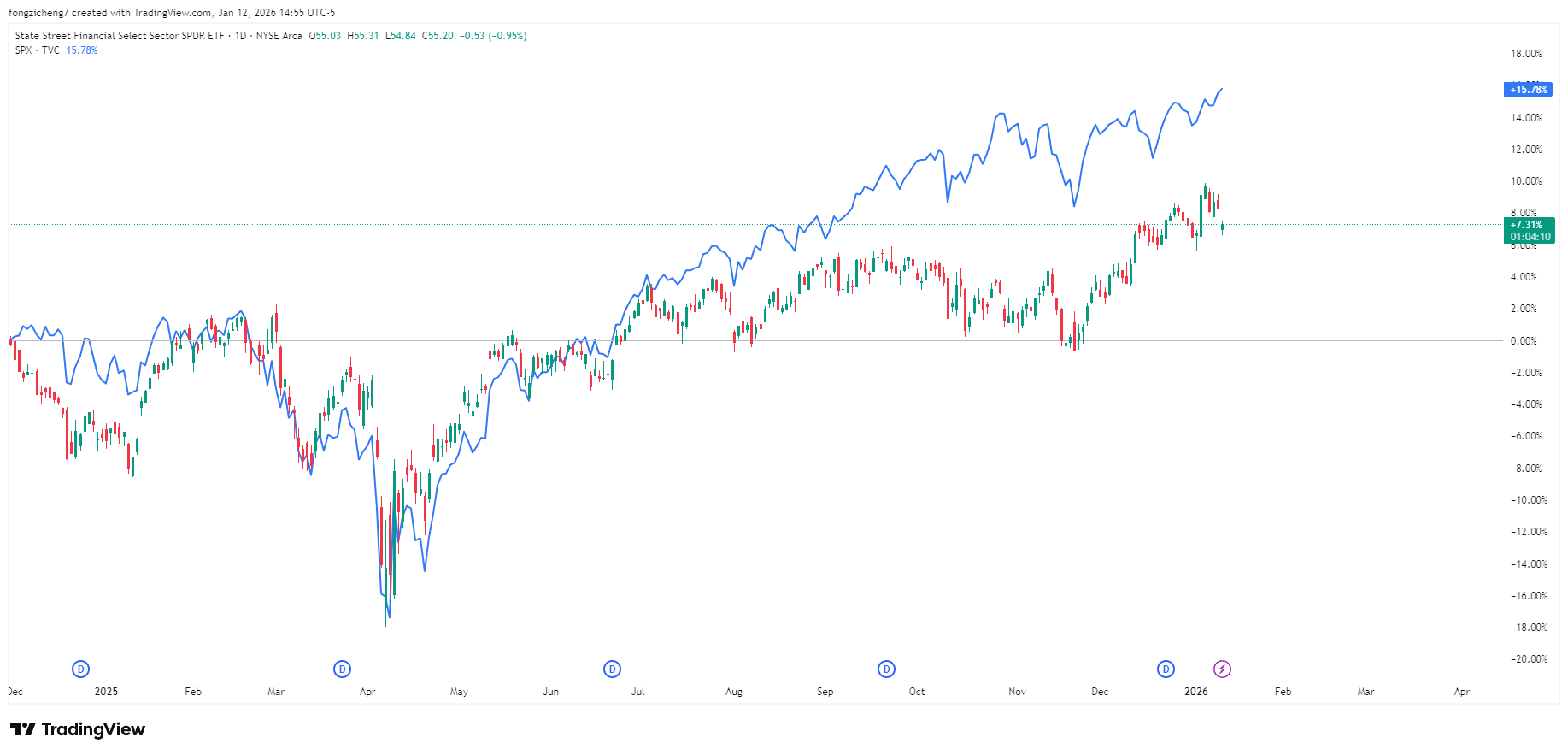
As seen in the chart above, the S&P 500 (blue) continues to outperform in absolute terms, but the Financial Select Sector SPDR Fund (XLF, candlesticks) has stabilised and rebounded from earlier drawdowns—signalling improving earnings visibility and positioning Financials as a likely leader of the 2026 sector rotation.
Energy and Industrials: Powering the AI Grid
The AI trade is maturing. The first phase focused on owning chipmakers; the current phase has moved inside the data centre.
The focus is now on the physical infrastructure required to keep the power grid stable under escalating compute demand.
- Traditional Energy: Upstream oil and gas companies are clear winners under the OBBBA, benefiting from full deductions for intangible drilling costs and the reopening of Alaskan federal lands.
- Heavy Electrical Equipment: Industrial giants and producers of large gas turbines are in high demand to meet surging power needs that renewables, currently facing regulatory headwinds, cannot yet fulfil.
- Nuclear and Geothermal: These emerge as winners, with nuclear facilities gaining energy community bonus credits and geothermal maintaining favourable tax treatment through 2033.
Consumer Discretionary: A K-Shaped Reality
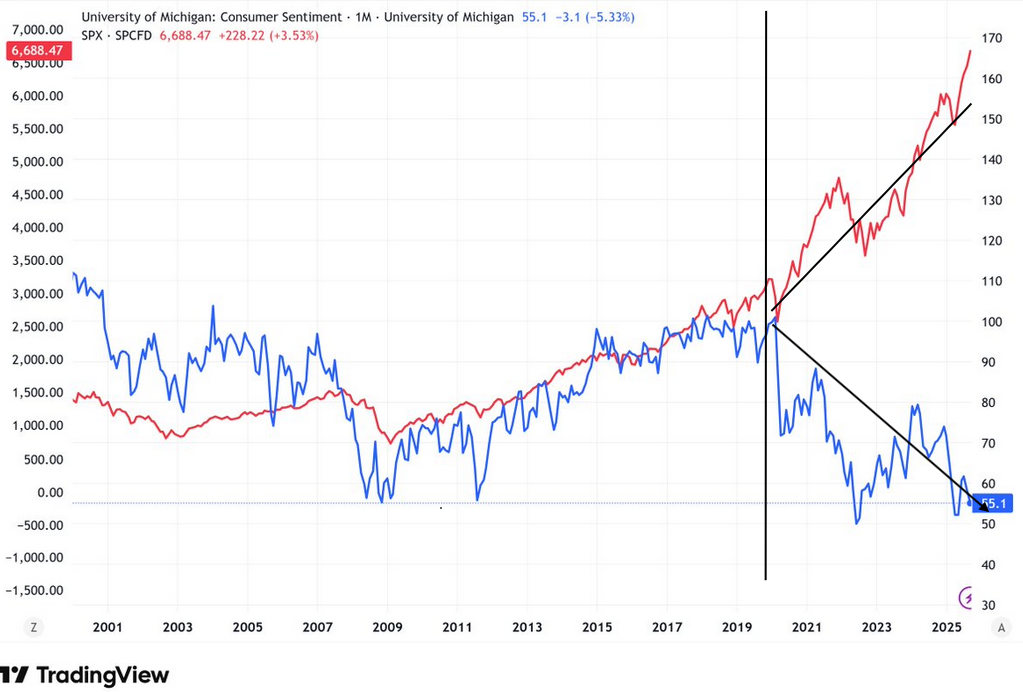
Resilient consumer spending, fuelled by OBBBA tax breaks, supports sectors from travel to luxury goods. However, traders must be wary of sticker shock from potential tariffs, which contributes to a K-shaped economy where household spending is widening.
Early indicators like Netflix’s results and Starbucks’ Q1 report will be vital for gauging the strength of the middle-class consumer. For full view of upcoming economic events, check out VT Markets’ Economic Calendar.
(Source: Investing.com)
The Tech Evolution: Execution Over Hype
Technology stocks are expected to face a “winner-takes-all” dynamic in 2026, where the market becomes less forgiving of unproven narratives.
- Magnificent Seven Scrutiny: After three stellar years, valuations for growth-oriented tech names are viewed as over-owned and vulnerable. While companies like Nvidia continue to forecast accelerating revenue — guiding for $65 billion in Q4 FY26 — the market is increasingly focused on the “picks and shovels” that physically build data centres, such as high-speed connectors and cooling systems.
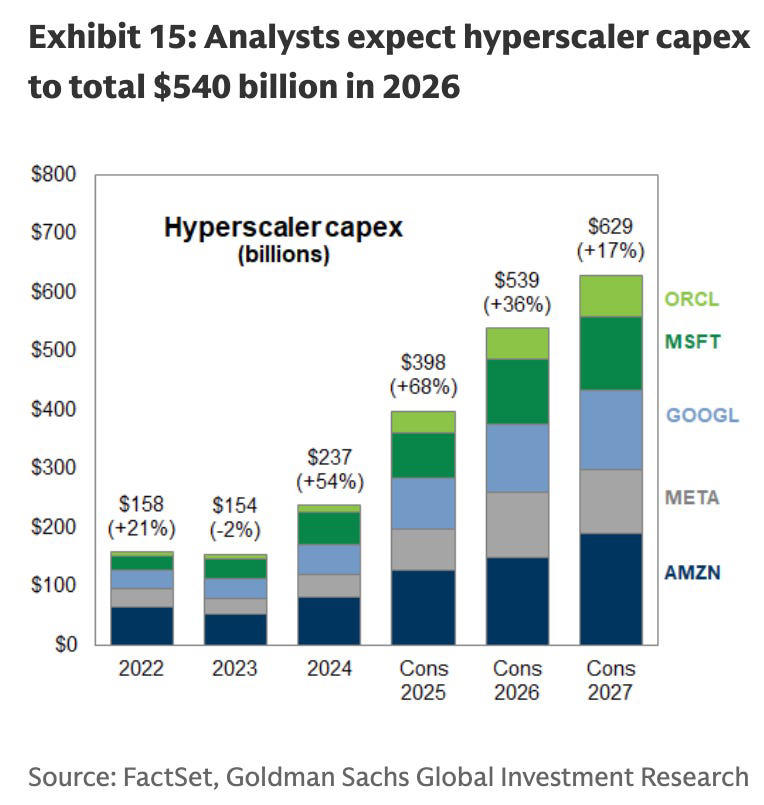
- The AI CapEx Cliff: Record-high capital expenditure (CapEx) from firms like Amazon (estimated at $125 billion in 2025) has begun to erode free cash flow, leading to scepticism about long-term sustainability. Traders should watch for a “decoupling” where stock prices stop tracking new era spending if execution fails to meet these massive investments.
(Source: FactSet, Goldman Sachs Global Investment Research)
How Traders Can Prepare for the Great Rotation
The Great Rotation will not unfold in a straight line; it will be driven by earnings surprises, guidance shifts, and changing sector leadership throughout the year.
For traders, preparation means moving beyond headline narratives and focusing on when and where capital is reallocating during key earnings windows. This is especially critical as dispersion widens between winners and laggards across sectors.
1. Reframe Your Market Lens: Track Leadership, Not Headlines
Rotation often happens quietly before it becomes obvious in the news. Traders should focus less on macro headlines, and more on relative performance.
What to do:
- Compare sector performance against the S&P 500, not just absolute gains.
- Monitor whether sectors like Financials, Energy, or Industrials are outperforming on down days — a classic early rotation signal.
- Watch for narrowing leadership where fewer tech stocks are driving index gains.
2. Shift from “Buy the Dip” to “Buy the Catch-Up”
In a rotation market, the old instinct to automatically buy tech pullbacks becomes riskier. However, market leadership is no longer guaranteed in 2026.
What to do:
- Look for sectors that have stopped falling but haven’t rallied yet.
- Prioritise sectors trading below historical valuation averages while earnings visibility is improving.
- Be cautious with crowded tech trades unless backed by strong earnings execution.
3. Practice Long/Short Thinking
Rotation markets reward relative positioning. Even directional traders benefit from thinking in pairs.
What to do:
- Identify one sector benefiting from policy or earnings tailwinds and another facing structural headwinds.
- Use relative charts to spot widening or narrowing performance gaps.
- Consider expressing views via sector-based exposure rather than single names.
4. Watch Other Macro Signals, Such As Power Demand
Unlike previous cycles, the AI boom has real-world constraints such as energy, infrastructure, and capital intensity.
What to do:
- Track oil prices, power demand narratives, and industrial earnings commentary.
- Watch for signs that capital spending is straining balance sheets rather than boosting growth.
- Use these signals as confirmation or warning before entering tech-related trades.
To navigate this environment effectively, traders should also adhere to the principles outlined in the Earnings Season Playbook, which further explains the three-phase strategy.
How to Manage Risk in a Dynamic Environment
The 2026 stock market is best described as dynamic rather than just uncertain. Inputs and relationships are changing rapidly, meaning traditional risk models may be less reliable.
- Volatility (VIX) and Leverage: With the VIX expected to remain above 20 due to the Fed transition, leverage must be used cautiously. A 10% adverse move in a leveraged position can be sufficient to wipe out the entire initial margin.
- Stop-Loss and Take-Profit Discipline: Given the potential for flash FX cycles and violent reversals in over-owned sectors, setting stop-loss orders at 10% below entry or using a 2:1 risk-reward ratio is essential.
- The Black Swan Weekend: CFD traders must account for gap risk where prices jump significantly over the weekend or outside of exchange hours. Indices, which often trade around the clock, can be used to hedge against these overnight events.
Do Not Retreat, but Be Selective
The 2026 earnings season and the broader Great Rotation mark a decisive transition for equity investors. The easy gains driven by excess liquidity are fading, replaced by a regime where fundamentals and execution define the winners.
For traders, the message is clear: do not retreat, but be selective.
2026 will reward those who understand where value is migrating away from the concentrated peaks of mega-cap tech and toward the engine rooms of the US economy: the banks, the power producers, and the tax-empowered consumer.








