Gold in Earnings Season Shockwaves: From Safe Haven to Momentum Asset
by VT Markets/
Jan 12, 2026
During earnings season, gold acts as a tactical tool to manage and trade volatility.
In 2026, gold is expected to be bullish, supported by geopolitical risks, strong central bank demand, and an easing Federal Reserve cycle that lowers the cost of holding non-yielding assets.
By monitoring the VIX and USD Index, traders can position around the Earnings-Dollar-Gold triangle and use XAUUSD to trade the market’s macro-reaction to equity shocks and shifting interest rate expectations.
For traders, earnings season often means surprises, gaps, and rapid shifts in sentiment. However, these shocks are rarely contained within equities; they spill over into the US dollar, treasury yields, and broad market volatility.
Gold (XAUUSD), in particular, often acts as the “volatility valve” in this environment, absorbing the pressure as the market reprices growth, rates, or risk.
Instead of trying to predict individual corporate earnings beats or misses, traders can use gold to trade the macro-reaction to these reports. For instance, when results from market leaders reshape expectations for US interest rates or risk appetite, gold offers a more structured way to capture that broader move.
Why Gold Moves During Earnings Season
Gold is a global macro instrument that primarily responds to two interconnected drivers:
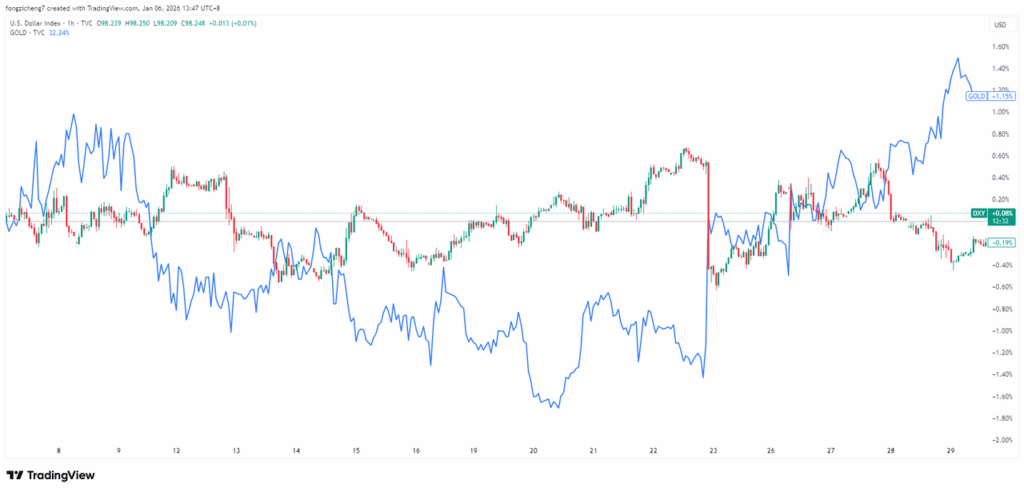
US dollar index (USDX): Gold has historically moved in the opposite direction of the US dollar. Since gold is priced in dollars, a softening dollar — often triggered by soft corporate outlooks or slowing growth — acts as a natural tailwind for the metal and supports higher gold prices. Conversely, a stronger dollar can create a headwind and weight on gold.
Gold in candlesticks and US dollar in blue line show an inversely correlated relationship
US interest rates and real yields: As a non-yielding asset, gold is highly sensitive to real yields (interest rates adjusted for inflation). When earnings data pushes markets to price in Fed rate cuts, real yields tend to fall. This lowers the opportunity cost of holding gold and often drives prices higher.
Earnings season can accelerate both of these drivers in a matter of hours. A cluster of high-impact surprises from sectors like technology or banking can fundamentally shift:
Equity index direction and volatility
Growth expectations and recession fears
Rate-cut expectations and bond yields
Demand for the US dollar
This is why gold can trend strongly even when the headlines are focused on tech giants, banks, or consumer names. It is the ultimate barometer for the market’s underlying health, not just stock-specific news.
Mastering the ‘Earnings-Dollar-Gold’ Triangle
To trade gold during earnings season, traders will need to understand the following chain of logic:
🔁Earnings Surprise → Equity Index Volatility → Rates Pricing and USD → Real Yields → Gold
As gold is primarily priced in USD, traders must understand its relationship with the greenback:
Strong Earnings → Stronger USD: Solid profits signal economic resilience, allowing the Fed to maintain higher rates. This tends to lift the USD and place short-term pressure on gold.
Weak Earnings → Weaker USD: Disappointing corporate data suggests slowing growth and increases expectations of Fed rate cuts, weakening the dollar and supporting gold.
This dynamic often plays out quickly around major earnings releases. Here is how it works in practice:
Scenario
Market Trigger
Typical Macro Reaction
Gold’s Performance
A: Risk-Off Tape
Multiple earnings misses or weak guidance.
Volatility (VIX) rises; bond yields fall as markets price in easier policy.
Bullish Gold rises on falling real yields. It may briefly dip in a “dash for cash” before stabilising.
B: Risk-On Tape
Broad beats with strong forward guidance.
Yields and the USD firm on growth expectations.
Bearish/Challenged Gold struggles against rising yields, might need a USD reversal or geopolitical catalyst to rally.
C: Mixed Tape
Contradictory reports; indices a choppy outlook.
USD and yields stay range-bound; volatility spikes and fades.
Range-Bound Gold often enters a consolidation phase. Trading focus shifts to technical levels and liquidity.
S&P 500 vs. Gold: What the Ratio Actually Reveals
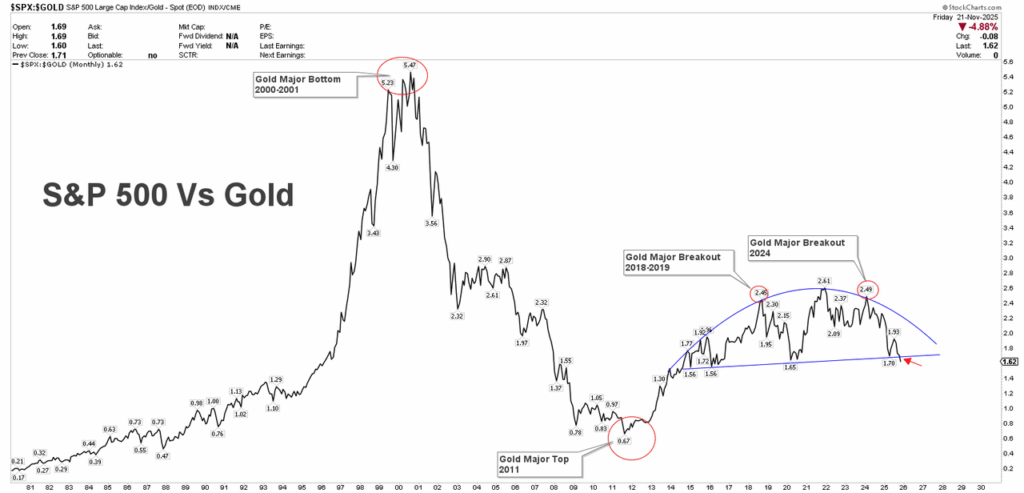
A useful metric for traders looking to capture gold’s movement during earnings season is the S&P 500-to-Gold ratio. This figure measures how many ounces of gold are required to “buy” the index, serving as a gauge of market sentiment:
When the ratio rises, equities are generally outperforming gold. It signals strong economic growth, low inflation, and high investor confidence in equities.
When the ratio falls, gold is outperforming equities. It typically indicates economic uncertainty, high inflation, or market downturns as investors seek the safety of gold.
S&P 500-to-gold ratio breakdown signals regime shift. (Source: FXEmpire)
For decades, gold and stocks moved in opposite directions. However, the last few years have redefined this relationship.
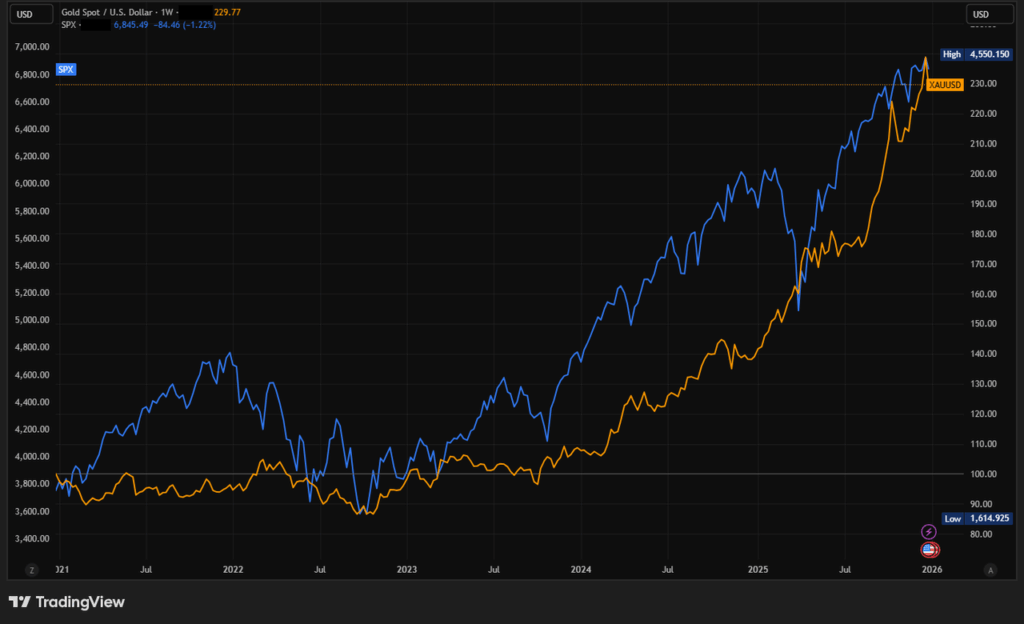
In 2025, both assets reached record highs in a rare tandem rally, supported by a Goldilocks environment of resilient growth and aggressive central bank accumulation. Yet beneath the surface, the ratio began to roll over.
By late 2025, the S&P 500-to-Gold ratio experienced a significant structural shift, falling to levels between 1.5 and 1.66 — thresholds not seen since the 2020 pandemic. This compression occurred because gold surged roughly 65% over the year, far outpacing the S&P 500’s 16–17% gains.
From a trading perspective, this “rounding top” in the ratio suggests the market has entered a new regime for precious metals. When gold outperforms even during a bull market for stocks, it points to deeper institutional caution around debt, fiscal stability, and long-term growth.
Key Takeaway for Traders
The S&P 500-to-gold ratio can function as an “early warning indicator” for the earnings season.
If the ratio breaks lower following a major tech report, it is a high-conviction signal that the market has pivoted from growth-chasing to capital preservation.
2026 Outlook: A Bullish Outlook for Both?
As 2026 unfolds, institutional sentiment remains overwhelmingly bullish for gold, even as equities test new highs.
Geopolitical risks, including Middle East tensions, maritime trade disruptions, and the Venezuela supply shock, have driven investors toward safe-haven assets.
Central bank buying has also remained unusually strong. According to the World Gold Council, central banks added over 1,000 tonnes to global reserves in 2024, for the third year in a row. After years of outflows, 2026 is projected to see a major return of institutional ETF demand, with 250 tonnes of inflows expected as pension and sovereign wealth funds increase their gold allocations to hedge against stagflationary risks.
At the same time, major institutions have reinforced this bullish view. For example:
Goldman Sachs has projected gold at $4,900/oz by December 2026, supported by strong central bank demand and the possibility of Fed rate cuts.
J.P. Morgan Global Research has also discussed a path toward $5,000/oz by Q4 2026.
Seasonal Gold Patterns Around Q1 Earnings: The “January Effect”
Beyond the immediate reactions to earnings and monetary policy, gold also exhibits strong seasonal patterns, particularly around the first quarter of the year. This historical trend provides a robust framework for strategic positioning.
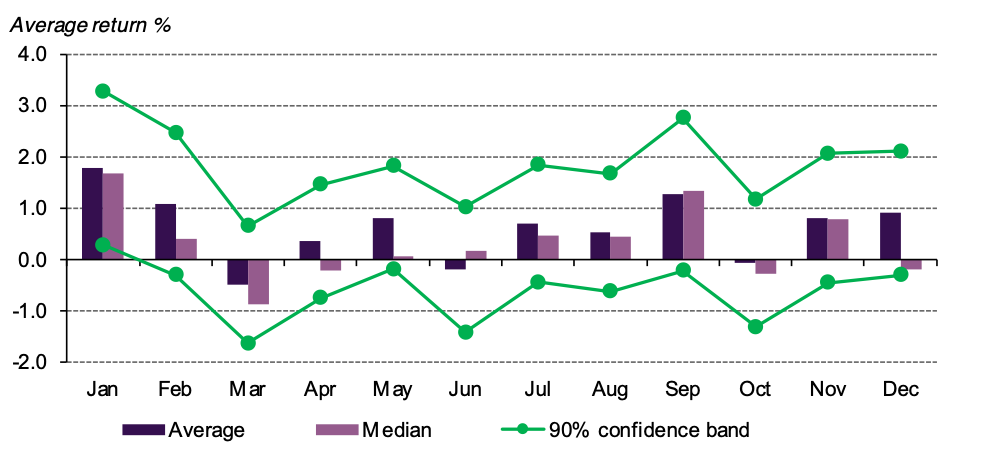
Data spanning the last decades (1971-2023) reveals a compelling phenomenon: Gold tends to perform well in January and late summer.
Average gold returns by month since 1971 to 2023. (Source: Bloomberg, ICE Benchmark Administration, World Gold Council)
Several factors drive this early-year strength:
Portfolio rebalancing: The start of the year often triggers institutional reallocation. If yields reset lower, gold becomes more attractive.
Early-year volatility: January and February reports (Q4 results) set the tone for the year. High-profile misses can quickly increase demand for safe havens.
Position building: Traders and institutions often build strategic positions in gold early in the year, anticipating both the safe-haven demand from earnings volatility and the broader macroeconomic trends (like potential Fed easing) that favour gold throughout the year.
Lunar new year demand: Physical gold demand typically rises in Asia, particularly in China and India, providing an underlying price floor during Q1.
During the lunar new year in Feb 2025 gold price went up from $2791 to $2959
How to Trade Gold During Earnings Season
For traders, trading gold offers a liquid, high-leverage gateway to exploit macro shifts without needing to own the physical metal.
Integrating gold during earnings season involves the following strategic considerations:
Hedge against index volatility: In equity-heavy portfolios, a tactical allocation to gold can function as a shock absorber during earnings-driven market corrections.
Counterweight to US dollar fluctuations: Gold offers a natural offset to movements in the US dollar. When weak earnings increase expectations of a more dovish Fed stance, the resulting dollar weakness often supports an immediate rally in gold prices.
Portfolio stabilisation during earnings volatility: Adding a non-correlated asset during periods of heightened earnings volatility can help reduce overall drawdowns and smooth portfolio performance.
Actionable Strategies for Traders
Phase 1: Prepare Before Earnings Hit
Don’t wait for the report to hit. Anticipate spikes ahead of major earnings reports from market-moving companies such as the Magnificent Seven. These reports frequently lead to increased market uncertainty, regardless of the outcome.
What to do:
Identify dates for major earnings reports
Assess current VIX levels and trends
Review analyst expectations for upcoming earnings
Check the economic calendar for CPI, PPI, and Fed events
Phase 2: Monitor USDX and react with discipline
Once earnings hit, focus on the USD and rates reaction rather than headlines.
What to do:
Define maximum capital risk per trade (e.g. 1-2%)
Set strict stop-loss orders on all positions
Determine clear take-profit targets
Watch for spread widening during volatility
Account for overnight funding costs (swaps)
Key Takeaway for Traders
Gold spreads can widen sharply during extreme volatility. If price action is disorderly, waiting 5–15 minutes for liquidity to normalise can improve execution.
Gold as an All-Weather Trading Asset
By understanding how earnings results feed into the US dollar, interest rates, and risk sentiment, traders can translate equity volatility into a structured gold strategy.
History shows that gold remains:
A reliable hedge during equity shocks
A counterweight to USD weakness
A strong performer during key seasonal windows
With institutional forecasts pointing towards $5,000+ gold by 2026 on the back of anticipated Fed easing, its role as a strategic and tactical trading instrument remains firmly intact in 2026.
Scan the QR code with your smartphone to start a chat with us, or click here.
Don’t have the Telegram App or Desktop installed? Use Web Telegram instead.
Important Access Notice
This Website may only be accessed where permitted by applicable laws and regulations.
VT Markets is neither established in nor operating from Singapore. VT Markets does not provide or promote its products or services to citizens or residents of Singapore, and account requests from such persons will not be accepted.
If you are a citizen or resident of Singapore, you must not apply to open an account with VT Markets or attempt to access or utilise any of its products or services.
By continuing past this notice, you confirm that you have accessed this website entirely on your own initiative, free from any direct marketing, invitation, targeted promotion, or solicitation by or on behalf of VT Markets.
Nothing contained on this website forms, or shall be interpreted as, an offer, invitation, or solicitation in any territory where such conduct is restricted, prohibited, or otherwise unauthorised. You bear sole responsibility for verifying that your access to and use of this website adheres to all regulatory requirements applicable within your jurisdiction.
This Website is intended solely for individuals residing in jurisdictions where its access and use are permitted by law.
Neither VT Markets nor any of its affiliated entities are established in, or operate from, your local jurisdiction.
By clicking "Acknowledge and Enter", you confirm that you are accessing this Website strictly on your own initiative, without inducement from any targeted marketing or promotional outreach. You explicitly acknowledge that any information obtained through this platform is requested and provided solely on the basis of reverse solicitation, in full compliance with the laws and regulations of your jurisdiction.
This website may only be accessed where permitted by applicable laws and regulations.
VT Markets has no establishment, office, branch, representative presence, or operations in Germany and does not conduct business from Germany. By continuing past this notice, you confirm that you are accessing this website entirely on your own initiative and that you are responsible for ensuring your access to and use of this website complies with all laws and regulatory requirements applicable in your jurisdiction.
Nothing contained on this website constitutes, or shall be construed as, an offer, invitation, solicitation, or promotion in any jurisdiction where such activity is restricted, prohibited, or otherwise unauthorised.