







Nvidia’s latest earnings did what markets expected: another strong beat, another record quarter, and another rally across the tech complex.
But beneath the surface, the tone of the market reaction is shifting. Traders are no longer asking how high Nvidia can climb, but how much longer this phase of the AI cycle can sustain.
The company remains the heart of the AI economy, commanding over 80 percent of the data-centre GPU market. Yet as demand growth begins to normalise, and as hyperscalers focus on optimising existing capacity rather than pure expansion, traders should start reading Nvidia’s results less as an all-clear and more as a cycle checkpoint.
Guidance is the New Indicator
Beats are the baseline; guidance is the signal.
Nvidia’s forward outlook now matters more than its quarterly wins. The company continues to post exceptional margins, but traders are watching for early signs of deceleration, particularly in data-centre revenue growth and order visibility from major cloud providers.
Strong guidance still supports a bullish structural story for AI infrastructure. But any moderation in spending guidance from hyperscalers such as Amazon, Microsoft, or Google could mark the start of a rotation: from explosive hardware investment toward efficiency, monetisation, and software deployment.
For traders, that transition has major implications for where the next leg of the AI trade will live.
The Hardware Cycle May Be Peaking
The AI trade has so far been defined by capex-heavy infrastructure spending: data centres, GPUs, and power build-outs. That is Nvidia’s world. But every investment cycle matures.
Once infrastructure reaches scale, capital tends to shift downstream toward application development, software services, and AI-enabled productivity tools.
Nvidia’s dominance gives it a powerful runway, but it also means the company is most exposed to the end of this first phase. Traders are beginning to price that in, rotating into plays that will benefit from the software and inference layer of the AI economy rather than the hardware backbone.
In other words: Nvidia is still the bellwether, but its signal may soon stop leading the market and start lagging it.
Why This Matters for Broader Markets
The correlation between Nvidia’s stock and the Nasdaq 100 remains one of the tightest in the market. When NVDA rallies, the entire tech sector moves with it.
That makes this earnings report not just a corporate event but a sentiment checkpoint for global equities.
If Nvidia’s growth rate starts to plateau, it does not imply a crash, it implies a rotation. Traders may see capital flow from semiconductors into other parts of the AI value chain, or even into traditional sectors that stand to benefit from AI adoption. This is the type of cross-sector rotation that can quietly reshape portfolio leadership.
Still Bullish, But Momentum is Slowing
Technically, Nvidia remains in an uptrend, holding well above its major moving averages. But volume momentum is tapering, and relative strength has started to diverge from the Nasdaq.
Price is consolidating near its highs, suggesting traders are waiting for confirmation from the next macro catalyst — whether that’s fresh Fed language or hyperscaler spending signals.
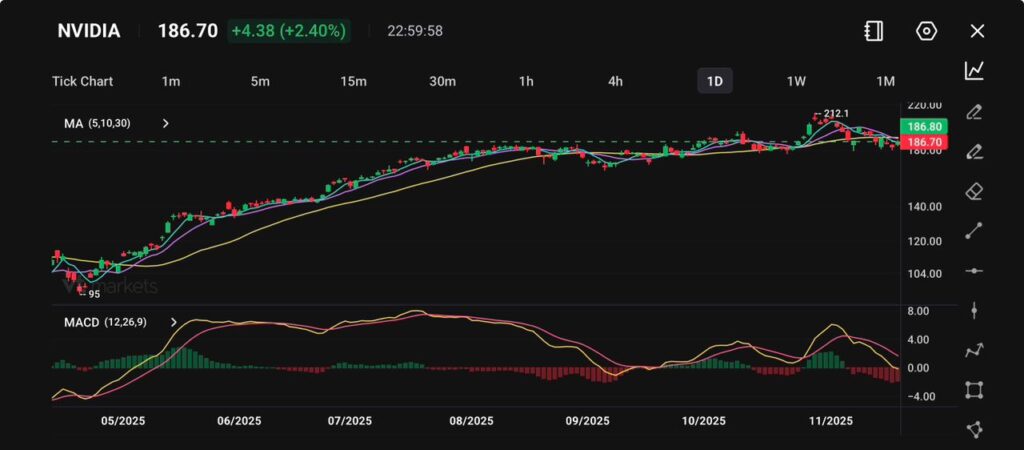
For now, the structure is bullish but stretched. Traders should watch for continuation above recent highs for confirmation, while a slip below near-term support could trigger a pullback into the lower channel.
What Traders Should Watch Next
The sustainability of the AI trade depends on four key factors.
Cloud and hyperscaler capital-expenditure updates will dictate whether data-centre demand is still expanding. Rising capex signals that the AI build-out continues; a slowdown suggests optimisation is taking over.
Export restrictions remain a risk. Tighter controls on chip exports to China could weigh on Nvidia’s overseas revenue. The company’s ability to diversify markets and re-engineer compliant products will be a critical test of its adaptability.
Semiconductor inventories deserve attention. Any build-up may imply that near-term demand is cooling or that production has outrun consumption. Conversely, lean inventories would reinforce the idea that AI infrastructure demand is still strong.
Finally, AI adoption patterns across enterprises will show whether the market is still in build mode or moving toward monetisation. Sustained adoption would support the long-term story, while slowing uptake could cap valuation multiples across the tech sector.
Together, these signals will determine whether the AI boom enters a mature growth phase or continues to deliver momentum-led trading opportunities.
Closing Insight
Nvidia’s earnings still move markets, but the nature of that influence is changing. The company’s performance now reflects the health of a maturing hardware cycle rather than a brand-new expansion.
Traders who recognise that shift and look one step beyond Nvidia to where AI spending flows next will be better positioned to capture the next phase of opportunity.









